Kindiki takes Sh4.05trn Infrastructure Fund market to Commonwealth meeting
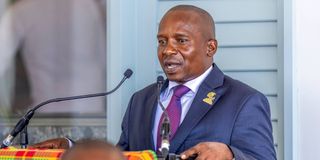
DP Kithure Kindiki addresses the Heads of Government and Business Leaders Meeting at the ongoing 28th Commonwealth in Antigua, Barbuda.

Kenya’s Deputy President Kithure Kindiki has presented the country’s newly established National Infrastructure Fund (NIF) to international investors as an opportunity for private capital pool. And he wants private investors to participate in commercially viable projects while sharing risks with the government in a Fund where Kenya is seeking financing for a $27 billion (Sh4.05 trillion) infrastructure investment programme.
Prof Kindiki said Kenya had secured $2.7 billion (Sh405 billion) in initial capital to attract private-sector investment into transport, energy, water and agricultural infrastructure.
The government hopes to leverage this capital to mobilise substantially more funding, reducing reliance on conventional public borrowing to finance major development projects.


“For every dollar, we expect to raise $10 from private investment,” Kindiki told the gathering at the Heads of Government and Business Leaders Meeting during the 28th Commonwealth Heads of Government Meeting (CHOGM) in Antigua and Barbuda, on Wednesday.
He described the fund as an investment vehicle established under legislation, with a governance framework intended to give investors confidence that their money would be managed professionally and allocated according to commercial considerations.
“The purpose of the National Infrastructure Fund, which has been established by law through statutes, is to have a very good governance framework. It is run by an independent board, with the majority of board members drawn from the private sector,” he said.
The Fund is expected to finance the modernisation of Kenya's transport and logistics infrastructure, including highways, railway networks, seaports and airports, as the country seeks to strengthen its position as a regional trade and logistics hub.
Kindiki said the investment programme would also expand energy generation capacity to support industrialisation and address infrastructure constraints affecting economic growth.
He offered investors assurances that the government would provide a framework for sharing investment risks, while the fund itself would operate on commercial principles.
“It is under the development of government and run on a commercial basis, but with public sector resources to underwrite any risks that the private sector may face in investing,” he said.
The risk-sharing arrangement is central to Kenya's strategy of attracting private capital into projects that require substantial upfront investment and have long repayment periods.
Agricultural transformation
The fund’s other major priority is agricultural transformation, with the government targeting the harvesting and storage of sufficient water to bring an additional 2.5 million acres under irrigation.
“The National Infrastructure Fund of Kenya is supposed to help the country transform its agriculture in the future by harvesting and storing enough water to put an additional 2.5 million acres of land under irrigation,” Kindiki said.
The irrigation ambition comes as Kenya seeks to reduce its vulnerability to increasingly unpredictable rainfall, improve food production and expand agricultural value chains.
Kindiki also highlighted renewable energy as a major investment opportunity, saying Kenya intended to build on its existing electricity generation mix to provide reliable power for manufacturing and other industries.
“As you are aware, Kenya has one of the best energy mixes in the world because 93 per cent of our energy is from renewable, clean and green sources, and we want to build on that record,” he said.
The government is seeking further investment in renewable energy projects as it positions electricity availability and affordability as important pillars of its industrialisation strategy.
Beyond the infrastructure fund, Kindiki used the Commonwealth gathering to highlight Kenya’s investments in digital connectivity, technical education and youth-owned enterprises.
He said the country was expanding technical and vocational education and training (TVET) institutions to equip young people with skills demanded by the labour market, while encouraging investment in digital infrastructure.
Kindiki argued that developing economies within the Commonwealth needed to rethink how they mobilise resources and build the capacity to compete in an increasingly technology-driven global economy.
“Our experience in Kenya, on the three things that are important to this discussion, is that the lessons learnt are that, going into the future, the Commonwealth, especially developing countries, must invest in three things: number one, people; number two, technology; and number three, partnerships between the public and private sectors,” he said.
Follow our WhatsApp channel for breaking news updates and more stories like this.