Yemen warns Africa over Houthis' threat and alleged Iranian support
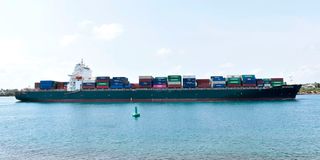
A ship. The recent attacks on ships in and near the Red Sea by Yemen’s Houthi rebels have affected some of the world’s top shipping and oil companies.

Yemen’s internationally recognised government has urged African countries to be wary of the Houthis and their backers in Iran, warning that Tehran’s alleged support for the group could threaten regional security, particularly in East Africa.
In a statement responding to the Nation’s interview with Iran’s Ambassador to Kenya, Dr Ali Gholampour, the Yemeni mission in Nairobi cited statements by Iranian officials, United Nations reports and alleged weapons transfers to dispute Tehran’s claim that it was not involved in the recent escalations in Yemen.
The Houthis, an armed movement that emerged from northern Yemen and has been fighting the internationally recognised government since 2014, now control most of the northern regions bordering Saudi Arabia and the capital, Sana’a. Since late September, they have launched a series of offensives against both the internationally recognised government and Saudi installations, including the main airport in Riyadh.


Yet the Houthis’ real threat to Africa lies in the way they target vessels operating through the Bab el Mandeb Strait, a narrow waterway between the Horn of Africa and Yemen, which is also a crucial link to Europe through the Red Sea and Suez Canal. Previously, the group also targeted Israeli installations with long-range missiles, citing support for Iran.
In Nairobi, the Yemeni embassy said the Houthis are relying on Iranian support to enable them to strike distant targets, including those in East Africa, putting countries such as Kenya at risk.
The mission observed that Tehran “could not simultaneously contribute to a conflict and present itself as a mediator seeking to resolve it,” after Iran offered to broker a deal between the Houthis and Saudi Arabia.
“Tehran cannot act as an arsonist in Yemen and the Red Sea and speak at the same time as a firefighter,” the embassy said. The Houthis have not yet threatened African countries directly. But Kenya is the only country in the Horn of Africa that has been part of a loose, US-led anti-Houthi coalition since 2024. The coalition is supposed to collaborate in targeting Houthi stations and cutting off networks that may help the group to expand beyond Yemen.
In his interview with the Nation, Dr Gholampour had rejected the characterisation of the Houthis as an Iranian proxy whose military decisions are controlled by Tehran.
“Iran has not interfered and will not interfere in Yemen’s internal affairs, decisions or positions,” the ambassador said, arguing that the movement had an autonomous decision-making structure and independent sources of revenue.
He maintained that the Yemen conflict should be resolved through a Yemeni-led process supported by the United Nations, rather than foreign intervention.
The Yemeni mission, however, argued that the relationship between Tehran and the Houthis is evidenced not merely by political affinity but also by public statements from Iranian officials, diplomatic exchanges and findings attributed to UN investigators.
Iran, it said, had supported the Houthis’ capabilities in building long-range missiles and financially backed the group. Various other reports by the UN Security Council had also reached this conclusion.
The response comes at a time when renewed fighting in Yemen and attacks against Saudi Arabia and commercial shipping have heightened international concern over the security of one of the world’s strategically important maritime corridors. The Houthis themselves have sometimes presented themselves to the outside world as a legitimate government. The UN, however, recognises the Presidential Leadership Council (PLC), headed by Rashad al-Alimi and based in Aden.
Although geographically distant, the Houthi escalation is having ripple effects on East African economies. For Kenya, disruptions to shipping routes can have implications for trade costs, supply chains and the movement of goods between Asia, Europe and East Africa.
On October 9, UN Special Envoy Hans Grundberg told the Security Council that the country had slid back into full-scale war, with fighting spreading across several frontlines. He also reported Houthi attacks against civilian and energy infrastructure in Saudi Arabia.
On October 15, the Security Council issued a presidential statement condemning escalating Houthi attacks against Saudi Arabia and reiterating concerns over attacks and threats to commercial navigation in the Red Sea and Bab al-Mandeb. It also reaffirmed support for Yemen’s unity, sovereignty, independence and territorial integrity.
Follow our WhatsApp channel for breaking news updates and more stories like this.