In some health facilities, doctors conducted open heart surgery on the same patient four times in one day and the cost was catered for by the Social Health Insurance Fund (SHIF).
Such billings occurred at least 3,235 times between July 2024 and June 2025. They cost SHIF Sh445.4 million.
In other facilities, one mother would deliver 10 babies on different dates within the same year. Such unlikely repeat births were recorded 6,392 times in that financial year. Again, such bills were catered for by SHIF, and cost Sh148.4 million.
In the same period, SHIF paid Sh26.8 billion to health facilities without any supporting documents for the services claimed to have been offered to patients.
A document trail assembled by Auditor-General Nancy Gathungu exposes unusual claims paid by SHIF, a fund run by the Social Health Authority (SHA), even as many contributors struggled to settle hospital bills and some facilities face closure over unpaid debts.
The anomalies picked up by Ms Gathungu’s office have left Sh50 billion unaccounted for, as some point at outright fraud at the taxpayer’s expense.
The auditor’s revelations have also put into focus, by contrast, multiple distress pleas by paid up contributors whose bills were rejected by SHA, and hospitals like St Mary’s Hospital in Mumias that is on its deathbed over an admitted debt of Sh180 million.
On Monday, the Ministry of Health said the anomalies were experienced in the initial transitional days from the National Hospital Insurance Fund (NHIF) to SHIF, terming the period “incredibly complex”.
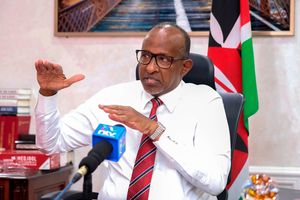
Health Cabinet Secretary Aden Duale (left) and the SHA Headquarters in Upper Hill, Nairobi. The authority lost Sh11 billion in six months.
Photo credit: Nation Media Group
“We view this audit not as a critique, but as an invaluable statutory tool that has played a critical role in helping us identify early transition gaps and continuously strengthen our internal controls and governance frameworks. Like all major technological and institutional migrations worldwide, it is expected to experience initial teething hitches and system stabilisation challenges,” Health Cabinet Secretary Aden Duale said.
The audit for the year ending June 2025 reported multiple claims for births through normal and caesarean section deliveries. Ms Gathungu reckons that paying for child deliveries by a single woman multiple times in a year exposes fraud at SHIF, possible data integrity issues or system abuse.
“Specifically, there are instances where patients delivered between two to 10 times during the period. The total amount claimed for these repeat interventions was Sh161,272,541, while the approved amount was Sh148,481,037,” Ms Gathungu’s report states.
Procedures like open heart surgeries, Ms Gathungu adds, are limited to once a year per patient as per SHIF’s surgical access rules, hence multiple claims for the same patient on the same day raise questions as to the credibility of settled bills.
“For instance, a patient underwent an open-heart surgery procedure four times in a day, and all the claims were paid. The total amount claimed for the repeat interventions amounted to Sh463,825,897, while the approved amount was Sh445,416,146,” Ms Gathungu says.
Mr Duale said the reported cases of multiple surgeries and child deliveries occurred during the transitional phase, when there was a temporary reliance on manual validation processes for benefits.
“This transitional gap may have resulted in some isolated cases of claims exceeding the prescribed frequency limits, particularly within the maternity and surgical packages,” he said.
“SHA has since fully configured the system to strictly restrict benefits to their legal limits, such as automatically capping maternity benefits to once in nine months. Furthermore, a comprehensive clinical and financial review of all flagged claims is ongoing,” he added.
Overall, the audit states that Sh26.8 billion paid by SHIF during the year (about 29.3 per cent of all payments) was not supported with records for claims made by contracted healthcare facilities.
SHIF started operations in October 2024, subjecting Kenyan workers to deductions of 2.75 per cent on their salaries, with an expectation that health services would improve, especially at public hospitals.
Social Health Authority CEO Dr Mercy Mwangangi.
Photo credit: Dennis Onsongo | Nation Media Group
The government planned to enrol 12.07 million households on the SHIF system during the year to June 2025, but only managed about half the number, at 6.17 million.
SHA, which runs SHIF, said the government has assessed the income levels of about 5.9 million households to determine those in need of subsidies, and plans to complete the assessment among all households by June this year.
The anomalies being raised by the auditor are coming to light even as the sustainability of SHIF is being put into question due to its overreliance on formally employed Kenyans.
During the year to June 2025, formal workers forked out Sh51.99 billion (90 per cent) of the Sh57.7 billion collected by SHIF, as the informal sector contributed just Sh5.72 billion.
With a spending of Sh96.1 billion on claims and operations, this left the fund operating in a Sh38.3 billion hole, about two-thirds of the cash it is raising from contributions.
The audit further flags a reported transfer of Sh1.3 billion from SHIF to the defunct NHIF between January and June last year, in breach of the law since NHIF ceased to exist with the coming of SHA. The transfers were done on January 29 (Sh421.35 million), April 28 (Sh55.2 million), April 29 (Sh141.7 million) and June 30 (Sh418.3 million), moving from the SHIF collection bank account to NHIF operations bank account.
“As a result, the amount transferred to SHA was overstated and no satisfactory explanation was provided to justify transfer of funds from SHIF to NHIF after transition date and is contrary to Section 2(1) and Section (6) of the First Schedule to the SHA Act, 2023,” the public auditor says.
Another Sh3.3 billion is also missing after SHIF reported transferring Sh7.3 billion to SHA, but the latter says it only received Sh3.9 billion.
Auditor-General Nancy Gathungu.
Photo credit: File | Nation Media Group
The audit also revealed 227 cases where SHIF overpaid claims by Sh2.4 million, causing financial loss to the fund and exposing it to potential fraud. In other instances, some 1,091 health facilities were paid Sh7.3 billion for services not authorised under SHIF.
This was besides SHIF paying out Sh1.5 billion to some 137 health facilities that have not been contracted by SHA.
SHIF is also accused of paying out Sh4.78 billion using service codes that have not been gazetted, increasing the risk of fraud and paying for unverified claims.
In the report, the auditor also states that 50,045 claims were reported as having multiple service codes lumped into single entries during payment, resulting into an overpayment of Sh1.4 billion.
“The lumping of multiple service codes into single claim entries compromises data integrity and increases the risk of inflated payments, inaccurate reporting, and financial losses due to facilities inflating the claim amounts,” Ms Gathungu says.
Further, the audit questions the alignment of the system used for benefits payments at SHIF with the fund’s operational needs since it was deployed before a comprehensive user requirement testing could be undertaken.
The Sh26.8 billion unsupported claims, the ministry said, represents expected future claim payments, while the Sh1.56 billion payments to non-contracted facilities were made in the early days to prevent disruptions in access to health services.
The ministry also said that where actual cases of overpayments have been confirmed, SHA has instituted recovery procedures.
“We have aggressively executed financial recoveries, recouping Sh305.8 million through administrative surcharges, and over Sh3.2 million via Alternative Dispute Resolution... with processes underway to recover a further Sh817.3 million,” Mr Duale said.
The CS maintained that the billions of shillings have not been lost or misappropriated, saying the figures “represent a mix of statutory accounting estimates and transitional alignment issues, rather than actual cash losses”.