Businesses across the country were on Tuesday counting losses from Monday’s demonstrations, during which rioters poured into the streets in major towns and cities to protest against high fuel prices.
Several suspects arrested during the protests were on Tuesday charged in court, even as transport stakeholders announced an end to the strike.
In Nakuru, at least 21 protesters were arraigned before a Nakuru court to face charges related to the disruption of transport.
33 people arrested for taking part in fuel price protests at the Nakuru Law Court. They pleaded guilty and were fined Sh2,000 each or face one month in prison.
Photo credit: Boniface Mwangi| Nation Media Group
The suspects, who appeared before a Nakuru Principal Magistrate, were jointly charged with unlawful and wilful obstruction of transport within Nakuru.
They were accused of causing obstruction by lighting bonfires, barricading roads, and disrupting the smooth flow of traffic.
In Laikipia County, 16 suspects were also arraigned in court. Nyahururu Police Commander Joseph Matiku said the suspects were arrested for allegedly participating in the destruction of property.
“The suspects attacked selected private businesses as they attempted to break in and steal property. They will face various charges, including malicious damage to property,” said the police commander.
Nakuru County Teaching and Referral Hospital received 10 male patients from the protests on Monday. Three, who sustained minor injuries, were treated and discharged, while seven were admitted.
Four were admitted with gunshot wounds, among them a 13-year-old boy who sustained an injury to his chin.
Rioters in Kiratina, Nakuru County, take to their heels after anti-riot police engage them in running battles. They blocked the Nakuru-Nairobi Highway as the matatu strike entered day two.
Photo credit: Boniface Mwangi| Nation Media Group
In Nyeri, three people charged with blocking roads were each released on a bond of Sh50,000 with an alternative cash bail of Sh20,000.
Appearing before Nyeri Senior Principal Magistrate Charity Cheruto, Paul Muchiri, Joseph Nderitu and Ibrahim Wachira were accused of taking part in an unlawful and riotous assembly on two highways in Nyeri County.
In Embu County, tension gripped Kiritiri town in Mbeere North after protesters on Tuesday broke into government stores and carted away bags of rice and beans meant for distribution to families affected by hunger in the area.
During the protests, suspected criminals allegedly took advantage of the unrest and stormed the government food stores before escaping with the relief supplies.
Mbeere South Sub-county Police Commander Ashford Kimoti confirmed the incident, saying security officers responded swiftly after receiving reports of the break-in.
The police commander said the demonstrations had been infiltrated by thugs who used the protests as an opportunity to loot and destroy property.
Traders across the country complained of huge losses after goons took advantage of the unrest to break into business premises.
In Murang’a, Beth Macharia, 34, who sells cooked cereals in Murang’a town, said she usually starts business at around 1pm.
On Monday, she had prepared stock worth Sh4,000, from which she expected a profit of Sh1,300.
“But it was not to be because by 11am, goons had taken over the town, looting, stealing, robbing and beating people. I had to sell my food to a farmer who keeps pigs for Sh300, hence incurring a loss of Sh3,700,” she told the Nation .
Mr Kamande Njogu, 54, lost mutura, soup and beef valued at Sh12,000 to the goons.
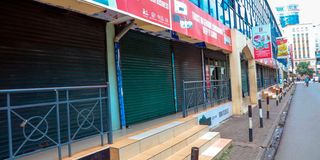
Shops remain closed along Moi Avenue, Nairobi, following a countrywide strike by public service vehicle operators over rising fuel prices.
Photo credit: Lucy Wanjiru | Nation Media Group
Even prominent individuals were not spared, with Township MCA Machigo Karina’s entertainment joint vandalised and foodstuffs stolen.
The Chamber of Commerce and Industry estimated that Murang’a County lost more than Sh100 million in net profit on Monday and Tuesday due to the shutdown of economic activities.
The strike also caused a major transport crisis along the Kitale-Lodwar highway, disrupting cargo services and leaving traders counting heavy losses.
The disruption paralysed the movement of goods from Kitale to Turkana, South Sudan and neighbouring counties, with traders dealing in perishable goods among the hardest hit.
Business people in the food and household goods sectors said tonnes of produce remained stranded in Kitale, with some already going to waste due to the lack of transport.
Kitale Municipal Market chairman Salim Bwire said traders who depend on customers from Turkana and South Sudan had suffered major losses.
“Most of our clients are from Turkana up to South Sudan, and now we are stranded because we cannot transport foodstuffs, including vegetables and fruits,” Mr Bwire said.
Closed shops in Nairobi’s Central Business District on Tuesday, May 19, 2026, during the second day of a public service vehicle operators’ strike over rising fuel prices.
Photo credit: Dennis Onsongo | Nation Media Group
He added that only one lorry had left for Lodwar on Monday, leaving huge quantities of goods stranded in Kitale town.
“There have been heavy losses due to lack of transport services, and some of the goods have already spoiled,” he said.
Mr Julius Mutie, a transport manager in Kitale, said the strike had disrupted both passenger travel and the transportation of goods, much of which is normally carried by matatus.
“We have been stuck since yesterday, and now we are just waiting for the government to act and end this strike,” he said.
Trans Nzoia business community chairman Titus Kilong said businesses had incurred losses running into millions of shillings because of the transport paralysis.
Mr Kilong noted that many affected traders transport household goods to Elgeyo Marakwet, Turkana, South Sudan and parts of Uganda.
Along the Mombasa-Nairobi highway, trucks offered much-needed relief to hundreds of travellers stranded along the route on Tuesday.
A spot check by the Nation showed the highway was busy on Tuesday, unlike the previous day when hundreds of truck operators had parked their vehicles in shopping centres along the route.
Dozens of matatu buses parked at shell Mountain view despite the suspension of the Matatu strike for one week.
Photo credit: Billy Ogada| Nation Media Group
Travellers along the busy highway boarded trucks as protesters scaled down their activities amid heightened police patrols in major trading centres.
In Mombasa, a crippling shortage of essential commodities was reported at Kongowea Market due to the disruption of transport, exposing the port city’s heavy dependence on food supplies from outside the county.
Daily, trucks from upcountry transport agricultural produce to the market, where residents buy food for household use, while retailers purchase supplies from wholesalers.
The only remaining Cabbages at the Kongowea Market in Mombasa as Vegetable Trucks fail to bring the commodity following the ongoing Countrywide Transport Strike.
Photo credit: Kevin Odit| Nation Media Group
As the fuel price strike eased on Tuesday, traders at the market were counting losses. Supplies of vegetables, cereals and other basic commodities had drastically reduced following the disruption of transport to and from Mombasa.
Transporters had avoided ferrying farm produce to Mombasa for fear that their lorries could be attacked or set ablaze on the roads.
Mr Peter Mutisya, chairman of the ripe bananas section at the market, said the region heavily relies on supplies from Meru and Taveta, but consignments had failed to arrive.
“Normally we receive between six and seven lorries of bananas daily, but for the last two days there has been no consignment because transporters fear their vehicles may be burned,” he said.
A state of normalcy was slowly returning to major roads in Nakuru City and its environs on Tuesday, a day after countrywide protests over increased fuel prices paralysed public transport and business activities.
While public transport and trading activities suffered heavy disruption on Monday, spot checks on Tuesday indicated that some shops and businesses had reopened and vehicles were gradually returning to the roads amid a heavy police presence.
Nakuru County Commissioner Lyford Kibaara said large contingents of police officers had been deployed to various roads and towns to ensure there were no disruptions by goons and protesters.
“We deployed enough police officers to monitor the situation and ensure goons do not take advantage, block roads and cause chaos. Some youth attempted to block the busy Nakuru-Nairobi highway, but they were overpowered by police officers and later retreated,” Kibaara told the Nation .
Reporting by MERCY MWENDE, MWANGI MUIRURI, GEORGE MUNENE JOSEPH OPENDA, WAIKWA MAINA, MERCY KOSKEI, EVANS JAOLA, STEVE KETER, PIUS MAUNDU, BRIAN OCHARO, ERIC MATARA, VITALIS KIMUTAI AND MERCY KOSKEI