What began as a nationwide protest over soaring fuel prices and a crippling transport crisis quickly degenerated into scenes of terror, extortion and organised chaos across Kenya’s highways, estates and towns.
By dawn, matatus had vanished from roads in Nairobi, Kiambu, Kajiado, Eldoret and several other counties as operators downed their tools to protest newly announced fuel prices. Bus termini that normally roar with engines and conductors’ whistles stood eerily silent.
But in the vacuum left behind, another force emerged, angry, aggressive and increasingly violent groups of youths who transformed the demonstrations into a theatre of lawlessness.
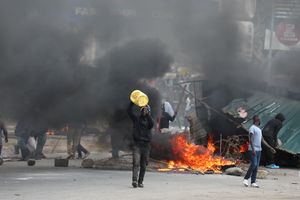
Bonfires lit by angry residents and matatu operators protesting against rising fuel prices in Kutus town, Kirinyaga county on May18, 2026.
Photo credit: George Munene | Nation Media Group
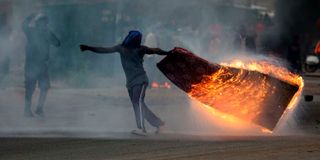
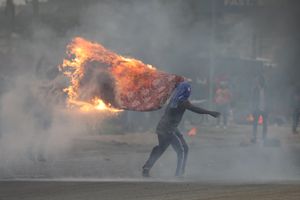
Across major roads, bonfires erupted with frightening speed. Huge boulders, stones and old tyres were dragged into highways by groups of chanting young men. Thick black smoke spiralled into the skies above towns already paralysed by fear.
For unlucky motorists attempting to reach work despite the shutdown, the roads became hunting grounds.
If the answer failed to satisfy them, the motorists were ordered to pay what the gangs openly called “tax” in Kikuyu and “toll” in Ruiru.
The charges varied wildly, from Sh50 to as much as Sh1,000, depending on the mood of the men manning the roadblocks.
Along the Southern Bypass in Kikuyu, the transformation from protest to outright criminality unfolded in plain sight.
Kikuyu bus park, ordinarily packed with matatus loading passengers from sunrise to late evening, resembled an abandoned field. No vehicles were parked at the busy terminus. Instead, hundreds of youths occupied the space, some in hoodies and masks, others carrying sticks and stones, their slippers and sneakers replacing the vehicles that normally define the area’s rhythm.
By 7 am, the Southern Bypass had become nearly impassable. Burning tyres crackled on the tarmac while piles of rocks and debris littered the highway. Vehicles that dared venture into the area without a police escort risked attack.
The chants booming from the crowds reflected a volatile mix of economic frustration and political rage.
Cries against the rising cost of fuel blended seamlessly with political slogans of “Wantam!” as protesters increasingly framed the demonstrations as more than just opposition to fuel prices.
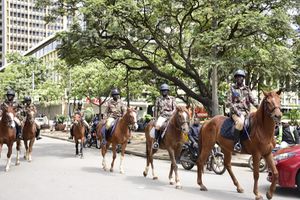
At around 10:40 am, Interior Principal Secretary Raymond Omollo briefly stopped near the Southern Bypass adjacent to Kikuyu town, speaking to officers deployed to restore order.
Two minutes later, he was gone.
Protesters in Kitengela light bonfires and barricade roads during national protests against rising fuel prices on May 18, 2026.
Photo credit: Dennis Onsongo | Nation Media Group
As police units moved towards the Kikuyu-Gitaru interchange to disperse protesters barricading the Nairobi-Nakuru highway, fresh groups of youths emerged almost immediately, reigniting fires and rebuilding roadblocks as though operating in coordinated shifts.
In Kitengela, hundreds of protesters stormed a Coca-Cola depot shortly after noon, vandalising the premises and looting goods as overwhelmed police officers engaged demonstrators in running battles in the town centre.
Along Namanga Highway and its feeder roads, protesters erected barricades that rendered the roads unusable. Entire sections of Kitengela ground to a standstill as gangs took over streets and intersections.
Nation journalists attacked
Some protesters appeared driven by rage. Others appeared motivated by hunger and desperation. But many simply exploited the chaos.
In Mwihoko, one motorist narrated how he was forced to pay Sh200 to pass through an illegal barricade controlled by youths.
“I’ve paid a Sh200 toll to goons manning an illegal roadblock in Mwihoko,” a motorist told Nation.
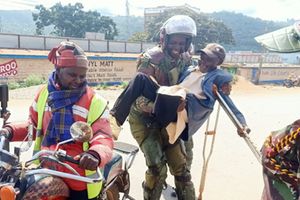
Across affected areas, boda boda riders were stoned, commuters robbed and pedestrians turned away from transport terminals by marauding gangs demanding money.
Even journalists were not spared. Nation Media Group journalists covering the unrest along Thika Road were attacked by dozens of armed youths near Ruiru Bypass after returning from assignments in Juja and Ruiru.
The attackers reportedly surrounded the media vehicle and demanded “toll fees” before allowing them to proceed.
Before negotiations could calm the situation, the gang descended on the journalists’ belongings.
Protective gear was stolen in the attack, leaving the crew shaken.
Elsewhere along Thika Road, a black Mazda vehicle was set ablaze in Githurai as protests intensified. Flames engulfed the car in the middle of the road while thick smoke billowed into the air, worsening traffic paralysis along one of Nairobi’s busiest corridors.
The burning vehicle became one of the defining images of the day; a testament to how quickly public demonstrations in Kenya can mutate into uncontrollable violence.
In Eldoret, riot police battled protesters who had barricaded the Eldoret-Huruma-Kitale road, while along Nairobi’s Eastern Bypass and Kamaki Road, gangs mounted fresh roadblocks and extortion checkpoints. Demands for toll were made, and refusal attracted violence.
In Wote, Makueni county, protestors venting their anger on the new fuel prices, resulted in torching a section of the country's ruling party, UDA's offices.
Police officers engaging protesters in running battles at Kimbo Area of Ruiru, Kiambu county during national protests against rising fuel prices on May 18, 2026.
Photo credit: Evans Habil | Nation Media Group
Nairobi regional police commander Issah Mohamud later acknowledged the situation had spiralled beyond peaceful demonstrations.
“They started blocking roads using blocks and rocks,” he said during a press briefing, noting that the groups were armed and had disrupted businesses and public order.
In recent years, Kenya has witnessed a growing pattern where legitimate protests, whether political or economic, become infiltrated by violent groups who exploit public anger to loot, extort and terrorise civilians. The distinction between protests, which are legal by law, and goonism is increasingly becoming blurred.
Sometimes the gangs appear spontaneous, emerging from impoverished neighbourhoods where frustration with unemployment and economic hardship runs deep. Other times, critics allege they are mobilised and financed by political actors eager to weaponise chaos.
The result is often the same, with ordinary citizens suffering, businesses remaining closed, as genuine grievances become overshadowed by violence.
Monday's demonstrations exposed how fragile public order can become once lawlessness takes root, as it dawned on thousands of stranded commuters, frightened motorists and battered businesses that the protests were no longer about fuel.