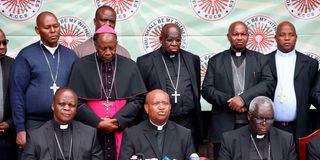
From left: Kenya Conference of Catholic Bishops chairman Archbishop Maurice Muhatia (seated ,left), vice-chairman Archbishop Anthony Muheria (centre), and Nairobi Archbishop Philip Anyolo address the media in Karen, Nairobi, on June 23, 2026.

Catholic bishops on Thursday, November 12, criticised presidential aspirants in the 2027 General Election over tribal and inflammatory language, which they said could plunge the country into chaos.
Speaking in Embu at the John Cardinal Njue Pastoral Centre, the bishops, led by Kenya Conference of Catholic Bishops Chairman Archbishop Maurice Muhatia and the Vice-Chairman Archbishop Anthony Muheria, asked the aspirants to avoid using inflammatory, tribal, hateful or demeaning statements.
“We call upon the security organs to be non-partisan in applying the law without favouring any aspirants or political affiliations,” they said.
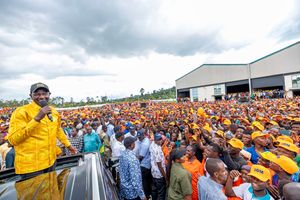
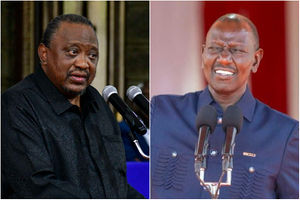
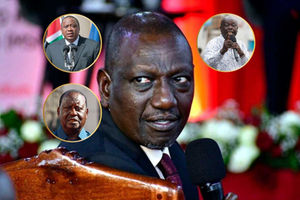
The call comes amid an escalation of exchanges between opposing sides. Over the last week, President William Ruto and his former deputy and Democracy for the Citizens Party (DCP) leader Rigathi Gachagua have traded barbs, with their comments bordering on insults and personal attacks.
“Charged campaigns should not be a pretext to use polarising language. We also remind the political actors that the stipulated campaign period has not begun and Kenyans expect people seeking office and their supporters to be civilised in their language, attitude and behaviour. The use of indecent and offensive language by political aspirants and their supporters undermines the morals that we teach our children; it sets a bad example for younger generations,” they said.
The bishops also declared a ban on politicking in all Catholic churches nationwide.
“As your shepherds, we emphasise that the pastoral agents in charge, particularly priests, have the obligation to protect sacred places from being used for political campaigns. Places of worship should be peaceful and prayerfully available to all, regardless of their political affiliation, and be symbols of unity, love and care. Politicians have many options to utilise in their search for votes, including media, barazas and roadside rallies,” said Archbishop Muheria.
He reiterated that political addresses in Catholic churches will not be permitted.
“We therefore instruct all our priests to implement this position of the Bishop’s Conference with diligence and the seriousness it deserves,” he said.
The bishops observed that uncivilised language sets the ground for hate speech.
“We must not forget that the relative peace we enjoy can be lost through careless words. It is in our interest to ensure that peace is sustained throughout the campaign period,” they said.
From left: Kenya Conference of Catholic Bishops chairman Archbishop Maurice Muhatia (seated ,left), vice-chairman Archbishop Anthony Muheria (centre), and Nairobi Archbishop Philip Anyolo address the media in Karen, Nairobi, on June 23, 2026.
The bishops invited all presidential aspirants to make a public commitment to keep the peace and maintain political decency.
Further, they condemned reported abductions across the country. They also expressed concern that freedom of speech in the country was being tested on all fronts and was frequently being curtailed, especially as Kenyans head to the General Election. They said that the civil society organisations and the public have a right to raise issues of national importance as provided for in the Constitution.
“The media also has the privilege and obligation of exercising its freedom to practise. In addition, we know human rights defenders have the right to express their concerns. However, we note that incidents of abductions, enforced disappearances and harassment continue,” they said. “What is of more concern is that some of these incidents involve armed people in collaboration with the police. In other cases, the police watch as goons harass legitimate actors exercising their right to freedom of expression.”
They stated that in a democratic country, people should be allowed to express themselves freely.
“We, the Catholic bishops, condemn the violations of freedom of expression and association. Let people enjoy their freedoms as a necessary part of building a vibrant democratic Kenya,” they said.
They also weighed in on the conduct of the Independent Electoral and Boundaries Commission (IEBC), telling the body to ensure a well-coordinated and deliberate effort to ensure a fair, credible and transparent electoral process.
Also Read: ‘You did not make me president,’ Ruto tells Gachagua as he questions DCP leader’s conduct
“For this to happen, the IEBC must work to raise public trust,” they said.
They lamented that in the past, electoral process mistakes had led to vicious disputes and loss of lives as well as destruction of property.
“These mistakes should not be repeated next year. IEBC should remain independent and resist every attempt by politicians or other powerful interests to intimidate, manipulate or compromise its work,” they stated.
The church leaders cautioned that any Bill being brought before Parliament must be genuinely motivated by the common good, saying Bills that strengthen the Electoral Act should be fast-tracked.
“At this hour, we should not introduce Bills that cast doubt on the credibility of the process into the general elections,” they said.
The bishops advised Kenyans to evaluate the performance of leaders and vote wisely during the 2027 General Election.
“We have the responsibility as voters to reflect in the quiet of our hearts in order to vote responsibly. We encourage all to listen to the campaign messages, discern the sincerity of those delivering them and then make the right choices,” Archbishop Muheria said.
Follow ourWhatsApp channel for breaking news updates and more stories like this.