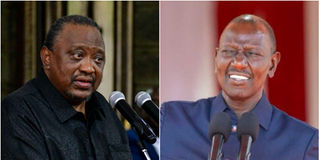
The contest between President William Ruto and his predecessor Uhuru Kenyatta has evolved into a battle for control of political networks, the Mt Kenya voting bloc and efforts to forge a united opposition alliance ahead of the August 10, 2027 General Election.
The rivalry between the former allies escalated yesterday when the two leaders, speaking about 300 kilometres apart, exchanged bitter political barbs, highlighting the growing significance of their contest in the run-up to the 2027 polls.
Speaking in Nairobi, Mr Kenyatta claimed Kenyans had already made up their minds to vote President Ruto out in 2027. He urged opposition leaders to shelve their individual presidential ambitions and rally behind a single candidate to deny Dr Ruto a second term.
Within minutes, President Ruto, while winding up his four-day tour of the Gusii region, hit back, describing his former boss as a “political broker”.
The President accused the retired Head of State of abandoning his role as a statesman and instead “misguiding” opposition leaders by suggesting he could help them ascend to power.
“I have heard that sponsor (in reference to Mr Kenyatta), don’t you know him? He has stopped being a statesman and has come down here as a broker. He is now trying to unite this one, that one... I am telling you, my friend, speed up your brokerage work. Look for the person you are looking for,” said President Ruto.
He added: “I have heard that sponsor say that people have decided. That he was taking ‘porridge’ (a reference to alcohol popularised by Mr Kenyatta). Now I want to tell my friend Uhuru Kenyatta to seek advice from sober people — working-class individuals, farmers, teachers, doctors, drivers, and medics. They will inform you that Kenya is moving forward,” he said.
Ruto: Uhuru is now a broker for the Opposition
He also accused the retired President of playing games with opposition leaders by repeatedly shifting his support from one candidate to another.
“They have for one and a half years been naming this or that person as their candidate. Moving from one hotel to another, from one home to another, going round to funeral ceremonies. I am telling them to hasten what they are doing. If you get one candidate, 10, or 1,000, we are ready to face you.”
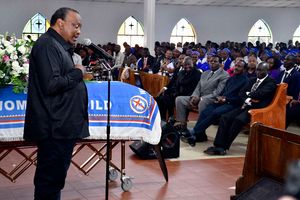
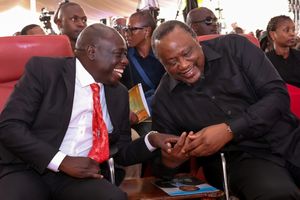
Speaking during the funeral service of his cousin Beatrice Wambui Muturi at PCEA Nairobi West Church in Lang’ata, Nairobi, Mr Kenyatta said the opposition’s biggest obstacle was not a lack of public appetite for change but its inability to agree on a common political direction. He warned that competing ambitions could undermine efforts to dislodge the Kenya Kwanza administration.
He singled out Wiper leader Kalonzo Musyoka, former Deputy President Rigathi Gachagua and Democratic Action Party of Kenya (DAP-K) leader Eugene Wamalwa, reminding them that only one person could occupy the country’s top seat at a time. The three leaders were present.
“As Kenyans, we should be concerned about the future, not the past. I tell my brothers Kalonzo, Rigathi Gachagua, Eugene that only one person can have the seat at one time,” he said.
The former President said his interactions with ordinary Kenyans had convinced him that voters wanted a change of government but expected the opposition to resolve its internal differences and present a common candidate.
“I also listen to people. Just because I am retired my ears are not closed. I talk to people and I listen to what they are saying. When I talk to people and listen to what they are saying, when I go about to buy uji (his reference to alcohol) and ask people what they want, there is one thing, and that is that the people have decided. They are ready this time round, but there’s only one problem: the unity of the opposition,” he said.
“They want these leaders in the opposition to be united. As our leaders, please be ready, fulfil the promises of Kenyans, that is unity. I am sure that you will deliver that for us.”
The rivalry between the two leaders began as a disagreement over the country’s succession in the run-up to the 2022 polls before evolving into a wider contest for political supremacy and control of the Mt Kenya voting bloc.
Dr Ruto and Mr Kenyatta were once close allies who turned to their political advantage the crimes against humanity charges they both faced at the International Criminal Court (ICC). They rode the wave to power in 2013, wearing matching shirts and ties, with the then President prom-ising his deputy support after retirement.
Dr Ruto has repeatedly accused Mr Kenyatta of abandoning their succession arrangement after the former President backed former Prime Minister Raila Odinga in the 2022 presidential election. He and his allies have questioned why Mr Kenyatta did not return the favour after Dr Ruto supported him in the 2013 and 2017 elections.
Former President Kenyatta urges opposition leaders to come together, present united front
The current confrontation has been fuelled by accusations from Dr Ruto and his allies that Mr Kenyatta is financing opposition activities. The former President has also been linked to the re-branding of Azimio La Umoja One Kenya Coalition as The Ukombozi Alliance as part of efforts to organise and unite the opposition.
His involvement in Jubilee Party activities has also drawn criticism from government allies. Yesterday’s remarks marked his clearest intervention yet in the emerging coalition negotiations, placing the question of a joint presidential candidate at the centre of the political contest.
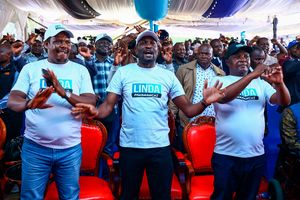
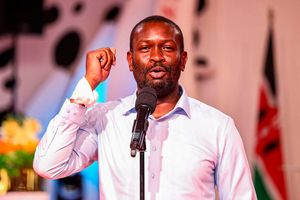
The opposition has increasingly coalesced around Mr Gachagua’s Democracy for the Citizens Party (DCP), Mr Musyoka’s Wiper Patriotic Front, Mr Wamalwa’s DAP-K, Linda Mwananchi Movement’s Edwin Sifuna, Kiharu MP Ndindi Nyoro’s People’s Party of Kenya (PPK), former Interior Cabinet Secretary Fred Matiang’i’s Jubilee Party and other formations led by Martha Karua’s People’s Liberation Party (PLP), Justin Muturi’s Democratic Movement and former Chief Justice David Maraga.
The emerging alliance, however, remains a collection of political interests with different regional constituencies, party structures and presidential ambitions.
Although the leaders have pledged to work together and support whoever emerges as their candidate, disagreements over leadership, decision-making structures and the selection of a flagbearer have exposed the difficulty of translating their shared opposition to President Ruto into a single political vehicle.
Former President Uhuru Kenyatta delivers his tribute during the memorial service of the late Mama Beatrice Wambui Muturi held at PCEA Nairobi West Church on November 11, 2026.
Photo credit: Francis Nderitu | Nation
Mr Kenyatta’s appeal comes against this backdrop, urging opposition principals to confront the question of who should lead the coalition rather than allow individual ambitions to stand in the way of a joint candidature.
His remarks also renewed attention on his relationship with Mr Gachagua, who has been seeking to consolidate his influence in the Mt Kenya region and build a broader opposition alliance. The two were previously political rivals following the fallout between Mr Kenyatta and his former deputy after the 2022 General Election.
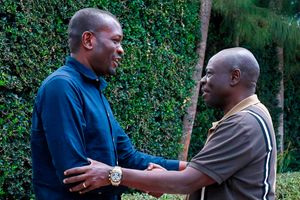
Mr Kenyatta, however, appeared to leave the door open for further political engagement, saying he would visit Wamunyoro, Mr Gachagua’s rural home and political base, when the time was right, even as he maintained that he had retired from active politics.
“I have lost someone who was very pivotal in my growing up. I have nothing else to say since I am retired. However, I want to say that I will come to Wamunyoro when the right time comes. We want peace and unity,” he said.
The reference to Wamunyoro is likely to attract political interest given Mr Gachagua’s efforts to establish himself as a central opposition figure and the significance of Mr Kenyatta’s influence in the Mt Kenya region.
Mr Gachagua has increasingly positioned Wamunyoro, his rural home in Nyeri County, as the nerve centre of his political operations and a rallying point for his efforts to consolidate support in the region. Since his fallout with President Ruto, he has used the homestead as a meeting place for political allies, elected leaders and delegations seeking to associate with his movement.
In his remarks, Mr Gachagua appeared determined to consolidate the Mt Kenya voting bloc, saying the community would no longer allow political divisions to undermine its collective interests.
He also acknowledged his role in the political realignments ahead of the 2022 General Election, describing his decision at the time as a mistake from which he had learnt.
“We have made a decision that at no time will we have someone dividing our community. I made a big mistake in 2022 and I have learned the hard way. I am happy now that we are together as a community and we will move forward together,” he said.
His ambition to make the region the bedrock of his opposition politics has, however, brought Mr Kenyatta’s influence in Mt Kenya into focus, where the former President retains a significant political profile.
Mr Musyoka, who also spoke during the funeral service, defended the former President’s right to express his views, saying Kenyans were determined to vote President Ruto out after one term.
“The fourth President of the Republic of Kenya is a statesman. He is entitled to hold an opinion. Kenyans have decided that we will shoot Ruto on the ballot. That’s why Kenyans have decided that it is one term,” Mr Musyoka said.
Mr Kenyatta also urged political leaders to focus on the country’s future rather than past disagreements, linking national unity to justice.
“There can be no peace without justice. That is all that we are looking for,” he said.
In Gusii, President Ruto warned that he would not allow his former deputy to incite Kenyans. Describing Mr Gachagua as a “permanent failure”, the President said he had no moral authority to lecture others and alleged that his career as a civil servant and politician was marked by questionable deals.
President William Ruto addresses residents during a public rally in Kisii Town on November 11, 2026.
Photo credit: Alex Odhiambo | Nation Media Group
President Ruto has been in the Gusii region, comprising Kisii and Nyamira counties, since Sun-day, seeking support for a second term while launching various projects.
On Wednesday, he launched the construction of the Keroka-Ibacho-Kiamokama Road in Keroka, Nyaribari Masaba. He also flagged off the Last Mile Electricity Connectivity Project, commissioned the Ibeno Kenya Medical Training College and later conducted a “meet the people” tour on foot in Kisii town.
He also laid the foundation stone for student hostels and commissioned a seven-storey tuition block at Kisii National Polytechnic in Nyaribari Chache Constituency.
The President was accompanied by several governors, including Simba Arati (Kisii), Gladys Wanga (Homa Bay), Abdulswamad Sharrif Nassir (Mombasa), Ann Waiguru (Kirinyaga), Fernandez Baraza (Kakamega) and Isaac Mutuma (Meru).
Senate Majority Leader Aaron Cheruiyot and National Assembly Majority Leader Kimani Ichung’wah were also present, alongside Narok Senator Ledama Ole Kina and Cabinet Secretaries Julius Ogamba (Education) and Hassan Joho (Mining).