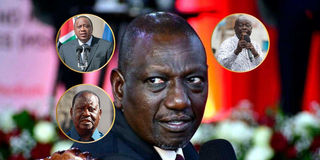
When President William Ruto took oath of office on September 13, 2022, his enemy had a name and a face. It was the system. It was State capture. It was former President Uhuru Kenyatta leaving empty coffers and, most impactful, Sh230 for a 2kg packet of maize flour (unga).
His then deputy, Mr Rigathi Gachagua, in his inauguration speech, told Kenyans that his boss was inheriting a dilapidated economy. The problem then, was yesterday’s men.
Four years later, in August 2026, the enemy has no single name. The enemy is everywhere, looming near and large, but wearing a uniform he remotely identifies as most likely worn by Mr Kenyatta.
Currently, President Ruto is going around claiming that his predecessor is the one mobilising the opposition to kick him out in 2027.
“Our president should relax. Call it electoral pressure, for all along he has mismanaged his politics to keep re-election pressure piling. But panic won’t save him. He needs to confront his challenges from a point of surgical precision,” said political commentator and scholar Prof Peter Kagwanja.
Prof Kagwanja said the ease with which President Ruto has been changing his opinion about who exactly is to blame for the perceived strong wave of national dissent against him is not doing him any good.
“We know President Ruto as a near-invincible politician who thrives under pressure. Of late, he is coming out as a man caving in, unable to know who exactly will be his competitor in 2027 and what he needs to tell the people so as to win the vote. He sometimes portrays himself as a cornered man,” he said.
The famous handshake between President Uhuru Kenyatta and former Prime Minister Raila Odinga at Harambee House in 2018.
Photo credit: File | Nation Media Group
“My message is for none other than Mr Kenyatta who is the single financier of Azimio chaos... Your properties will also be raided,” Mr Ichung’wah said at the time.
President Ruto was emphatic that the government could not work because Raila was destructive and distractive.
Nyoro: Governance is 'another ball game'
Kiharu MP Ndindi Nyoro addressing journalists at Safari Park Hotel, Nairobi, on August 17, 2026.
Photo credit: Lucy Wanjiru | Nation Media Group
But Kiharu MP Ndindi Nyoro now calls the bluff, saying that “after we won power we realised it was easy to win the vote but another ball game when it came to governing ... we had no plan and we engaged in a lot of blame game and shenanigans”.
Mr Nyoro said that to hide the confusion, the government resorted to escapist explanations, seeking to buy time.
But in a Saturday interview with the Nation, President Ruto complained that “Kenyatta had set me up for failure and had promised his allies that I had six months to survive, then my presidency would collapse”.
He added that Mr Kenyatta had ignored him and brushed him off in efforts to bury the hatchet and serve the country on a united front.
As President Ruto searched for the functional button to press and get things right, he started a fallout with Mr Gachagua, who was impeached in October 2024. To him, Mr Gachagua was an enemy who had grown horns and become incompatible with the values of a progressive president whose calling was national and not ethnicised.
But Mr Gachagua told the Nation on Sunday that “all those were explanations of a man who appeared not to understand why and how he had won the presidency”.
“President Ruto’s biggest enemy was his mindset that he was the brightest of all Kenyans, capable of advising his advisors on how to advise him ... and where reason could not work, money, lies and force would straighten things out,” the former DP said.
After protests: Raila 'not bad'
President William Ruto and Raila Odinga at State House, Nairobi, where Odinga was officially unveiled as Kenya’s candidate for the chairperson of the African Union Commission on August 27, 2024. Odinga passed away on October 15, 2025.
Photo credit: Photo | PCS
President Ruto later said he had since found that Raila was not a bad man and invited him to form a broad-based government that would reflect national integration and cohesion.
This was after, in July 2024, the Gen Z held serious protests against the government, ignited by the passage of the Finance Bill 2024.
“This is the period I came to realise that President Ruto was paranoid and erratic in decision-making. He was sure that the Gen Z had been unleashed on him by either Mr Kenyatta, me or forces outside the country. He believed that a coup was being plotted against him and immediately brute force was assembled to deal with the issue,” Mr Gachagua said.
“His has been a game of revolving doors. Mr Kenyatta, Gachagua, Ford Foundation, Githurai, Mt Kenya ... he has never been clear about who caused the Gen Z to turn against him even when it was very clear that he was his own enemy and his policies and State capture were the big issue," Mr Gachagua said.
Even when extrajudicial killings, abductions and enforced disappearances became national tools for countering dissent, President Ruto countered the national rage that erupted by blaming parents for the poor upbringing of their children.
After mask hawker, Boniface Kariuki was shot during protests in Nairobi and later died, his mother, Ms Susan Njeri, quipped: “We raised children who ask why taxes are high and you call us failed parents ... then murder them?"
“Even when we hear that those who died in the cruelty of cracking down on dissent will be paid to keep quiet, one of these days the country will need to know who was killing our children. That cannot be let to pass unaccounted for. No matter the time it will take,” said Kikuyu Council of Elders Chairman Wachira Kiago.
When things fail, blame games start
As President Ruto searched for a turning point, in a moment that shocked even State House staff, in June 2024 President Ruto publicly turned on his own Cabinet. In a meeting that was supposed to be about performance, he said ministers were clueless, lazy, late for meetings, ignorant about government programmes, lacking in strategy and brains.
At the time it was praised as accountability. In retrospect, it was the start of a pattern — when delivery failed, the team, not the coach, was clueless. By 2025, the blame became institutional and abstract.
Courts were accused of derailing programmes. Every conservatory order was framed as sabotage by activist judges working with cartels. Cartels became a convenient enemy; faceless, nameless.
Media was next—accused of amplifying negativity, giving voice to enemies of government and blacking out the novelty of the government’s transformative agenda.
Perhaps the most bizarre turn has been the church. President Ruto has been donating millions to churches weekly. Now, according to President Kenyatta’s cousin, Kung’u Muigai, a new theory has emerged to explain criticism from the church: those that are missing out on the cash donations are to blame. Mainstream clergy, including ACK and Catholic bishops, have termed this insulting. Their criticism on abductions, taxation and corruption, they say, is moral.
Political scientist John Okumu says President Ruto has become a “crybaby”, not sure who is eating into his re-election bid.
“The national conversation he is now driving has many issues ... Sometimes it’s politicians impregnating women and murdering them, to politicians with no brains ... those are not ideologies or issue-based politics,” he said.
Mr Okumu mused that the recent broad-based government retreat in Naivasha produced yet another potential perceived enemy — Deputy President Kithure Kindiki. He said that the blatant claim for the DP’s seat by forces led by Kisii Governor Simba Arati was telling.
“For him, enemies are all over the place, blinding himself to the reality that the problem, after all, might be him,” Mr Okumu said.