The Law Society of Kenya (LSK) will continue with its targeted boycott of selected courts despite the Judiciary’s ongoing recess, insisting the action will remain in place until the Judicial Service Commission (JSC) takes concrete steps to address concerns over accountability.
LSK President Charles Kanjama said the boycott targeting specific judges and judicial officers would continue in the coming weeks as the society pushes for reforms over alleged corruption, inefficiency and challenges affecting the delivery of justice.
Speaking during a press briefing in Nairobi on Friday, Mr Kanjama said the one-day nationwide court boycott held on July 22 had succeeded in drawing attention to concerns raised by lawyers and members of the public over the state of the justice system.
“The targeted court boycott is ongoing and will continue over the next few weeks until we get a resolution of the matters we have raised,” he said.
The announcement came as the High Court, Court of Appeal and Supreme Court began their scheduled recess, with LSK saying the period should offer the JSC an opportunity to reflect on and address concerns affecting judicial accountability.
But in a long statement, the JSC has defended its record on judicial accountability, revealing that it has received 506 complaints against judges and judicial officers this year alone, even as it cautioned against disruptions to court proceedings arising from the Law Society of Kenya's targeted boycott of some judicial officers.
In a statement issued after a consultative meeting with the leadership of the Law Society of Kenya (LSK) and the Senior Counsel Bar (SCB), the Commission sought to reassure the public that it was actively addressing concerns over integrity within the Judiciary while safeguarding judicial independence.
The meeting came against the backdrop of heightened tensions between the Bench and sections of the legal profession over allegations of corruption and calls by the LSK for lawyers to boycott some judges and judicial officers.
Law Society of Kenya (LSK) President Charles Kanjama.
Photo credit: Bonface Bogita | Nation Media Group
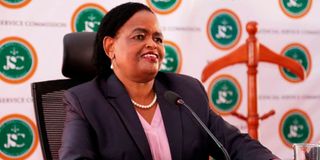
JSC Chairperson Chief Justice Martha Koome said the engagement had provided an important platform to discuss judicial accountability, institutional integrity and reforms aimed at improving the administration of justice.
"The Commission welcomes constructive engagement with stakeholders and recognises the important role played by the legal profession in strengthening Kenya's justice system. Such dialogue is essential in advancing a Judiciary that is independent, accountable and responsive to the people it serves," CJ Koome said.
The Commission disclosed that of the 506 petitions and complaints received this year, 417 have already been processed while the remainder are at different stages of disciplinary proceedings.
"Some are undergoing formal hearings, while others are pending responses from the affected judicial officers or other procedural steps as required by law. These matters are being handled diligently, fairly and strictly in accordance with the Constitution and the Judicial Service Act to accord the parties the required due process," the statement said.
The Commission also pointed to its disciplinary record since the promulgation of the 2010 Constitution, saying it had recommended the removal of 10 judges, with four eventually being removed from office after constitutional tribunals investigated their conduct.
"These outcomes demonstrate the Commission's unwavering commitment to ensuring that judges and judicial officers uphold the highest standards of integrity, professionalism and accountability," Justice Koome said.
The JSC further highlighted reforms aimed at increasing transparency, including plans to publish individual performance data for judges and judicial officers for the first time once pending court cases challenging the move are determined.
It also cited the latest Judiciary performance report, which showed the Supreme Court as the best-performing superior court with a 96.3 per cent score, followed closely by the Kadhi Courts at 95.41 per cent. The Court of Appeal scored 84.97 per cent, the High Court 86.8 per cent, the Employment and Labour Relations Court 88.67 per cent, the Environment and Land Court 87.12 per cent, while Magistrates' Courts attained an overall score of 87.12 per cent.
CJ Koome said the Commission had also finalised the Judicial Service (Petition for Removal of a Judge) (Procedure) Regulations, 2026, which are currently before Parliament. She noted that the regulations were developed through consultations with stakeholders, including the LSK and the Senior Counsel Bar, to provide a transparent framework for handling petitions seeking the removal of judges.
Mr Kanjama, on his part, earlier said the LSK Council, together with members of the Senior Bar, had held discussions with the JSC on Friday, where they raised concerns over alleged corruption, court inefficiencies and what they described as challenges in holding some judicial officers accountable.
He said delays in the hearing and determination of cases, administrative hurdles and declining confidence in the courts had continued to affect Kenyans seeking justice.
The LSK president, however, acknowledged the work of judges, judicial officers and Judiciary staff who continue to serve with integrity, saying the society’s concerns were directed at individuals accused of misconduct.
“There should not be a single judge, judicial officer or judiciary staff engaging in corruption or failing to serve Kenyans efficiently, because justice delayed is justice denied,” he said.
LSK Vice-President Teresia Wavinya said the society’s position was not an attack on judicial independence but a demand for accountability aimed at protecting public trust in the justice system.
She said judicial independence must be accompanied by transparency and effective mechanisms to deal with officers found guilty of misconduct.
The LSK said the targeted boycott currently affects between 12 and 14 judicial officers drawn from different levels of the Judiciary, including the Supreme Court, Court of Appeal and magistrates’ courts.
In her statement, CJ Koome criticised reports that court proceedings had been disrupted following the LSK's announcement of a targeted boycott.
"While every person and institution has the right to express concerns regarding the administration of justice, the Commission is concerned by reports that court proceedings before some of the affected judges and officers have been deliberately disrupted under the guise of enforcing the announced boycott," CJ Koome said.
Chief Justice Martha Koome and Judicial Service Commissioners at Supreme Court of Kenya on July 11, 2024.
Photo credit: Evans Habil | Nation Media Group
"Such actions do not advance judicial accountability. Instead, they impede the administration of justice, inconvenience litigants, delay the determination of cases and undermine the constitutional right of every person to have disputes heard and determined fairly and without unreasonable delay."
The Commission said it had nevertheless reached common ground with the LSK on tackling corruption and unethical conduct within both the Judiciary and the legal profession.
"The Judicial Service Commission and the Law Society of Kenya have reaffirmed their shared commitment to working together to combat corruption and unethical conduct within both the Judiciary and the Bar. We shall strengthen cooperation, encourage the reporting of credible complaints and ensure that all allegations are addressed promptly, fairly and in accordance with the law and established disciplinary processes," Justice Koome said.
The Commission also condemned intimidation, cyberbullying and personal attacks directed at judges, judicial officers, advocates and court staff, saying public criticism should remain factual and respectful.
"Where there are complaints against any judge or judicial officer, the Constitution and the law provide a clear and legitimate mechanism for addressing them through the Judicial Service Commission. Resorting to extra-constitutional measures or actions that undermine the orderly administration of justice is inconsistent with the rule of law and cannot be condoned," the Chief Justice said.
She maintained that the Judiciary would continue to discharge its constitutional mandate "without fear, favour or prejudice" while strengthening mechanisms that promote integrity, transparency and public confidence in the administration of justice.