The Judiciary will begin publishing individual performance data for judicial officers, including judges and magistrates, from July 1 in a major policy shift aimed at boosting accountability and restoring public confidence in the courts.
Chief Justice Martha Koome announced the move as part of broader reforms targeting efficiency, integrity and transparency, saying performance measurement was “a critical accountability mechanism” that must now be made public to reflect service delivery.
For court users and litigants, the policy shift could provide unprecedented visibility into case handling and court performance, while for judges and magistrates, it introduces a new layer of scrutiny that could reshape judicial culture and expectations.
The decision comes against the backdrop of persistent case delays, even as the Judiciary reports measurable progress in reducing backlog and improving case resolution rates.
According to the latest State of the Judiciary and Administration of Justice report, courts handled 621,525 new cases in the 2024/25 financial year and resolved 647,666, achieving a case clearance rate of 104 per cent.
Pending cases dropped to 598,628, down from 635,262 the previous year, while backlog cases declined sharply by 31 per cent to 169,349.
Despite the gains, the report shows the system remains under pressure, with nearly 600,000 unresolved cases still in the pipeline and significant strain in magistrates’ courts, which account for the bulk of pending matters.
As at June 2025, Magistrates’ Courts carried the heaviest burden with 470,558 pending cases, while superior courts such as the High Court and Court of Appeal recorded 61,020 and 13,552 pending cases, respectively.
It is this tension between progress and persistent delays that now frames the Judiciary’s push to publicly track individual judicial officers’ performance.
“There is a clear need to enhance transparency in the assessment of performance and reporting on the productivity of judges and judicial officers in a manner that reinforces public confidence while upholding judicial independence,” Chief Justice Martha Koome said.
She added that the Judiciary is working closely with the Law Society of Kenya (LSK) and other institutions to strengthen accountability mechanisms, enhance transparency and enforce stricter measures to protect the integrity of the justice system.
The new policy is expected to shift scrutiny from institutional performance to individual judges and judicial officers, exposing how many cases each handles, clears or delays.
LSK President Charles Kanjama welcomed the decision, saying it would strengthen oversight.
Law Society of Kenya president Charles Kanjama during an interview at his office in Nairobi on February 24, 2026.
Photo credit: Bonface Bogita | Nation Media Group
“This is quite welcome, since it will contribute to judicial accountability,” Mr Kanjama said.
Senior Counsel and Bar chairperson Phillip Murgor described the policy as a long-overdue intervention targeting inefficiency and integrity concerns within the Judiciary.
“Proven non-performance can be described as incompetence and lead to removal from office. This is a wake-up call to non-performing judicial officers,” Mr Murgor said.
He said the Bar had for years pushed for greater disclosure of judicial performance data, arguing that existing internal performance management systems were not sufficient.
“There is already a performance management system in the Judiciary, but this new policy shift is meant to deal with those not performing. The Chief Justice will have to address those lagging behind,” he said.
Mr Murgor also linked the reforms to recent integrity concerns, saying the Judiciary had faced pressure to act following audit findings and public complaints.
The Judiciary’s own report shows complaints against judges and staff remain a concern, with over 1,200 complaints recorded and about 90 per cent resolved during the year.
The new policy places Kenya among a small group of jurisdictions experimenting with public disclosure of individual judicial performance.
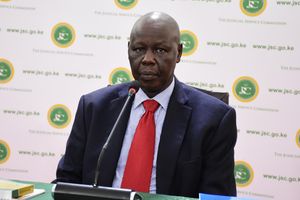
Justice Warsame Abdulahi Mohammed during the JSC interviews for the position of Supreme Court Judge on April 29, 2026, at the Milimani Law Courts. He was nominated for the position.
Photo credit: Billy Ogada | Nation
In some mature democracies, including the United Kingdom, United States and South Africa, judicial accountability is largely reported at the institutional level through aggregate statistics on case clearance, backlog and efficiency.
While some countries such as India and parts of Latin America track individual performance internally or in limited forms, public ranking or disclosure of judges’ productivity remains rare and contested.
Legal analysts say the shift could redefine judicial accountability by making judges directly answerable to the public, but also risks introducing new pressures into decision-making.
The Judiciary has acknowledged the need to balance transparency with independence, stating that the framework will be structured to safeguard institutional integrity.
“The Judiciary shall commence the publication of individual performance data for judges and judicial officers in a structured and transparent framework that safeguards judicial independence and institutional integrity. This is in recognition of our duty to remain accountable to the people of Kenya, who are the ultimate consumers and financiers of justice and in whose name judicial authority is derived and exercised,” said Chief Justice Koome.
She stressed that the institution maintains a zero-tolerance policy on corruption and urged Kenyans to report misconduct, noting that public vigilance is critical in cleaning up the justice system.
This year alone, 52 judges have been appointed across superior courts, the largest expansion in recent history, in an effort to improve case disposal and reduce backlog.
At the same time, staffing levels remain below capacity, with the Judiciary operating at 64 per cent of its approved workforce, a gap that continues to affect efficiency.
Funding constraints also persist, with a budget shortfall of over Sh22 billion limiting infrastructure expansion and digitisation efforts.
Against this backdrop, the decision to publish individual performance data signals a shift toward deeper accountability as the Judiciary seeks to demonstrate value to taxpayers and court users.