For years, the marriage between Dutch businessman Tob Cohen and Sarah Wairimu was marked by disputes that increasingly drew the attention of their friends, employees and police.
Witnesses have told the High Court of arguments, alleged assaults and police complaints that marked the couple’s troubled marriage before Cohen disappeared in July 2019, while a musician recalled him singing “Love Gone Sour” at a City hotel hours earlier the disappearance.
Their accounts, given during Ms Wairimu’s murder trial, offer a detailed chronology of the troubled relationship in the months before Cohen’s death.
Cohen, founder of Tobs Kenya Golf Safaris, a travel business specialising in golf tourism, was deeply involved in Kenya’s golf industry. He had also served as a director of Muthaiga Golf Club, founded the Kenya Golf Marketing Alliance and chaired the Kenyan chapter of the International Association of Golf Tour Operators. Cohen and Wairimu married in 2007.
He was reported missing after July 19, 2019. His body was discovered in an underground tank at his Lower Kabete Kitisuru home in September.
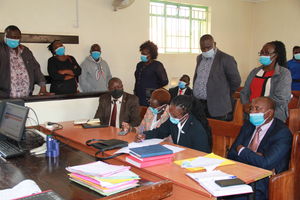
Sarah Cohen follows proceedings during the hearing of the murder case against her in which she was charged with killing of the late Dutch businessman Tob Cohen before Justice Diana Kavedza at Kibera law courts in Nairobi on September 30, 2026.
Photo credit: Billy Ogada | Nation
Ms Wairimu was subsequently charged with his murder, which she has denied. The charge states that Cohen was killed on the night of July 19 and 20, 2019. He was 71 years at the time.
The prosecution has presented evidence about the couple’s home life, Cohen’s movements and the police investigation. The defence has challenged parts of that evidence and argued that Cohen’s conduct contributed to the domestic conflict.
One of the clearest accounts came from Chrispinus Shihemi, a former gardener and housekeeper at the couple's residence. He told the court that on February 8, 2019, he heard Cohen shouting in the house, “You are killing me, you are killing me.”
Mr Shihemi said he rushed to the scene and found Cohen near the stairs, bleeding and crying. He testified that Ms Wairimu was holding a chair above him.
He said he intervened to stop the confrontation and spoke to Ms Wairimu, who, according to his testimony, listened to him and lowered the chair, allowing him to help Cohen away from the scene. But after he helped Cohen out of the scuffle, the businessman tore Ms Wairimu's dress and verbally abused her.
The account was challenged in cross-examination. Defence lawyer Pravin Bowry pointed out that four earlier statements did not mention a chair. Mr Shihemi said he was unaware of the omission.
The defence also potrayed Cohen as a difficult and erratic man whose behaviour generated constant friction at home.
Mr Shihemi described Cohen as a heavy drinker and chain smoker, who kept ash trays in every corner of the compound, including the office, and whose behaviour changed after drinking.
The late Dutch tycoon Tob Cohen.
Photo credit: File | Nation Media Group
He said Cohen frequently insulted him, calling him foolish and stupid, but he did not take the remarks seriously because Cohen sometimes gave him cash, at times Sh1,000 or Sh2,000.
The witness said on many occasions Cohen arrived home late and that the couple was technically separated.
The witness described a dispute involving a safe containing documents. He said Cohen ordered him to move and open it, but he refused. Another man later used a drill to open it outside.
According to Shihemi, Cohen returned with documents and said, “I got what I wanted.” Mr Shihemi said Ms Wairimu later told him she knew the safe’s code and alleged Cohen wanted land documents for a property sale.
Mr Shihemi also said Cohen stopped eating at home, and instead prepared or bought his own meals.
Police testimony provided another record of the domestic conflict. Inspector Moses Mbalwe told the court that Cohen reported an alleged assault by Wairimu on February 13, 2019. Mr Mbalwe said Cohen initially did not want his wife arrested but later requested police action.
Police officers visited the residence, but Ms Wairimu allegedly locked herself inside a room. Mr Mbalwe said officers later pursued summons and obtained an arrest warrant.
Mr Mbalwe told the court that on July 19, a letter purportedly seeking withdrawal of the complaint reached the station. Police tried to contact Cohen to verify the withdrawal, but his call was not answered.
“When the letter from Cohen was received by the OCS seeking to withdraw the assault complaint, he informed me to get in touch with him, but his call was never answered," testified Mr Mbalwe.
The officer testified that the assault matter was overtaken by Cohen’s death after his body was found in the septic tank. His evidence concerned the earlier complaint and police response.
Tob Cohen's unorthodox "in loving memory" newspaper tribute by his family caught the attention of many.
Photo credit: Nation
In cross-examination, he acknowledged that his investigation had been completed and that the police file did not contain a statement from Ms Wairimu because she had not been arrested.
Davis Kamau, a member of Chamber of Commerce, told the court that Ms Wairimu had spoken to him about difficulties in the marriage and alleged that Cohen was abusive.
Mr Kamau said he and businessman Peter Karanja went to the Lower Kabete home on July 19 after Karanja received Wairimu’s distress call. They encountered men in civilian clothes identifying themselves as police officers.
According to Mr Kamau, Cohen later emerged and questioned their presence. He made a telephone call about the men and then drove away. The testimony placed the marital dispute alongside the events of Cohen’s final known day.
The prosecution also traced Cohen through Muthaiga Golf Club and Plums Hotel. Club officials produced evidence showing his visit on July 19, although one witness could not establish when he left.
At Plums, waiter Michael Wainaina said Cohen was later joined by three women. He testified that Cohen left at about 1:30am. Bartender Aggrey Ingano gave a similar account and said Cohen appeared jovial when he left.
Musician Haston Kombe also saw Cohen at Plums that night. Mr Kombe said Cohen joined the band and sang “Love Gone Sour”. He recalled Cohen singing, “You old woman, you treat me so mean; you are the meanest old woman I have ever seen.”
Sarah Wairimu Cohen during an interview at her Njigari home in Nyeri county on June 17, 2021.
Photo credit: Joseph Kanyi | Nation Media Group
"He was excited when the band began to perform the song and requested to perform it," Mr Kombe told the court. Cohen sang for about five minutes while the crowd cheered, after which the band moved on to another song.
Mr Kombe described the venue's clientele as high-end regular customers of Indian, British and American origin.
The testimony about Cohen’s final movements does not resolve what happened after he left the hotel. The prosecution is continuing to call witnesses during the hearing, while the defence has not presented its full response.
Forensic evidence has also entered the trial, with former Government Chemist John Kimani producing 40 assorted exhibits recovered from the couple's residence. Mr Kimani told the court that he examined exhibits recovered from the residence, vehicles, bedrooms and a water tank.
He said some exhibits produced DNA profiles from unidentified male and female sources. He said DNA from the steering wheel of Cohen’s vehicle belonged to an unknown male.
He also testified that profiles from Cohen’s cartilage and nail samples were consistent with those of his biological siblings, Gabriella Hannah Cohen and Bernard Cohen. Other exhibits produced mixed profiles or no DNA profile.
The trial has brought together accounts of marital disputes, a reported assault, property-document disagreements, police intervention, Cohen’s final movements and forensic examinations.
Sarah Cohen at the Kibera High Court in Nairobi on June 9, 2026.
Photo credit: Richard Munguti | Nation Media Group
The witnesses have not offered one account of the marriage. Shihemi described alleged violence by Wairimu and Cohen’s difficult behaviour.
Ms Wairimu’s alleged complaints to Mr Kamau presented a different account. The defence has challenged the Prosecution's evidence and maintains that she is not guilty.
The court is expected to consider that evidence in the murder charge, not simply the marriage’s history. Wairimu remains presumed innocent unless proved guilty.
In February 2026, the court rejected her mistrial application. “I am not persuaded that there exists any bias in this matter,” the judge ruled.
The trial continues on October 12 and 14, when further prosecution witnesses are expected.