The question came the way such questions usually come. Politely, with one small, sharpened word buried in the middle of it.
A white patient wanted to know where Catherine Maina was from. She had lived in London for five years, so she named the part of London where she lived.
“No, he wanted to know where I was really from,” Maina said. “When the emphasis is on ‘really’, you know what they mean. ‘Kenya,’ I replied.”
Minutes later, she told him she needed to remove his surgical drain. She was the most experienced renal nurse specialist on his case. “‘Do you even know how to remove this?’ he asked, pointing to the drain bag protruding through his hospital gown,” she recalled. “‘I do not want you to try to be a hero.’”
Maina did not file the two moments away separately. “I might have dismissed the comment in isolation,” she said, “but it came hot on the heels of the question about where I was really from.”
She is one of hundreds of Kenyan nurses who have arrived in Britain since June 2022 under a health workforce agreement that both governments once held up as a model of orderly migration. Kenya’s surplus of highly trained clinicians matched, neatly, to Britain’s shortage of hands.
Catherine Maina, a Kenyan nurse based in the UK.
Photo credit: Pool
The pact was struck in 2021, brokered during an official visit to London by then-President Uhuru Kenyatta, and it opened 20,000 positions in the National Health Service to unemployed Kenyan nurses.
Applicants submitted to a gruelling regulatory gauntlet, proving clinical mastery, clearing strict background vetting, passing specialised language examinations, all for the chance to work the front lines of British medicine.
For the Kenyan nurses, and for thousands of other Black and minority ethnic staff members in the health service, arrival has meant stepping into a workplace where systemic inequality is documented, and where open racial abuse on the ward has become an occupational hazard.
“A recent report from the National Health Service describes patients refusing care from Black and ethnic minority healthcare workers,” Maina said. “I wish I could say this surprised me.”
The NHS depends on international recruitment to keep its doors open, yet data gathered by the British Medical Association and the Royal College of Nursing describe a workforce that is indispensable and, at the same time, routinely dehumanised.
Staff members have reported being called “dirty foreigners” and “monkeys”, or hearing that immigrants are “taking our jobs”. The hostility runs the length of the clinical spectrum. A survey by the Society of Radiographers recorded a marked surge in overt racism, including patients who flatly refused treatment by Black or Asian staff members.
One explanation offered: “Black people frighten me.” Visible markers of identity, such as skin, name, and accent, are regularly turned into weapons. More often, the abuse is quieter, and arrives as a challenge to basic competence.
Paul Awah, 39, a radiographer who moved to Britain from Nigeria, said white patients frequently pretend not to understand him, though he speaks English with complete clarity. The same patients, he noted, navigate thick Scottish and Irish accents without difficulty.
His African accent is heard differently, as a signal of exclusion, and as evidence, falsely, that he is unqualified. Nor does it stop at the hospital door. “Yes, it happens,” said Kioko Mutua, a Kenyan nurse. “A while back, a lady called us for ambulance dispatch services and when our team responded, found that she was calling on behalf of her friend, who was unwell but our team established that they were both drunk.”
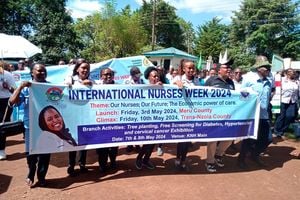
Nurses in Eldoret City, Uasin Gishu County, during a procession to mark International Nurses Week on May 07, 2026.
Photo credit: Jared Nyataya | Nation Media Group
“They started insulting our team and the lady even called one of the paramedics ‘a monkey,’” Mutua said. “The colleague reported the matter and the lady declined to apologise.”
Staff members and healthcare advocates trace the surge on the wards to the political weather outside them. As far-right rhetoric has normalised anti-immigrant sentiment, blaming minorities for rising energy bills, the cost-of-living crisis and the decay of public infrastructure, prejudices once whispered are now spoken at full volume.
Public-facing health workers, bound by a duty of care they cannot set down, make convenient targets for a country’s frustration. Confronted, patients tend to retreat only when they must. Maina remembers pressing hers.
“I asked whether he would prefer another nurse, since he clearly doubted my competence,” she said. “Confronted with his own assumption, he decided to let me proceed. As he lay on the bed asking about the training of nurses from Africa, I removed the drain. He had not even noticed. His apologies were profuse. Maybe he was sorry, or maybe competence is simply inconvenient when it contradicts prejudice.”
Inside the institution, the safety nets meant to catch such workers are frayed. Despite official zero-tolerance policies, managers often press minority staff to place clinical necessity above their own safety and keep treating abusive patients.
The health service’s own Workforce Race Equality Standard data says Black and minority ethnic staff report higher rates of bullying by colleagues, are disproportionately referred for disciplinary action and remain sparse in senior management.
For international recruits tethered to employer-sponsored visas, silence is the cheaper option. “The NHS findings ignite a critical conversation,” Maina said. “Patients have the right to refuse treatment and, where appropriate, express preferences about their care. But autonomy cannot mean entitlement to a workforce rearranged according to race. And if it did, the NHS would have to confront the reality that it simply could not function without Black and ethnic minority workers.”
Asked about the racism and safety concerns facing its nurses abroad, the Kenyan government did not provide a formal statement. Labour Cabinet Secretary Alfred Mutua declined to comment on conditions in British workplaces, referring inquiries to the State Department for Diaspora Affairs.
“Healthcare workers owe patients dignity and institutions owe their workers the same,” she said. “A hospital should treat illness, not accommodate racism as though it were another clinical need.”