Can one sue a WhatsApp group of which he is a member for failing to contribute towards burial expenses? That is the question the Small Claims Court in Mombasa was recently called upon to answer after a disgruntled member sought to compel his welfare group to pay Sh300,000 following a family bereavement.
Nicholas Ogola sued the Luo Professionals (Lup) Welfare Group, accusing its officials of failing to mobilise members to support him during his bereavement.
He argued that the group, formed as a professional welfare platform, was expected to offer financial assistance to members in times of need such as during funerals.
However, the Small Claims Court in Mombasa has since dismissed Mr Ogola’s Sh300,000 claim, in which he had asked the court to compel the Lup Welfare Group to contribute towards burial expenses following the death of his stepmother.
Ogola argued that the group, formed as a professional welfare platform, was expected to offer financial assistance to members in times of need.
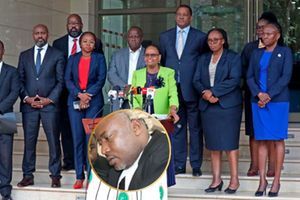
Photo credit: Pool
The court relied on the provisions on bereavement in the welfare group’s constitution, which allow for financial support of its members in the event that such a member loses a foster parent.
"However, such a foster parent or guardian must have been declared by that member to the welfare group. The Claimant in this matter and as he conceded, had not properly declared Caren Akello Ogola in his declaration as his stepmother, foster parent or guardian," the court noted.
According to the court, this failure to declare explains the reasons of the welfare group and its officials declining to whip the members to offer financial support upon the claimant losing his stepmother.
"That said, and in view of the foregoing, the inescapable conclusion that the court must then arrive at, is that the claimant’s case was never proved to the required standard. Consequently, it is one for dismissal," the court said.
With that, Mr Ogola lost out on the Sh300,000 bereavement fund that he would have benefitted from had he declared his stepmother in the biodata provided to the welfare group at the time he joined.
In his Statement of Claim, Mr Ogola told the court that despite being a member of the Lup Welfare Group, a members’ contribution self-help outfit, he was “unjustly left out of financial support” when he lost his stepmother.
Based on the number of members and expected individual contributions, he said he had hoped to receive about Sh300,000 to accord his stepmother “a decent send off.”
He blamed the group’s officials, including the chairman Pius Oketch and treasurer Morris Abwao, accusing them of failing to whip the membership into raising their individual contributions when he lost his stepmother. He termed the decision a violation of the group’s constitution and sought not only the Sh300,000 but also protection from expulsion from the welfare for merely demanding his right.
At trial, Mr Ogola, as a lone witness, explained that he comes from a polygamous family and that the deceased, Caren Akello Ogola, was his stepmother and guardian who raised him after the earlier death of his biological mother.
He said he had faithfully contributed towards the bereavement of other members and was therefore shocked when the chairman dismissed his request for support.
“Despite the deceased not being my biological mother, it was her who brought me up,” he maintained.
Though there might have been an oversight while filling in his biodata details when joining the group, Mr Ogola insisted that his claim remained justified even after the burial.
To support his case, he produced the group’s constitution, the obituary booklet, which listed him among the deceased’s children, a copy of her national identity card and his own birth certificate. The birth certificate, however, showed that his biological mother was one Cecilia Anne Jole.
In response, the group’s treasurer, Mr Abwao, who testified on behalf of all the respondents, acknowledged that Mr Ogola was indeed a member.
He maintained that according to the biodata Mr Ogola had provided, the departed stepmother did not meet the Lup Welfare Group’s standards for assistance of its members upon being bereaved.
"The question of the claimant’s stepmother having looked after him was not in his declaration. In fact, the declaration stated only an uncle had taken care of his education," said Mr Abwao.
According to him, members are required to declare their prospective beneficiaries upon registration. Financial support, he said, comes from case by case contributions, not from a standing fund, as the group “never kept any liquid cash awaiting to be disbursed on demand.”
According to the records produced in court, Mr Ogola had indicated one Carolina Ogola as his mother and indicated that his father was deceased. So, when he later informed the leadership about the death of his stepmother, officials resolved not to mobilise members for contributions.
The Employment and Labour Relations Court ruled that the bank had valid grounds to dismiss the employee, Mr NM.
Photo credit: File | Nation
Mr Abwao told the court that while Mr Ogola was free to seek help from friends, including group members in their personal capacity, the stepmother had not been declared as a beneficiary in the official records. He added that even where a declared beneficiary dies, contributions are voluntary and not guaranteed.
“At any given time, not all members contribute,” he said, questioning how the Sh300,000 figure Mr Ogola demanded would have been assured.
The respondents also told the court that when the decision not to mobilise support was communicated to Mr Ogola by the secretary-general, he reacted by insulting him.
They noted that the Secretary General had not even been sued, arguing that Mr Ogola had “cherry picked” officials he had personal scores to settle with.
From the evidence presented in court, the Lup Welfare Group is a voluntary membership self-help outfit guided by its constitution. According to its founding principles, the group exists to be a forum where members would give each other financial, social, emotional, mental and spiritual support whenever necessary.
The group’s constitution outlines a structured process during bereavement, where a member must notify the Executive Committee through the chairman within 24 hours. The committee then deliberates and “gives direction or advice on the contributions and allocations” before collections are done within seven days.
The contributions are organised after deliberation and consultation and are not automatic entitlements payable on demand.
In dismissing the claim for Sh300,000, the court effectively found that the deceased was not declared in the biodata of the welfare group, hence the outfit could not be compelled to pay the money.
On Mr Ogola’s plea that he should not be expelled from the group, the court declined to intervene, noting that the welfare outfit has a robust Constitution capable of dealing with such internal issues on the very first instance and ruled that it lacked jurisdiction to descend into that arena.