For more than two decades, a Nairobi doctor had built a career helping couples struggling with infertility to have children through assisted reproductive technology.
But one surrogacy arrangement involving a couple of Canadian origin, an anonymous egg donor of Indian descent, and a Kenyan surrogate mother drew Dr Sukhija Sarita, trading as Myra IVF Clinic, into a legal dispute after the intended parents claimed DNA tests showed the baby delivered through the process was not genetically related to them.
Soon after the birth, the intended mother, Ms CMM, raised concerns about the baby’s complexion, saying it appeared darker than expected, given the genetic father and the selected egg donor.
The allegations prompted police investigations into possible offences, including cheating and even child trafficking, before the doctor moved to the High Court to block the probes, arguing they violated medical confidentiality and her constitutional rights.
In a ruling, the High Court halted the criminal investigations, saying the actions of investigators had crossed constitutional limits and risked violating the doctor’s rights to privacy, fair administrative action and a fair hearing.
The dispute traces back to March 2024, when a couple, Mr RM and Ms CMM, approached the fertility clinic seeking help to have a child through surrogacy.
According to court records, Mr RM provided a sperm sample while the clinic sourced an anonymous egg donor of Indian descent after the couple expressed that preference.
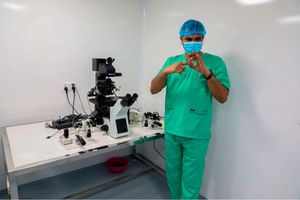
Certified IVF Consultant and Fertility Specialist Dr Sarita Sukhija during the interview at Myra IVF Clinic in Westlands Nairobi County Photo | Dennis Onsongo
Doctors then created embryos through in vitro fertilisation (IVF) before transferring one embryo to a surrogate mother identified and screened through the clinic in accordance with professional standards.
The parties later signed a surrogacy agreement on November 4, 2024, setting out the responsibilities of the intended parents, the clinic and the surrogate mother during the pregnancy.
The pregnancy progressed under medical supervision until complications developed late in the third trimester.
At about 33 weeks of gestation, the surrogate mother experienced bleeding and was rushed to a Nairobi hospital.
Doctors performed an emergency caesarean section on June 4, 2025, delivering a premature baby boy.
The newborn required specialised care and was later transferred to a children’s Hospital for neonatal treatment before being discharged into the care of Mr RM and Ms CMM.
According to the court record, the surrogate mother had consented to the registration of the birth in the names of the intended parents.
But shortly after the delivery, the couple began expressing doubts about the child’s parentage due to the skin tone.
They later commissioned independent DNA tests, which they said showed the child had no genetic relationship to them.
The couple subsequently wrote to the fertility clinic demanding refunds and compensation and reported the matter to the police.
Investigators from the Directorate of Criminal Investigations (DCI) summoned the doctor and several members of her staff to record statements.
Following these events, the DCI summoned the doctor to record a statement regarding the alleged offence of cheating contrary to section 315 of the Penal Code, which she duly complied with in the presence of her legal representatives.
Police also demanded extensive medical, embryology and administrative records relating to the surrogacy process.
The doctor argued the demands were excessive and violated the privacy of patients, donors and the surrogate mother.
Benchtop incubator at Myra IVF Clinic in Westlands Nairobi County in this picture taken on January 17, 2023.
Photo credit: Dennis Onsongo | Nation Media Group
Dr Sarita told the court she had acted in accordance with accepted medical standards throughout the process and denied any wrongdoing.
Her petition argued that disputes arising from the surrogacy arrangement should be resolved through civil proceedings or professional regulatory processes rather than criminal investigations.
She denied any wrongdoing, including misrepresentation, child swapping, cheating or trafficking and contended that “the criminal allegations were speculative, unfounded and motivated primarily by dissatisfaction with the child’s appearance rather than credible evidence of criminal conduct.”
Dr Sarita further stated that the intended parents were actively involved at all stages of the surrogacy process, including sperm and egg collection, fertilisation, embryo creation and implantation, with one embryo remaining at her clinic while another was successfully implanted into the surrogate mother.
In regard to the concerns over the baby’s skin tone, she told the court that it was too early to draw conclusions, especially given that the baby had been born prematurely and spent time in neonatal care.
During questioning in court, the doctor also said she could not confirm whether the baby she delivered was the same child later handed over to the intended parents.
The intended parents opposed the application and maintained that the investigations were necessary to establish what had gone wrong in the entire process.
They said the DNA findings raised serious questions about possible embryo mix-ups or other irregularities during the fertility procedure.
In addition, they contended that they had been deprived of the right to create a family as contractually agreed and of access to truthful and credible information regarding the status of the embryos and the child genetically related to Mr RM.
Investigators also argued that access to clinic records was necessary to determine the fate of the embryo and establish the child’s true genetic parentage.
However, the court found that the criminal investigations had proceeded without a sufficient evidentiary basis.
The judge noted that many of the questions raised by investigators appeared to relate to possible professional negligence rather than clear criminal conduct.
“The nature of the questions and the persons targeted point more toward alleged negligence or incompetence in the handling of the surrogacy arrangement rather than establishing a prima facie case of a serious criminal offence such as child trafficking,” said the court.
The court also found that the sweeping demands for confidential medical and administrative records were intrusive and disproportionate.
In the judgment, the court stated that continuing the investigations in their present form would violate the doctor’s constitutional rights.
“Investigatory zeal must be balanced with proportionality,” the court said, warning that excessive intrusion into professional medical practice could infringe constitutional protections.
The court also observed that the doctor was already facing regulatory proceedings before the Kenya Medical Practitioners and Dentists Council.
That professional body, the court said, was better placed to examine technical questions surrounding IVF procedures, record keeping and professional conduct.
Allowing criminal investigations to run alongside those proceedings risked prejudging matters that required specialised medical expertise.
“To permit criminal proceedings to advance in the absence of a clear evidentiary foundation, and before the specialised regulatory body has rendered its determination, risks prejudging matters properly within that forum,” the court stated.
The High Court issued an order prohibiting the police and prosecutors from continuing or pursuing criminal investigations against the doctor arising from the surrogacy arrangement.
However, the ruling did not permanently close the door to criminal action. The court said investigators could revisit the matter if credible evidence of criminal conduct emerges from the outcome of the regulatory inquiry.