A city hospital and two institutions specialising in in vitro fertilisation (IVF) procedures have been ordered to release all records relating to services offered at their facilities for one year, following a complaint by an American couple whose surrogate delivered a child later found not to be genetically related to them.
The High Court further directed the three institutions to preserve all records, logs, and any other materials used in conducting the IVF procedures from April 2024 to January 19, 2025, the date when the child at the centre of the dispute was born.
In the ruling, the court noted that the prayers sought by the couple identified as AAD and ANA were far-reaching and could have significant legal implications not only for the named institutions but also for third parties whose privacy might be intruded upon without consent.
“Of course, this will have legal ramifications,” the court observed.
Milimani Law Courts in Nairobi.
Photo credit: File | Nation Media Group
According to the court, there was no harm in directing the institutions to release to the couple all records and documentation related specifically to them, the minor, and the surrogate mother, noting that such access was their constitutional right as parties to the matter.
“The ball squarely shall be in the respondents’ court. They are the holders of all medical records, logs, and any other paper trail in respect of the said IVF exercise. It is incumbent upon them, jointly and severally, to guard and preserve the same until further orders of this court,” the court ruled.
The couple sued a city-based facility that offers assisted reproductive technologies, including IVF procedures, egg and sperm handling, fertilisation, and embryo transfer.
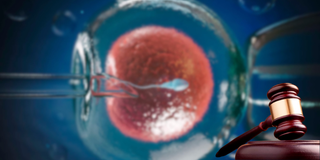
An illustration of in vitro fertilization (IVF) of human egg cell or fertility treatment.
Photo credit: Pool
Also named in the suit is another institution that coordinates surrogacy arrangements and fertility-related services.
The second institution is accused of selecting the surrogate mother, identified as GPO, identifying the hospital where the child was born, and coordinating the surrogacy arrangement involving GPO.
The American couple has sued the institutions and the surrogate mother for allegedly breaching a fundamental term of gestational surrogacy under IVF procedures that the resulting child would be genetically related to them.
Court documents indicate that the couple sought IVF services in April 2024, during which their eggs and sperm were collected for embryo creation and implantation into the surrogate mother.
While making arrangements for the child’s travel, a DNA test was conducted and the results revealed that the child bore no genetic relationship to either AAD or ANA.
“This revelation caused us unspeakable shock, grief, and distress,” the couple stated.
They further alleged that the facilities denied and refused to provide a coherent explanation for the apparent mix-up involving gamete collection, embryo fertilisation, and implantation.
They accused the institutions of failing to take responsibility for the severe consequences suffered as a result of the alleged errors.
The couple claims that the facilities mishandled genetic material entrusted to them for IVF purposes, resulting in the fertilisation and implantation of an embryo using gametes that did not belong to them.
They also accused the institutions of negligent supervision and management of medical personnel, allowing errors in gamete handling, mix-ups, and wrongful embryo fertilisation.
The petitioners said the results caused severe emotional distress and psychological trauma, including the loss of reproductive opportunity, due to what they describe as gross negligence that resulted in the birth of the wrong child through a gestational surrogacy arrangement.
The hospital has been accused of failing to exercise the standard of care expected of a medical institution involved in assisted reproductive services, particularly in high-risk or complex gestational surrogacy arrangements.
The surrogate mother, GPO, has also been accused of participating in or enabling the concealment of the child’s true genetic identity, despite knowing the child was not genetically related to the couple.
AAD and ANA argue that the harvesting of their eggs and sperm for IVF, followed by the birth of a child with no genetic link to them, violated their rights under Article 43(1)(a) of the Constitution.
They further allege that the swapping of genetic material infringed upon their right to family life.
“The trauma of losing a child we planned for, carried hope in, and trusted the defendants to deliver through professional care has left us with lasting emotional scars,” AAD stated.
He added, “The breach of that trust and the loss of our chance to parent our biological child has caused profound pain, especially for my wife, who underwent hormonal treatments for the egg retrieval process.”
The couple is seeking a declaration that the institutions are liable for negligence and breach of contract, as well as an award of damages.
They have also asked the court to issue orders to facilitate the identification and reunification of the minor with the child’s biological parents and to trace the whereabouts of their own genetically related child.
“We wish to identify and trace the biological identity of the child placed with us and establish the whereabouts of our genetically related child,” the couple stated.