Can a technician be held criminally liable simply because he cannot produce purchase receipts for every electronic item entrusted to him for repair?
The High Court has ruled that a technician’s failure to provide proof of purchase for items in their possession does not, in itself, constitute criminal liability.
According to the court, technicians routinely hold numerous electronic items belonging to different customers and cannot reasonably be expected to demand original purchase receipts before accepting them for repair.
“A technician cannot be legally forced to demand original purchase receipts from every customer who brings an item for repair,” the High Court in Busia said.
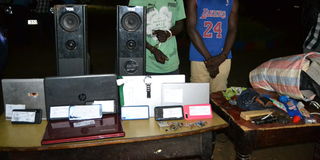
Turbo Sub-County Police Commander Edward Masibo (right) and other officers display recovered electronic goods at Huruma Police Station in Eldoret town on January 6, 2022.
Photo credit: Jared Nyataya | Nation Media Group
The court made the remarks while setting free technician Samuel Walubengo, who had been serving a 15-year cumulative sentence after being convicted over the alleged theft and possession of electronic items.
The High Court found serious flaws in the prosecution case, including inconsistencies in the timeline, failure to produce key exhibits and shortcomings in proof of ownership.
The court declared the criminal conviction against him unsafe and unsustainable, finding that it was not founded upon proof beyond reasonable doubt.
“The convictions against Walubengo, on all counts, are quashed, and the cumulative sentence of 15 years’ imprisonment is set aside due to total insufficiency of evidence,” the court said in a ruling dated September 21.
Walubengo was arrested in 2023 and charged with five counts arising from alleged thefts in Nambale Centre, Busia County.
He was accused of breaking into Jentrix Auma’s shop at about 3am on October 26, 2023, and committing a felony. He was also accused of breaking into the same shop around midnight on August 20, 2023, and stealing a power bank valued at Sh10,000.
Further, he was accused of breaking into Patricia Pamba’s shop at about 9.30am on October 10, 2023, and stealing a money scanner valued at Sh1,000.
The fourth count accused him of breaking into Eliza Juma’s house at about 2am on September 24, 2023, and stealing a six kilogrammes gas cylinder valued at Sh6,000. The second, third and fourth counts carried alternative charges of handling stolen property.
The High Court has ruled that a technician’s failure to provide proof of purchase for items in their possession does not, in itself, constitute criminal liability.
Photo credit: Shutterstock
In the last count, he was accused of having suspected stolen property in his possession, including eight television sets, two water heaters, a power bank and a speaker. The prosecution called four witnesses.
Ms Pamba told the court that she found her shop broken into on October 10, 2023, with a number of items missing, including three gas cylinders, a printer, hair products, a money scanner, an M-Pesa board, a Maasai shuka, two woofers and 450 coins. She later identified the money scanner at Walubengo’s shop.
Ms Auma said her shop was broken into around midnight on October 26, 2023, and later identified a white power bank at Walubengo’s house.
Ms Juma testified that her premises were broken into on September 24, 2023, while she was in Nairobi. She said her green F-gas cylinder, phones, earphones, clothes and shoes were among the missing items. She later identified the gas cylinder recovered by police and produced a receipt.
The investigating officer said police arrested Walubengo after one of the suspected thieves was assaulted by members of the public and died on the way to hospital. Walubengo, he said, fled to Tanga Corner Police Station.
Police subsequently took him to his house, where the complainants identified some of the items reported stolen. Officers also recovered several other electronic items that Walubengo could not account for, although some remained unclaimed. A customer, Caroline Okwara, produced a receipt for one of the televisions, saying she had taken it to Walubengo for repair.
Walubengo, however, told the court that he operated a licensed electronics repair shop and that the items recovered from his premises belonged to customers.
He said that on October 26, 2023, four boys approached him at an M-Pesa shop, pretending to seek repair services, before assaulting him and accusing him of theft. He said they took him to Tanga Corner Police Station and later Nambale Police Station, where officers took him to his shop and confiscated televisions, solar panels, electric kettles and speaker boxes.
The trial magistrate convicted him and imposed a cumulative 15-year sentence, prompting him to appeal to the High Court in Busia.
Walubengo challenged the conviction on grounds, including a discrepancy between the date of his arrest and the date he was recorded as having taken plea, failure to produce the power bank and gas cylinder, lack of proof of ownership, alleged violations of his fair-trial rights and the removal of key documents from the certified appeal record.
The timeline became one of the central issues in the appeal. The trial record showed that Walubengo took plea on October 20, 2023, yet the prosecution case was that he was arrested and the alleged stolen property recovered on October 26.
The High Court, however, found that the October 20 date was a clerical error, noting that the charge sheet bore a receipt stamp dated October 30, 2023, as did page two of the handwritten proceedings.
The court nevertheless criticised the handling of the proceedings, saying the conflicting dates created an unexplained anomaly in the record.
“This court would be left with an absurd scenario. The state claims it locked up, charged, and took a plea from a citizen who would not be caught or linked to the crime until six days later. This timeline mismatch cannot be excused as a simple clerical error. It shows that the entire proceedings were carelessly constructed,” the judge said.
The white power bank and the green gas cylinder were never produced in court. Only the money scanner was presented as a physical exhibit.
The court further found that the prosecution had not adequately established ownership of the recovered items. Ms Pamba did not provide a receipt, serial number, brand or other distinctive feature for the money scanner, while Ms Auma had no receipt for the power bank.
Although Ms Juma produced a receipt for the gas cylinder, the court noted that it had not been supplied to Walubengo before trial, raising a fair-trial concern.
The judge said the trial magistrate had effectively treated the complainants’ identification of the items as proof of ownership without requiring the prosecution to first establish that they belonged to them.
“Before a court can accept that a witness has identified a recovered item, the prosecution must prove that the witness owned such an item before the theft took place,” the judge said.
The court was particularly critical of the evidence concerning the gas cylinder. It was never produced in court, while a photograph relied upon by the prosecution showed two cylinders.
The scene-of-crime officer who took the photograph was not called to testify, while Ms Juma told the court that she had not identified the cylinder at Walubengo’s shop but had only been shown items at the police station.
The High Court also found that the trial court mishandled the sentencing process by failing to order a pre-sentence report, which the judge said was necessary to understand the appellant’s background, character and level of risk.
“The trial court failed to look at the positive testimonies regarding Walubengo’s established business as a technician in the local area,” the judge said.
According to the High Court, sentencing under the Kenya Sentencing Guidelines is a distinct judicial process that requires careful consideration and cannot be handled summarily.
“It cannot be treated as a quick footnote at the end of a judgment. The trial court completely ignored the mandatory steps required before a citizen’s liberty can be taken away,” the judge said.
The judge also faulted the decision to impose consecutive sentences totalling 15 years, holding that the offences arose from related incidents and should have attracted concurrent sentences.
The court further found the punishment disproportionate and inconsistent with Article 50(2)(p) of the Constitution, which requires an accused to benefit from the least severe prescribed punishment.
“By rushing through the sentencing phase, the trial court turned what should have been a fair evaluation into an act of pure punishment. This approach directly violates the legal requirement to ensure sentences are fair, consistent, and focused on rehabilitation,” the court said.
The judge concluded that the prosecution had failed to establish the case beyond reasonable doubt and quashed all five convictions, setting aside the 15-year sentence.