The deaths of 22 people in a bus-truck collision at Kanga in Makueni County have renewed concerns over the safety of the Nairobi-Mombasa highway, where two major crashes in October alone have claimed 39 lives.
The Sunday, October 25, tragedy came barely three weeks after 17 people, most of them Catholic pilgrims, died in a multiple-vehicle crash at Salama, also in Makueni County.
In just one month, 41 people have lost lives in three tragic accidents on the road.
The incidents have exposed the dangers facing motorists on the busy transport corridor, where heavy trucks, passenger buses, private cars and matatus share a road that serves millions of travellers and carries cargo to and from the Port of Mombasa.
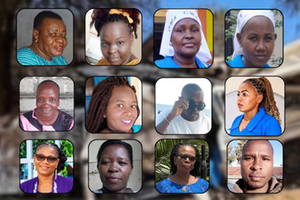
12 of the 17 pilgrims killed in a horrific multi-vehicle highway collision(from left): Florence Atieno, Hilcah Orina, Regina Mwai, Martha Nzyoki, Janet Miito, Veronicah Musyimi, Samuel Muigai, Veronica Ngandi, Scholastica Ochieng, Catherine Joseph, Ann Mwanthi and Josephat Mekonge.
Photo credit: Kevin Odit| NMG
The latest accident occurred around 7am when a bus carrying passengers returning from a funeral in western Kenya collided with a lorry at Kanga, beyond Mtito Andei, as it headed towards Mombasa.
The National Transport and Safety Authority (NTSA) subsequently identified the Kanga stretch as an accident black spot. The authority said recommendations had previously been made to address safety concerns along the section.
The tragedy followed a road crash on October 3 at Mlima Kiu in Salama, where 17 people died when a chain of collisions involving several vehicles ended in a head-on crash between a lorry and a Toyota Hiace carrying Catholic pilgrims from Mombasa to the Subukia National Shrine in Nakuru County.
Police said the lorry, travelling from Nairobi towards Mombasa, was allegedly overtaking other vehicles when it struck another truck. It then lost control and collided with several vehicles, including the pilgrims' van.
The van's driver and 12 passengers died, alongside the lorry driver and three occupants of the truck. Several other people were injured.
Makueni Governor Mutula Kilonzo Junior called on the Kenya National Highways Authority (KeNHA) to take urgent measures to improve safety at Salama.
“I urge the national government through KeNHA to take quick measures and improve safety and give it the same attention that was taken at dangerous sections such as Salgaa and Nithi Bridge,” the governor said.
Vehicles scaling Mlima Kiu, a notorious blackspot a long the Mombasa-Nairobi highway.
Photo credit: Pius Maundu | Nation Media Group
The concerns extend beyond the two October tragedies. On September 23, two people died and six others were seriously injured when a Dreamline bus carrying 52 passengers hit the rear of a stationary trailer near Taru and Mackinnon Road.
The bus's front cabin was badly damaged, with some passengers trapped inside. The injured were taken to hospital, while emergency responders worked to free those caught in the wreckage.
Coast Regional Traffic Enforcement Officer at the time Asha Wario said the trailer might have developed a mechanical problem but its driver allegedly failed to place a warning triangle behind it.
She urged drivers to observe traffic regulations, avoid overtaking on continuous yellow lines and refrain from using mobile phones while driving.
The three crashes resulted in at least 41 deaths between September 23 and October 25. This figure covers only the three incidents and does not represent the total number of road fatalities along the highway this year.
The deaths have drawn attention to a longstanding problem: several sections of the Nairobi-Mombasa highway have been identified as accident black spots, yet fatal crashes continue to occur.
A Kenya National Police Service list of dangerous road sections identifies Salama-Sultan Hamud, the stretch between Emali Simba Market and Kibwezi, and the Mtito Andei-Tsavo River section among the areas where motorists should exercise extra caution.
The risks are particularly pronounced where the highway narrows from a dual carriageway to a single carriageway, leaving vehicles travelling in opposite directions separated mainly by road markings.
A dual carriageway ends at Machakos Junction. From there, motorists travelling towards Mombasa encounter a narrower road where overtaking can expose them to oncoming traffic.
Residents also describe repeated crashes, including one family whose patriarch died in a collision at Mlima Kiu just two weeks before the pilgrims' tragedy.
For motorists, the danger is that a single mistake can trigger a chain reaction involving several vehicles, leaving drivers with little room to manoeuvre or avoid an oncoming truck.
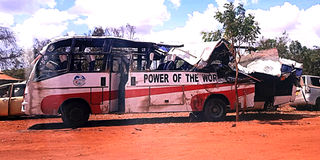
The wreckage of the bus that collided with a lorry at Kanga in Mtito Andei on October 25, 2026. Twenty-two people were killed in the crash.
Photo credit: Kevin Odit | Nation Media Group
On October 5, NTSA recorded 3,995 road deaths between January 1 and October 4, 2026, a 9.2 per cent increase from the 3,657 recorded during the same period in 2025.
The data also showed that 15,472 people had sustained injuries in road crashes during the period. Pedestrians accounted for 1,490 deaths, followed by motorcyclists at 1,061, passengers at 662 and drivers at 352.
NTSA Director of Road Safety Andrew Kipalgat said the authority was concerned about the persistent rise in deaths despite enforcement and public awareness campaigns.
The authority has identified more than 270 accident black spots nationally, with 199 located along the Mombasa-Malaba Northern Corridor, which includes the Nairobi-Mombasa highway.
The agency has also reported suspending 25 drivers' licences, summoning 20 public service vehicle operators and impounding more than 2,400 vehicles during a three-month enforcement period.
Following the Salama crash, Makueni Governor Mutula Kilonzo Junior renewed calls for the national government to upgrade the highway to a dual carriageway.
He urged KeNHA to give Salama the same attention as other dangerous sections, including Salgaa and Nithi Bridge, where road safety interventions have been undertaken.
The governor also called for a trauma centre along the highway to provide emergency treatment to people injured in crashes.
The challenge for authorities is to translate warnings and investigations into lasting improvements on the ground.
The repeated identification of black spots raises questions about the pace of infrastructure upgrades and whether existing safety recommendations are being implemented.
For the families of the 41 people killed in the three September and October crashes, the consequences are irreversible.
The wider question is whether action will be taken to prevent more families from suffering similar losses before the year ends.