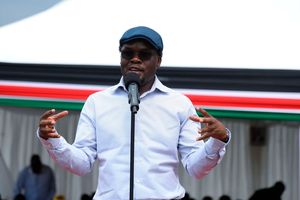
A joint parliamentary committee is set to mediate between the government and university lecturers over the implementation of the 2025–2029 Collective Bargaining Agreement (CBA), which has stalled learning in all public universities for three weeks.
The National Assembly’s committees on Education and Labour are scheduled to convene a meeting between the two parties following a petition by university lecturers seeking the intervention of the House to resolve the impasse.
In the petition, signed by representatives of the Universities Academic Staff Union (Uasu), the Kenya Universities Staff Union (Kusu) and Kudheiha, the unions want MPs to compel the National Treasury and the Ministry of Education to table an adequate counter-offer backed by a written, binding commitment guaranteeing exchequer funding for the new CBA.
The unions told the House that negotiations had reached a deadlock after the Inter-Public Universities Consultative Forum (IPUCCF), which represents the government, unilaterally settled on a counter-offer that does not adequately address the expanded components of the new agreement.
They want Parliament to compel the government to commit to settling the full Sh7.9 billion in outstanding salary arrears accumulated under previous agreements, including the 2017–2021 CBA.
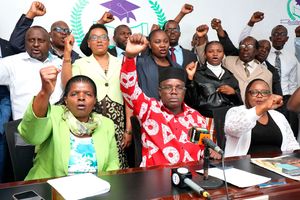
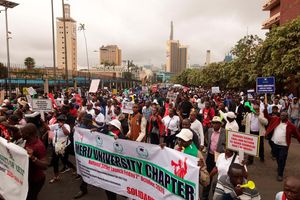
University staff went on strike on October 2 after the expiry of a seven-day strike notice, demanding that the government finalise, sign and implement the 2025–2029 CBA.
The unions have warned that the prolonged strike risks undermining the quality of university education and research, as well as the welfare of university employees.
“Unless urgent and appropriate action is taken to resolve the CBA dispute, establish a clear and sustainable funding framework, and provide adequate financial resources for public universities, the country faces the risk of a prolonged crisis in the higher education sector,” the petition reads.
The unions questioned why other CBAs covering sections of public university employees had been honoured by the government while the agreement covering lecturers remained unresolved.
Members of the Universities Academic Staff Union, led by Uasu Secretary General Constantine Wesonga (centre), protest in Nairobi on October 15, 2026.
Photo credit: Evans Habil | Nation Media Group
“The Collective Bargaining Agreements covering employees in other segments of public education were implemented in 2025, while employees of public universities have continued to await the conclusion and implementation of their CBAs, despite their equally important contribution to the national education system,” the petition reads.
On September 21, 2026, the Salaries and Remuneration Commission (SRC) told the unions that neither the Ministry of Education nor the National Treasury had provided a written commitment guaranteeing that the financial obligations arising from public university CBAs would be funded through the Exchequer.
“That disclosure raised serious concerns about the credibility and practical utility of the negotiations that had been taking place at Machakos University since 2025, given that the parties had no clear and binding commitment on the source of funding necessary to implement the agreements,” the unions told Parliament.
The unions also protested against the proposal to fund university staff salaries from students’ fees, arguing that other public university employees are paid through the Consolidated Fund appropriated by Parliament.
National Assembly Majority Leader Kimani Ichung’wah called on both parties to exercise restraint and give dialogue a chance to resolve the dispute.
“I want to call for sobriety from the lecturers and give dialogue a chance because it is our children who are suffering as they are unable to do exams,” Mr Ichung’wah said.
“In as much as there is a CBA and they are justifiable in their call demands for what is right, they must give sobriety a chance, and SRC must be on the table because it’s a constitutional right,” he added.
Funyula MP Wilberforce Oundo urged the government and striking lecturers to put students’ interests first.
“I sympathise with my former colleagues in the lecture hall. This is a CBA that has been implemented in piecemeal because this has become a ritual, as every year they stage a demonstration,” Dr Oundo said.
Tetu MP Godfrey Wandeto said the education sector had been affected by systematic underfunding arising from the new education funding model introduced by the Kenya Kwanza administration.