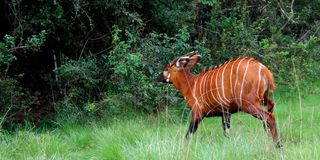
Four mountain bongos have been repatriated from the Czech Republic to the Mount Kenya Wildlife Conservancy, bringing the total population at the facility to 106.
The four males are expected to enhance the genetic diversity of the critically endangered mountain bongo population and boost ongoing conservation efforts.
The animals underwent a long journey travelling approximately 12 hours by road from the Czech Republic to Amsterdam, followed by an eight-hour flight to Nairobi, and a further 7-hour road trip to Nanyuki.
In the wild, the mountain bongo, scientifically known as Tragelaphus eurycerus isaaci is classified as critically endangered, with an estimated 66 individuals remaining in the wild as of 2025 down from 150 in 2021. It is listed in the International Union for Conservation of Nature (IUCN) Red List, showing the urgency of conservation efforts needed.
This translocation forms part of a broader conservation strategy aimed at restoring the species in its natural habitat and rebuilding sustainable population levels.
The exercise was witnessed by Prime Cabinet Secretary Musalia Mudavadi, Tourism and Wildlife Cabinet Secretary Rebecca Miano, Kenya Wildlife Service Director General Dr Erustus Kanga, and conservationist Humphrey Kariuki, who will serve as the custodian of the four bongos.
“The story of the Mountain Bongo is, in many ways, a reflection of our broader environmental reality. Once thriving across our montane forests—from the Aberdares to Mount Kenya, Mau, and Eburu—this iconic species now faces the stark reality of near extinction,” said Mudavadi while receiving the Mountain Bongos on Tuesday night.
“Today’s milestone, anchored in science, collaboration, and long-term planning, demonstrates the effectiveness of policy when matched with action. The Mountain Bongo Recovery Programme aligns directly with Kenya’s national biodiversity strategies, our climate action commitments, and the global Sustainable Development Goals,” Mudavadi added.
This operation forms part of the Mountain Bongo Recovery Plan 2026–2030, aimed at restoring the species in its natural habitat.
The operation was coordinated in close collaboration with the Kenya Wildlife Service, MKWC, and leading international conservation partners including the European Association of Zoos and Aquariums (EAZA). The selected animals were identified by conservation experts based on age, health, and genetic suitability, following more than a decade of coordinated breeding management.
Kenya Wildlife Service Director General Dr Erustus Kanga, said that the country aims to grow the number of mountain bongos and they provide close surveillance to make sure it happens.
"We have grown the number of the Mountain Bongos from under 50 in the last three years, and with the arrival of the four from abroad, we will seek to increase the numbers further from the current 102 plus the extra four to a bigger number in future," said Dr Kanga.
It is the first time mountain bongos have been returned from European zoological populations to Kenya as part of a structured rewilding programme.
Conservationists view it as a critical step in reversing decades of population decline driven by habitat loss and poaching, despite global progress in captive breeding efforts.
The animals were brought in using Air France Martinair Cargo which had a specialist air transport system that had been meticulously planned to navigate geopolitical and logistical challenges, alongside regular monitoring for animal welfare standards to ensure safe delivery to Kenya.
According to the Kenya Wildlife Service, any translocation of wildlife has to be using a multidisciplinary committee which includes; scientists, security personnel, protected area managers, Veterinary doctors, Capture personnel, trained boma or animal husbandry personnel where appropriate, Air Wing and other technical personnel will be co-opted on a need basis.
KWS guidelines indicate that every translocation of wildlife has to follow internationally accepted standards for animal welfare, as well as comply with the legislation, regulations and policies on animal welfare in Kenya.