For nearly half a century, Dr David Silverstein listened to some of Kenya’s most powerful hearts. But while medicine gave him access to presidents, Cabinet ministers and political secrets, he built his reputation through something less dramatic: an insistence that every patient, powerful or ordinary, deserved his time.
Dr Silverstein’s death on Sunday morning marks the era the American-born cardiologist who pioneered modern cardiology in Kenya and served as President Moi’s personal physician for many years. He was 82.
His death closes the remarkable story of a young Chicago doctor who came to Kenya intending to stay for only a few years but remained for more than half a century. In that time, as he recounts in his autobiography, he helped establish Kenya’s first cardiac catheterisation laboratory, trained generations of doctors and became one of the most trusted physicians in the country.
To most Kenyans, Silverstein was synonymous with “Moi’s doctor” and quietly and attended to the President for 42 years, taking him abroad for treatment disguised as visits. He also remained beside President Moi during his final illness.
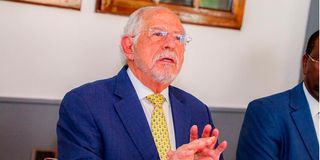
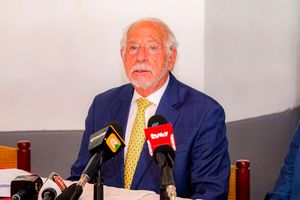
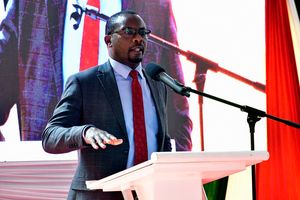
Consulting Physician Cardiologist Dr David Silverstein speaks to the media at Muthu Silver Springs Hotel in Nairobi on March 16, 2026.
Photo credit: Lucy Wanjiru | Nation Media Group
“To him, Mzee Moi was not merely a client,” Moi’s son Gideon said in a tribute. “He was a human being whose health, dignity and wellbeing mattered deeply to him.”
Born in Chicago in 1944, Silverstein grew up in a Jewish household headed by a father who was both a doctor and an ordained rabbi.
Silverstein was intellectually gifted and entered medical school early, graduating from the University of Chicago in 1967 at the age of 22.
He completed his residency in Seattle before serving with the United States Air Force in Taiwan. He later returned to Seattle for specialist training in cardiology.
When his fellowship ended in 1974, Silverstein considered three possible destinations: the South Pacific, Israel and Kenya. His principal requirement was that wherever he went should have, or be preparing to establish, a cardiac catheterisation laboratory.
As he later recounted, the University of the South Pacific offered the promise of island life but had no plans for such a laboratory. Israel appealed to him culturally and religiously, and Silverstein spoke Hebrew, but the promised facility at Ben-Gurion University was still some distance away. He also found the summer heat of Beersheba unbearable.
Kenya entered the picture through Dr Ashvin Patel, a Kenyan cardiologist whom Silverstein had met during his training. The University of Nairobi and Kenyatta National Hospital were preparing to establish a catheterisation laboratory and needed somebody to run it.
After months of silence, Silverstein received a telegram asking him to come almost immediately. He arrived in Kenya in 1974 and found both an opportunity and a country that would become his permanent home.
At Kenyatta National Hospital, Silverstein helped to establish and run the cardiac catheterisation laboratory, which allowed doctors to examine the heart and blood vessels using catheters and diagnostic imaging. At a time when specialised cardiac medicine was still in its infancy in East Africa, the laboratory represented an important technological leap.
Silverstein later headed the hospital’s cardiology unit and became a senior lecturer at the University of Nairobi’s medical school. He once remarked that, apart from the university’s first class of medical graduates, almost every subsequent early class had passed through his hands.
In 1977, he was appointed chief cardiothoracic physician to the Kenya government. That year also brought the patient who would define the public side of his career: Vice-President, Daniel arap Moi, who needed a medical examination. Moi’s secretary, a Mrs Smith, had telephoned Silverstein and asked whether he could see him.
“I told her I could see him any time at Kenyatta National Hospital,” Silverstein later recalled. “That is how we began our 42-year relationship.”
He recalled that when Moi visited the hospital, Silverstein’s superior, Professor Hilary Ojiambo, became suspicious of the young American Jewish physician attending to the Vice-President.
Jeremiah Kiereini, the powerful Defence permanent secretary, later telephoned Silverstein and told him that Ojiambo had raised fears that an agent of either the CIA or Mossad was treating Moi.
Kiereini dismissed the suspicion with the observation that both agencies belonged to friendly countries and that Silverstein had once saved his son’s life.
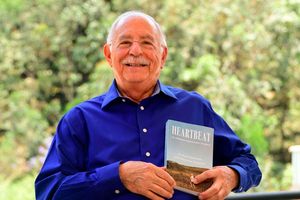
Dr David Silverstain with his memoir ‘Heartbeat: An American Cardiologist in Kenya.’
Photo credit: Pool
A few months later, Moi succeeded Jomo Kenyatta as President in August 1978, and Silverstein was formally appointed his personal physician in 1983. His duties went far beyond occasional consultations at State House. He travelled with Moi on presidential visits and was responsible for the President’s health wherever he went.
Silverstein accompanied Moi to China during the era of Deng Xiaoping. He joked that one of his tasks was to ensure that the President did not experiment with exotic dishes, including snakes and cats, or drink buffalo milk.
The association nevertheless developed into more than a clinical relationship. Moi and Silverstein discussed medical discoveries, international politics, Israel and the Old Testament. Silverstein sometimes used biblical stories to persuade the President to follow medical advice.
When he thought Moi was overworking himself, Silverstein invoked the story of Moses and Jethro. In the Book of Exodus, Jethro advises Moses not to carry every burden himself but to delegate responsibility. It was a language that the deeply religious Moi understood.
Moi was, according to Silverstein, a disciplined patient. Although he loved meat, he generally followed instructions about medication, diet and lifestyle.
At State House, Moi worried that the time Silverstein spent attending to him deprived other patients of the doctor’s services. Yet he rarely allowed Silverstein to leave without tea and conversation.
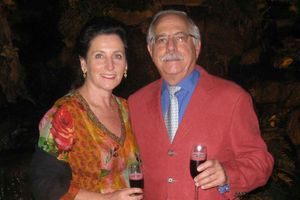
Their friendship extended into their private lives. Moi attended Silverstein’s wedding to Channa Commanday and participated in family occasions, including the birth and circumcision of one of Silverstein’s sons.
Career not without controversy
Silverstein also remained close to former Attorney-General Charles Njonjo, even after Njonjo’s spectacular political rupture with Moi. As a doctor, Silverstein managed to retain the confidence of both men without becoming publicly entangled in their rivalries.
His patient list reflected his unusual place at the intersection of medicine and power. He treated Njonjo and attended to Nelson Mandela when the South African leader became ill with pneumonia during a visit to Kenya in July 1990.
Silverstein later recalled encountering Mandela in a hotel corridor some two years after treating him. As others moved aside for the celebrated South African leader, Mandela recognised the cardiologist.
“Dr Silverstein, I’m still alive,” Mandela told him. “You’re a better doctor than you thought.”
Silverstein’s career was not without controversy. In 1999, he was taken to court by the family of Chief Justice Zacchaeus Chesoni following the judge’s death at the Nairobi Hospital.
Chesoni had been admitted under Silverstein’s care on August 24, 1999, complaining of pain in his left knee and neck. The initial diagnosis was gout, but his condition deteriorated and doctors later diagnosed pneumococcal meningitis. He died on September 5 after suffering cardiac complications.
Members of the Chesoni family accused Silverstein of failing to diagnose the illness promptly and leaving the Chief Justice in the hands of doctors they considered insufficiently qualified. The dispute threatened the cardiologist’s reputation and medical career.
Dr David Silverstein and wife.
The family’s complaint was initially investigated by the Medical Practitioners and Dentists Board. In February 2000, the board cleared Silverstein of allegations of infamous or disgraceful professional conduct. Chesoni’s daughter, Atsango Chesoni, challenged that decision in the High Court, effectively turning the medical dispute into a prolonged legal battle.
Silverstein maintained that Chesoni had received appropriate care from a team of qualified specialists. He had also requested a post-mortem examination to determine the precise cause of death, but the family declined.
In May 2005, the High Court dismissed the family’s appeal. Justices Philip Ransley and J.B. Ojwang found that Chesoni had received “the best medical care possible” and had been under the continuous attention of competent doctors. The court also ordered that the costs of the appeal be paid to Silverstein.
For the cardiologist, the case illustrated the hazards of treating the powerful: successful treatment attracted little attention, but the death of a prominent patient could bring public suspicion, professional proceedings and years of litigation. In his memoir, he described Chesoni’s death as the episode that left him fighting to save his medical career.
The case revealed the burden carried by physicians whose patients were prominent public figures. Success was often treated as routine; death brought scrutiny, accusations and demands for explanations.
Away from hospitals and State House, Silverstein cultivated an unexpectedly adventurous life. Despite having served in the Air Force, he feared flying. Convinced that the fear arose from his lack of control, he obtained a pilot’s licence.
He established a farm near Lake Naivasha, where he lived among cattle, horses, geese, dogs and other animals. He joked about jogging in the mornings alongside giraffes, zebras, impalas and warthogs, with the occasional buffalo adding an element of danger.
It was at the Nairobi Hospital that he met Commanday, a nurse practitioner. Their first date came after the August 1998 bombing of the United States embassy in Nairobi. They had spent the day helping to treat hundreds of casualties before going out to dinner. They remained together thereafter.
Silverstein was also a prominent member and leader of Nairobi’s small Jewish community. He was proud of his Jewish identity while equally regarding Kenya as home. He described himself as American, Jewish and Kenyan and spoke warmly about the country that had accepted him and allowed him to practise the kind of medicine he loved.
When Moi died at the Nairobi Hospital on February 4, 2020, Silverstein stood at Kabarak to eulogise the man he had treated for more than four decades. His tribute was brief, personal and occasionally humorous.
He recalled their conversations, Moi’s Christian faith and the glasses of sweet kosher sacramental wine that Moi sometimes shared with Silverstein, Njonjo and Cardinal John Njue.
Then Silverstein placed a Jewish prayer cap on his head and recited El Maleh Rachamim, the Jewish prayer for the departed, first in Hebrew and then in English.
It was an extraordinary conclusion to the funeral of a former African president and a reflection of the unusual friendship between a Christian statesman from Sacho and a Jewish doctor from Chicago.
“I miss him still,” Silverstein later wrote.
In 2023, he published his memoir, Heartbeat: An American Cardiologist in Kenya, written with Mary Anne Fitzgerald. It was both a medical memoir and an account of life close to power. Its title captured the two worlds he had inhabited: the physical heartbeat he had spent a lifetime examining and the political heartbeat of a country whose history he had quietly witnessed.
His greatest legacy was not simply that he treated a President. It was that, when Kenya desperately needed specialists, he came, established a cardiology service, taught young doctors and stayed.
The physician who spent his life caring for other people’s hearts has now taken his final bow. But his imprint survives in Kenya’s hospitals, in the doctors he trained and in the thousands of patients whose lives passed through his hands.