When police officers responded to reports of an accident on the Nairobi-Nakuru highway on September 21, they expected to assist injured persons before proceeding with the protocols for traffic incidents.
A private car heading towards Nairobi was overtaking other vehicles when it collided with a truck near Shiners Boys School.
The driver was nowhere to be found when police arrived. Upon searching the vehicle, the officers found seven sacks of cannabis whose total weight was later determined to be 241.5 kilogrammes. The drug had a street value of Sh7.245 million.
Later that day, police in the Kairi, Thika, mounted a roadblock. A motorcycle rider carrying a passenger had been flagged down but attempted to flee.
A speed bump just a few metres away aided the police officers as the rider was unable to keep his motorcycle steady when negotiating it. He eventually fell.
The unsealed package raised suspicion among officers, and a search of it turned up five rolls of bhang.
The police officers caught up with the man. Upon searching him, they found 300 rolls of marijuana. Another three kilogrammes of the drug wrapped in yellow packaging was strapped to the motorcycle seat. The rider was promptly taken into custody.
On the same day, police say, 26-year-old Bernice Achieng Otieno walked to Buru Buru Police Station and requested officers to deliver a loaf of bread to her boyfriend.
The officers say they obliged but later noticed the packaging had been unwrapped and did not have the seal attached to most loaves of bread.
That triggered an inspection, which revealed five rolls of marijuana and a matchbox hidden inside.
According to officers at the police station, more search uncovered additional seven rolls in her jacket pockets.
The three incidents on that day have contributed to seizures totalling 13.88 tonnes of marijuana across the country between January and September.
The drugs, held by the Anti-Narcotics Unit of the Directorate of Criminal Investigations (DCI), have a street value of Sh416.372 million.
Across Kenya’s arterial highways, border crossings and urban suburbs, law enforcement agencies are locked in an increasingly intense game of cat-and-mouse with evolving cannabis trafficking syndicates.
On September 26, officers at Kitui police station arrested a person after finding 69 rolls of bhang hidden in a parcel of rice meant for a remandee.
There was a near-identical tactic at Gilgil police station, Nakuru County, in 2022, where a woman was apprehended attempting to smuggle cigarettes and rolls of bhang stuffed in a loaf of bread to her detained husband.
Between January and September, responding anti-narcotics officers have arrested 1,661 people in connection with marijuana trafficking.
One in every 15 of those taken into custody was a woman, meaning the illicit trade is still male-dominated.
Of those arrested, some 1,552 were men and 109 were women. Thirteen of those apprehended were foreigners, police say.
Millions of grams of cannabis – valued at substantial amounts – are flowing into the country through highly organised cross-border routes, sophisticated concealment tactics and dense urban distribution networks.
Of the detected cases, only 112 had been finalised by courts during that time, underlining the strain placed on the justice system.
A parallel review of publicly reported police and media cases identified at least 60 major seizures between October 5, 2025 and October 5 this year.
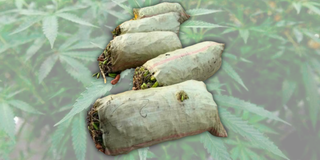
Gunny bags containing cannabis sativa disguised as sacks of bananas.
Photo credit: File | Nation Media Group
Police sources say the high-profile interceptions demonstrate that cannabis trafficking has evolved far beyond localised street-level peddling into large-scale highly structured commerce.
The primary pipeline supplying the growing domestic marijuana market runs through Western Kenya, with Uganda serving as a key regional source.
In one of the most dramatic operations during the period, authorities in Migori County impounded 1,137.8 kilogrammes of cannabis valued at an estimated Sh34.134 million on April 24, 2026. It happened after a trailer plunged into River Kuja.
On August 8, 2026, DCI officers raided a residential house in Busia town following a tip-off by locals. The officers reported finding 780.95 kilogrammes of cannabis stuffed in 15 gunny bags. The consignment, they said, was valued at Sh23.43 million.
Traffic along the Busia corridor trickles through transit hubs – including Kakamega, Lugari, Nandi, Elgeyo Marakwet and Nakuru – before reaching Nairobi, Mombasa, Thika, Nakuru and other major markets.
Notable seizures include a car intercepted in Kaimosi, Vihiga County, with 271.3 kilogrammes valued at Sh13.4 million; some 266.2 kilogrammes seized in Keiyo South, Elgeyo Marakwet County, on January 18, 2026; a total of 387 kilogrammes valued at Sh11.6 million found in a car in Nakuru on January 19, 2026; and some 59 kilos concealed under cassava sacks in a lorry in Busia on October 2, 2026.
While Western Kenya remains the main entry point, the country’s southern border points are equally active, as demonstrated on January 20, 2026, when police in Namanga, Kajiado County, intercepted a large consignment valued at Sh2.5 million on a bus that was heading to Nairobi from Tanzania.
Once in Kenya, the drug syndicates utilise long-distance trucks, private cars and public service vehicles to move the illicit cargo to distribution hubs in the Coast, Nairobi and Central Kenya.
The Coast-Nairobi highway has become an important artery, highlighted by the interception of a truck carrying 568.85 kilogrammes of cannabis valued at Sh17 million on October 8, 2025.
Coastal urban centres – particularly Mombasa, Kilifi, Kwale and Likoni – have emerged as markets and strategic storage points.
Security agents intercepted a lorry carrying 450 kilogrammes of marijuana valued at Sh12.15 million in Mombasa County on June 20, 2026.
On February 1, 2026, a total of 203.4 kilogrammes of cannabis valued at Sh6.1 million was seized in Jomvu from a trailer originating from Uganda.
More raids netted 142 kilos at a residence in Kilifi on May 20, 2026 and 170 kilogrammes in Likoni on April 25, 2026.
Nairobi remains the primary consumer destination and regional redistribution hub. Police operations in the capital target bulk drops and suburban packaging dens.
Interceptions have been reported in diverse neighbourhoods, including Nyamakima, where 90 kilos was found in a lorry on January 6, 2026; Ruai, where 187 kilogrammes valued at Sh5.6 million was seized on September 23, 2026; and Kibra, Korogocho, Umoja, Embakasi and South B.
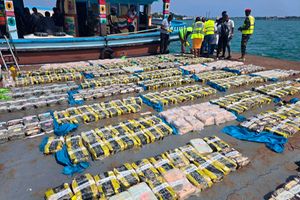
Police officers display of a consignment of bhang at Baharini Police Station in Eldoret City, Uasin Gishu County on August 26, 2025.
Photo credit: File | Nation Media Group
Beyond raw leaf material, government agents face a shift in consumption patterns – the proliferation of cannabis-infused edibles and processed derivatives.
Findings by the National Authority for the Campaign against Alcohol and Drug Abuse (Nacada) in its 2023 Five-Year Evaluation Survey and the 2025 University Students Report confirm a sharp increase in marijuana consumption, establishing bhang as Kenya’s most abused drug.
“Use surged by 90 per cent over five years, affecting more than 518,000 Kenyans aged 15 to 65, with Nairobi recording the highest regional prevalence at 6.3 per cent,” the 2023 Nacada report says.
Cannabis also registered the highest addiction burden, with 47.4 per cent of users suffering from severe substance use disorder.
The 2025 university report highlighted a shift from raw herbal leaf towards processed, cannabis-infused edibles – including cookies, cakes, candies and liquid sachets – targeting youth and urban populations.
Nacada attributed the surge to social media normalisation that masks the effects of drug use, coupled with affordability.
To counter these decentralised networks, the authority expanded real-time urban wastewater testing to track community usage and uncover secret production sites.
On July 14, 2026, officers raided residential houses in Kahawa Wendani and Kahawa Sukari, seizing 230 rolls alongside 12 sachets, 34 cookies and six cannabis cakes.
Similar infused products, cookies and packaged sachets were seized during police operations in Kahawa West on January 6, 2026, as well as Machakos and Kitengela, reflecting a growing market targeting youth and urban populations.
International air traffic has also been exploited by the syndicates as was observed when customs officers at Jomo Kenyatta International
Airport intercepted a two-kilogramme consignment sent from Bangkok, Thailand, disguised as latex cushions. Officials said the cannabis was valued at Sh300,000.
To bypass police checkpoints and urban surveillance, trafficking networks have adopted creative techniques.
Publicly reported cases detail shipments hidden in everyday items and commercial goods, such as 50 kilogrammes packed in domestic water tanks in Mathira, Nyeri County, in January; ten kilogrammes hidden in a commercial public-address system in Kirinyaga County in early
September and consignments buried under cassava sacks or disguised in parcels of rice in Kitui on September 26, 2026.
Traffickers routinely use briefcases, suitcases and travel bags or strap packages in buses. The audacity of traffickers extends beyond the highways into law enforcement facilities, leading to bizarre attempts to sneak bhang to individuals in custody.
The Anti-Narcotics Unit seized 33.8 tonnes of marijuana across Kenya last year. Police say the estimated street value of the drug is Sh1.015 billion.