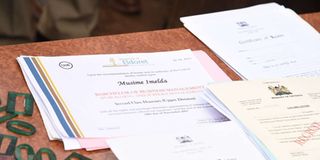
Less than two years to the 2027 General Election, the Ethics and Anti-Corruption Commission (EACC) is tightening the noose in its pursuit of public officials with fake academic papers and credentials.
The Nation has learnt that some top politicians currently in office and others aspiring to run for county and national seats in next year's polls may be blocked by the anti-graft body and the Independent Electoral and Boundaries Commission (IEBC), for presenting fake academic documents to secure positions.
Although some of the politicians were cleared to run in the 2022 polls, the anti-graft body has questioned the authenticity of their academic credentials and may recommend their disqualification from running for office over integrity issues.
Aspirants seeking to vie for various positions in the country, including the Presidency must undergo a dual clearance by the EACC and the IEBC to ensure compliance with integrity laws, before running for office.
Integrity Centre in Nairobi which houses the Ethics and Anti Corruption Commission offices.
Photo credit: Pool I Nation Media Group
EACC is responsible for enforcing Chapter Six of the Constitution, which dictates the leadership and integrity standards that should be met before an individual runs for public office.
According to EACC documents seen by the Nation, among prominent figures whose academic papers are facing scrutiny are two county governors (sitting and former), two sitting Members of Parliament and a County Assembly Speaker.
"We are already investigating some politicians for holding academic papers whose authenticity is questionable. They face disqualification from contesting if found culpable," revealed EACC Chief Executive Officer Abdi Mohamud.
"We will also step up the review of academic papers for various aspirants, to ensure they meet the integrity requirements of Chapter Six of the Constitution. No aspirant with questionable academic papers will be cleared to run for office," added Mr Mohamud.
The former governor, who is seeking to make a comeback in 2027, is suspected of forging a Kenyatta University degree certificate and using it to contest in the 2017 and 2022 elections.
The sitting governor, on the other hand, is on the spot for forging a master’s degree certificate, which he claims he acquired from a university in India.
One of the sitting MPs is alleged to have forged a degree in Electrical and Electronic Engineering from the Jomo Kenyatta University of Agriculture and Technology.
The other legislator also allegedly used forged academic papers, including a Kenya Certificate of Secondary Education (KCSE) certificate, to enrol for a Bachelor of Arts degree at a local university.
The county assembly speaker, who is eyeing a seat in next year's polls, is also facing a probe over suspected forgery of a Kenya Certificate of Secondary Education (KCSE) certificate.
The EACC has declared war on academic fraud, warning that aspirants who will present fake academic papers and credentials ahead of next year's polls risk being barred from running for office.
"This is a warning to all aspirants in next year's General Election. Fake academic papers will mean automatic disqualification from contesting for a seat and subsequent prosecution. We will work closely with the Independent Electoral and Boundaries Commission (IEBC), to make sure that only men and women who satisfy the integrity threshold are elected to positions of leadership in 2027," he added.
This comes when the EACC is pushing for constitutional and legal amendments ahead of the 2027 General Election, to block individuals convicted of graft and other integrity violations from running for political office.
If the National Assembly approves amendments proposed by the anti-graft body, several individuals convicted of graft and other integrity violations eyeing seats in the National Assembly, Senate and county assemblies may be blocked from running for political office.
The commission has already tabled proposals before the National Assembly, seeking amendments to key constitutional provisions that hinder the effective enforcement of integrity requirements for candidates seeking elective office.
EACC is seeking an amendment to sections of the Leadership and Integrity Act to ensure that individuals convicted of graft or any integrity issue remain disqualified from running for office until their conviction, sentence, or decision is successfully overturned on appeal or review.
The proposal seeks to reverse the current practice where pending appeals allow convicted politicians to vie for office.
Currently, the Constitution provides that a person is not disqualified from contesting an election by virtue of having been convicted or found, in accordance with any law, to have misused or abused a State or public office, or to have contravened Chapter Six, unless all avenues of appeal or review have been exhausted.
However, the EACC now describes this as a ‘backdoor’ that undermines ethical leadership.
According to EACC CEO Abdi Mohamud, the current legal framework allows individuals who have been convicted or found to have violated the Constitution or the law to remain eligible for clearance as long as they demonstrate that an appeal or review is pending.
As a result, such individuals may also continue holding public office while pursuing appellate or review processes.
While appearing before the Constitutional Implementation Oversight Committee of the National Assembly recently, to make submissions on the implementation of Chapter Six of the Constitution and its relationship with provisions on representation under Chapter Seven, the EACC boss said that although the presumption of innocence applies until a person is found guilty, the burden should shift to the convicted person to overturn the decision through the appellate process.
The proposal would require amendments to Article 99(3) and Article 193(3) of the Constitution of Kenya, which the commission says currently pose a significant obstacle to enforcing ethical, moral, and integrity standards for candidates in elections.
"The two provisions should be amended so that the person remains disqualified until the conviction, sentence or decision has been successfully appealed against or reviewed. This is because the presumption of innocence remains until one has been found guilty of an offence, whereupon the burden shifts to the accused to demonstrate otherwise through the appellate or review procedure," explained Mohamud.
"Further, persons who have been convicted or found to have violated the constitution will always abuse the constitutional provision by filing an appeal or review, circumventing the integrity requirements," he added.
Parliament buildings in Nairobi.
Photo credit: File| Nation Media Group
Mohamud told the parliamentary committee that the commission had previously raised the issue in several forums, including the Building Bridges Initiative (BBI), the National Dialogue Committee (NADCO), and various parliamentary committees.
However, he revealed that no national initiative had been undertaken to address the matter.
In the run-up to the 2022 elections, several politicians were allowed to run for office despite having criminal convictions or active court cases.
For instance, Sirisia Member of Parliament John Waluke was allowed to defend his seat despite a 2020 conviction for forging documents and a 67-year prison sentence.
At the time, EACC flagged 241 candidates with integrity concerns, but only five were ultimately barred from running for political office.
In addition, the commission, through a memorandum to the Constitutional Implementation Oversight Committee of the National Assembly, has proposed amendments to Section 13(2) of the Leadership and Integrity Act to clarify EACC's role in vetting candidates seeking election to public office.
The commission says that the Act is currently silent on the responsibilities of the IEBC regarding the handling of self-declaration forms and the role of EACC, which is mandated to oversee and enforce compliance with integrity laws.
The EACC has recommended amendments to the law to introduce statutory timelines for integrity verification and establish a formal institutional framework for information sharing among agencies that hold relevant data on candidates.
"The IEBC submits details on candidates with a very short window for the verification exercise. The law should provide clear timelines within which the IEBC shall submit the details for candidates, and the time which EACC and other institutions with relevant information shall submit the verification reports. The timelines should also apply to by-elections," states EACC in the memorandum.
According to the commission, this would strengthen collaboration, coordination, and the timely exchange of information with the IEBC during the clearance and registration of candidates.
"It is important for all stakeholders who play various roles in ensuring the integrity of candidates in the General Election to collaborate and coordinate their strategies for synergy. This will be vital to the electoral preparedness as we move towards the 2027 General Election, and to ensure that only those men and women who satisfy the integrity threshold get elected to positions of leadership,” he said.
EACC has, in the recent past, stepped up its fight against academic fraud, indicating that it had received over 549 cases of forged academic and professional certificates since 2022, with investigations leading to multiple prosecutions and recovery of salaries irregularly earned.