More than 30,000 secondary school, Special Needs Education (SNE) and vocational training teachers will undergo mandatory refresher training in December as the Ministry of Education races against the clock to prepare for the transition of 1.1 million Grade 9 learners to Grade 10 in January 2026.
The intensive training, scheduled from December 1 to December 19, 2025, targets educators from 9,626 secondary, special needs and vocational institutions.
It will cover all 55 learning areas and the three specialised pathways under the Competency-Based Education (CBE) Senior School framework.
“TSC has planned the retooling of senior school teachers in Competency-Based Education (CBE) with effect from December 1 to December 19, 2025. The retooling will be done face-to-face in selected suitable venues and/or procured venues in the county,” said Dr Reuben Nthamburi, TSC Director for Teacher Professional Management, in a circular to educators.
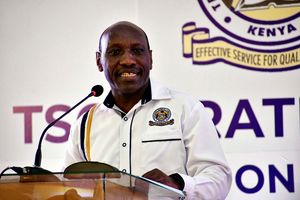
Teachers Service Commission Director of Teacher Professional Management Dr Reuben Nthamburi.
In senior school, learners will be required to take seven subjects, four of which will be compulsory, in line with recommendations from the Presidential Working Party on Education Reforms (PWPER).
The four compulsory subjects include English, Kiswahili, Core Mathematics/Essential Mathematics, and Community Service Learning (CSL).
Some of the optional subjects in senior school include Music and Dance, Theatre and Film, Business Studies, Geography, Biology, Chemistry, Physics, General Science, Agriculture, Computer Studies, Home Science, Aviation, Building Construction, Electricity, Metalwork, Power Mechanics, Woodwork, Media Technology, and Marine and Fisheries Technology.
According to the Ministry of Education, the training aims to equip teachers to deliver the specialised pathways chosen by the transitioning cohort.
The teachers will receive instruction in specialised pathways, including Science, Technology, Engineering and Mathematics (STEM), Social Sciences, and Arts and Sports Science, aligning with the Senior School structure introduced under the CBE framework.
The Teachers Service Commission (TSC) will spearhead the training, which will be conducted face-to-face using a smart cascade model in selected venues across the counties.
Experts from the Kenya Institute of Curriculum Development, Kenya National Examination Council, Centre for Mathematics, Science and Technology Education in Africa (Cemastea), Ministry of Education, Kenya Institute of Special Needs (KISE), and Teachers Training Colleges will also support the sessions.
The multi-agency team includes officials from KICD, KNEC, and CEMASTEA. The sessions will be residential for teachers in ASAL areas and those specialising in SNE.
“The target participants for retooling are teachers currently teaching in secondary schools, regular, Special Needs and vocational institutions. The teachers will be clustered according to the subjects in the pathways, including Social Sciences, Arts and Sports, and Science, Technology, Engineering, and Mathematics (STEM),” added the TSC official.
The training will be residential for educators in ASAL regions and SNE teachers, who will be clustered according to their areas of specialisation, for instance, Hearing Impaired, Visually Impaired, among others.
This final push targets the remaining 10 percent of teachers who have not yet undergone CBE training, supplementing the more than 300,000 already trained. Teachers from private schools have also been invited.
“We have done a lot of retooling to support CBE. So far, we have trained more than 300,000 teachers, and the remaining about 10 per cent will be trained in December,” said TSC Chairperson Jamleck Muturi during the Kenya Primary School Heads Association (Kepsha) annual delegates’ conference in Mombasa.
Teachers Service Commission (TSC) Commission Chairman Jamleck Muturi.
Photo credit: File | Nation Media Group
The teacher training comes amid a race to address severe infrastructure and staffing gaps ahead of the January transition.
President William Ruto has ordered the Ministry of Education to fast-track the construction of 1,600 new laboratories, especially in remote schools. This directive addresses critical infrastructure deficits to ensure 100 percent transition readiness.
“My instruction to the Ministry is to expand laboratories by another 1,600, especially in schools in remote areas. It is not right that a student comes to do an exam in a laboratory for the first time they are entering one,” Dr Ruto said on November 18, 2025, emphasising equity in education.
He also addressed reforms in higher education, noting that universities will admit the first cohort of Competency-Based Education and Training (CBET) graduates in 2029.
Education stakeholders, including Kepsha and the Kenya Human Rights Commission (KHRC), have stressed the importance of fast-tracking laboratory construction to ensure children in rural areas receive the same quality of education as those in urban areas.
“Some schools, especially in rural areas, lack laboratories, which is crucial for CBE. We want equity: a child in a rural area must get the same education as the one in an urban area,” said Mr Cornelius Oduor of KHRC.
The facilities are critical as the 1.1 million Grade 9 candidates transition to Senior School in January 2026.
Currently, more than half of the learners who sat the Kenya Junior Secondary Education Assessment (KJSEA) have chosen the STEM pathway. About 437,000 chose Social Sciences, while 124,000 opted for Arts and Sports.
Learners will be placed in Senior School based on their preferred pathway, subject combinations, and performance.
The 9,603 public secondary schools have been categorised as C1 schools (national schools): Offer all three pathways, including STEM, Social Sciences, and Arts and Sports, and C2 (Extra County), C3 (County), and C4 (Sub County/Day schools): Offer fewer options depending on capacity and facilities.