The Office of the Auditor General has exposed shocking fraud that saw 33 non-existent schools receive billions of shillings in the past four years, even as schools teeter on the brink of closure due to underfunding that has piled up to Sh117 billion.
Auditor-General Nancy Gathungu, in a special audit on capitation and infrastructure grants in schools submitted to the Public Accounts Committee (PAC) of the National Assembly, paints the picture of wanton theft and glaring dysfunction in the funding of free primary and secondary education.
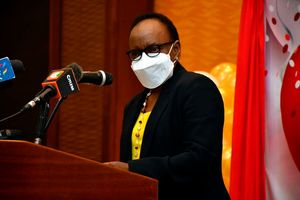
Auditor-General Nancy Gathungu during a past event.
Photo credit: File | Nation Media Group
Presenting the special audit before PAC, the director of audit in the Office of the Auditor General (OAG), Mr Justus Okumu, revealed that some ghost schools had fraudulently received Sh3.7 billion capitation as others struggle to remain open due to a biting cash crunch.
“The main problem facing public schools is underfunding because the Ministry of Education comes up with the budget for various activities for the schools that is always scaled down.
Some of the activities end up being shelved or are undertaken but end up being pending bills,” said Mr Okumu “The ghost schools are in the system, but when we got to the ground we did not find them.”
“They are getting the capitation fees but the education officers could not show us where they exist,” he added.
The fraud, executed between the financial years 2020 and 2024, was revealed even as it emerged that public schools remain underfunded to the tune of Sh117 billion, secondary schools being the most underfunded at Sh71 billion, junior schools Sh31.98 billion, primary schools Sh14 billion and Sh67.1 million for secondary schools’ special needs education.
The audit faulted the capitation model used to disburse the public funds, terming it un-equitable for the country.
The special audit concluded that the current allocation per learners, based on the funding model, does not factor in the varying needs and circumstances of the learners and schools.
“The capitation model therefore is not equitable,” the special audit states.
The Public Accounts Committee directed the Office of the Auditor-General to table details of the ghost schools that benefited from the fraudulent capitation remittances.
The audit challenges the National Assembly to tighten the monitoring of funds sent to schools, as it raises concerns over the mixing up of funds.
This is after it was established that three secondary schools that received capitation totalling Sh103.3 million operated a single school bank account.
The commingling of funds, the audit report says, diminished the accountability achieved from the segregation of the funds into tuition and operations bank accounts.
Following the revelations, the committee has summoned Basic Education Principal Secretary Julius Bitok to shed light on the Auditor-General’s expose.
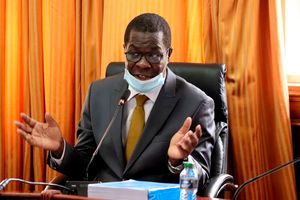
Basic Education Principal Secretary Julius Bitok addresses participants during the launch of the Educational Assessment Resource Centre at New Mitihani House, Nairobi on July 4, 2025.
Photo credit: Bonface Bogita | Nation Media Group
“We have written to the ministry, asking them to appear here and provide details,” said Butere MP Tindi Mwale, the PAC chairperson.
The special audit has flagged ghost students in 723 schools out of the 1,039 sampled schools.
This was unmasked through variances between the actual number of students enrolled and those registered under the National Education Management Information System (Nemis).
Of the Sh3.7 billion fraudulent transfers, a staggering Sh3.5 billion was overfunded in secondary schools, Sh30.8 million in Junior Secondary Schools (JSS) and Sh79.4 million in primary schools.
The audit shows that each of the 83 schools sampled, 33 were non-existent, exposing massive irregularities in the Nemis’ distribution of grants to various schools as well as irregular supply of books.
Funyula MP Dr Wilberforce Oundo, a member of PAC, claimed that Nemis was designed to disenfranchise some sections of the country and “that is why there are many cases where the numbers of students in Nemis is half of what is in schools.”
“We also want to know the ghost schools, and this heartless public officer who pressed the button to send money to the ghost schools. Action must be taken against that officer,” demanded Dr Oundo.
Chepalungu MP Koech Mandazi claimed that the ministry is geared toward doing business rather than providing services.
“It is because of this that there are cases where they have failed to register schools and are still being funded,” said Mr Mandazi.
The audit further shows that 14 schools received capitation of Sh16.7 million yet they did not appear in the County Director of Education (CDES) records and that the CDES were not aware of their existence.
Some other six schools that had ceased operations due to various actions by the government, received capitation of Sh889,348 during the period under review.
This notwithstanding that the Ministry of Education had indicated that funds disbursed to four out of the six schools had not been utilised and were still being held in the respective bank accounts.
About 13 schools with capitation of Sh11.02 million had registered names that differed with those captured in the Nemis.
The audit also shows that 14 schools in the capitation data whose 'Date Created' was after the period in which they appeared in the capitation disbursement data.
Of the 14 schools, one school received capitation of Sh6.4 million before the 'Date Created' while the other 13 schools were in the capitation disbursement data but did not receive capitation.
The report further says that a review of data in the Nemis revealed that there were variances in the sets of data maintained by the State Department for Basic Education- Nemis, the Teachers Service Commission, the Kenya National Examinations Council and the Kenya Primary School Education Assessment systems in 32 counties.