As over 3.6 million candidates prepare to sit national examinations and assessments, the exercise has entered a critical phase, with pressure is mounting on the schools and teachers to deliver credible results against a background of funding shortfalls and a boycott threat by a union.
Candidates registered for the Kenya Certificate of Secondary Education (KCSE) were taken through rehearsals on October 15, marking the beginning of the final stretch. Oral and practical examinations are scheduled to start on Monday, October 19 2026, while the large candidature KCSE papers will run from November 2 to November 20 2026.
Candidates sitting the Kenya Primary School Education Assessment (KPSEA) and Kenya Junior School Education Assessment (KJSEA) will begin their assessments later in the month.
The exercise is expected to involve approximately 3.6 million candidates across the three assessment levels, placing substantial demands on schools, teachers and the government to ensure that examination materials, personnel and facilities are available throughout the exercise.
But behind the examination timetable is a financial and labour dispute that threatens to complicate preparations, with school heads struggling to meet operational costs even as teachers demand better remuneration for administering and marking examinations. Unpredictable weather during the examination period poses another challenge for the administrators.
For school principals, the immediate challenge is finding money to provide the materials required for practical examinations, at a time when government funding for the academic year fell short of expectation and needs.
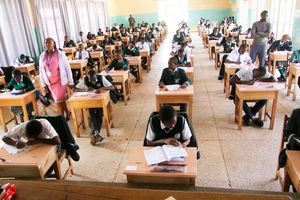
Examination invigilators at Kisian Secondary School in Kisumu County during a KCSE examination rehearsal on October 16, 2026, ahead of the national examinations set to begin on October 19.
Photo credit: Alex Odhiambo | Nation Media Group
“Everything is bought on credit. We have to purchase materials and laboratory supplies for practical examinations, but where is the money? There are suppliers who depend on us to pay them, and we have expenses that must be met whether the money is available or not. Even if we received 100 per cent of the expected capitation, it would still not be enough,” said a principal in Nairobi.
“During this period, learners still have to eat and be comfortable in school. We have borrowed from suppliers to keep schools running, and now even moving around to attend to school matters has become a problem because we have no money,” said another principal in Nairobi.
The chair of the Kenya Secondary Schools Heads Association, Willy Kuria, said national examinations bring additional costs that schools must meet despite inadequate capitation.
“We have to buy materials and laboratory supplies for practical papers, but where is the money? Salaries and other essential bills must be paid whether the money is available or not,” Mr Kuria said.
He said some schools were relying on suppliers to provide chemicals and equipment on credit, hoping to settle the bills when more funds become available, while others were turning to parents who were already struggling financially.
In September, school heads reported a shortfall of about Sh8,000 per learner against the annual allocation of Sh22,244 for public secondary schools.
According to the Ministry of Education, schools should receive the Sh22,244 per learner in three tranches at the ratio of 50:30:20 across the three terms (Sh11,122, Sh6,673 and Sh4,449).
Langalanga Senior Mixed School Principal Peter Muchiri displays an approved electronic calculator to Form Four candidates during a Kenya Certificate of Secondary Education examination rehearsal conducted by Kenya National Examinations Council officials on October 16, 2026.
Photo credit: Boniface Mwangi | Nation Media Group
However, earlier figures provided by the Kenya Secondary Schools Heads Association (KESSHA) showed that schools received less than their expected allocations in the first two terms, creating funding gaps that have carried into the final term.
However, in the first term, schools received Sh6,577 per learner, alongside Sh1,375 retained by the government, bringing the total allocation to Sh7,952. This represented a shortfall of Sh3,170 per learner.
In the second term, schools received Sh4,852, with a further Sh285 retained, bringing the allocation to Sh5,137, leaving a deficit of Sh1,536.
A July 28 circular subsequently indicated a third-term allocation of Sh3,367.60 per learner, representing a further gap of Sh1,081.40.
The cumulative shortfall per learner for the year is Sh5,787.40, assuming the third-term allocation was released as indicated.
At the same time, the Kenya Union of Post-Primary Education Teachers (Kuppet) has directed its members to stay away from examination administration, supervision and marking until their concerns are addressed.
The union is demanding a minimum daily payment of Sh4,000 for examination supervisors and related officials, as well as at least Sh100 for marking each examination paper.
Kuppet Secretary-General Akello Misori has called on teachers not to accept examination assignments until an agreement is reached on their remuneration.
“We are asking our members to sit back and not participate in any exam conducted by the Kenya National Examination Council,” Mr Misori said.
The reported rates for examination duties vary according to responsibility. Supervisors earn between Sh630 and Sh680 a day, centre managers between Sh500 and Sh550, and invigilators between Sh430 and Sh510. Payments for marking individual scripts generally range from Sh35 to Sh75, according to reporting on the dispute.
Examination supervisor Julius Oyola takes candidates at Kisian Secondary School in Kisumu County through examination procedures on October 16, 2026, ahead of the Kenya Certificate of Secondary Education examinations.
Photo credit: Alex Odhiambo | Nation Media Group
Kuppet argues that the rates do not adequately reflect the workload, responsibility and time teachers spend away from their regular stations. It has also raised concerns over accommodation and welfare at marking centres, including reports of overcrowded dormitories and inadequate sleeping arrangements.
In Murang’a County, 30,000 KCSE candidates are expected to sit their exams under enhanced security measures, County Director of Education Philip Wambua has said.
Form Four candidates at Langalanga Senior Mixed School in Nakuru County follow proceedings during a Kenya Certificate of Secondary Education examination rehearsal conducted by Kenya National Examinations Council officials on October 16, 2026.
Photo credit: Boniface Mwangi | Nation Media Group
County Commissioner Hassan Bule said the County Security and Intelligence Committee had put measures in place to secure candidates, examination officials and materials, and respond to emergencies.
He added that candidates sitting exams in hospitals would be accommodated, while transport and relocation plans had been prepared for schools in areas prone to heavy rains and landslides to ensure no candidate misses the examinations.
In Mama Ngina Girls High School, principal Mwanahamisi Omar said all 274 candidates were in school, and the institution was prepared for the exams despite forecasts of El Niño rains.
At Shimo La Tewa High School, principal Mathew Mutiso said 427 candidates would sit the exams, up from 413 last year, adding that the school was ready and faced no challenges.
Nakuru County Director of Education Victoria Mulili said 48,038 candidates would sit the examinations across 485 centres, with all candidates accounted for.
She said examination papers had been secured in 17 containers awaiting dispatch, while supervisors, invigilators, centre managers and standby police officers had been deployed to curb cheating and ensure a smooth exercise.
In Bomet, County Director of Education Leonard Ngugi reported no incidents during Friday’s rehearsals but said he was yet to receive the consolidated number of candidates from sub-counties.
Additional reporting by Mwangi Muiruri, Winnie Atieno, Mercy Koskey, Vitalis Kimutai And Joseph Openda