Education stakeholders have reacted in fury to the announcement by the government that it cannot fully fund the free education programmes and warned of a looming crisis in the country’s basic education sector following a reduction in government capitation for learners.
In view of the announcement by Treasury Cabinet Secretary John Mbadi, the Kenya Secondary Schools Heads Association (Kessha) asked the government to make “a clear pronouncement allowing cost-sharing with parents in view of the significantly reduced capitation disbursement”.
“Kessha urges the government to make a clear pronouncement allowing cost-sharing with parents in view of the significantly reduced capitation disbursement. School heads are currently in a dilemma, expected to run institutions without adequate resources while being restricted from engaging parents meaningfully in bridging the shortfall. This is unsustainable,” said Kessha chair Willy Kuria.
He also called on the government to provide a special grant to cover the deficits schools accrued, since they made financial commitments based on the promise of full capitation.
“Even when the capitation stood at Sh22,244, it was still insufficient, having been set over eight years ago and not adjusted for inflation and increased operational costs. The real value of this amount has been severely eroded, making it increasingly difficult for schools to provide quality education under the current circumstances,” Mr Kuria said.
If effected, it would see parents pay more money in school fees to bridge the financial gap. This raises questions about the constitutional requirement for free and compulsory basic education.
While appearing before the National Assembly Education Committee on Thursday, Mr Mbadi admitted that the government is unable to fully fund the Free Primary Education (FPE) and the Free Day Secondary Education (FDSE) programmes. Under FPE, each learner is entitled to Sh1,420, those in junior school Sh15,042 and secondary school learners Sh22,244.
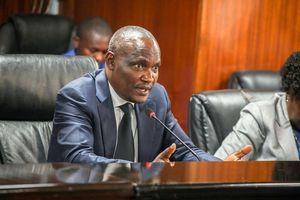
National Treasury Cabinet Secretary John Mbadi (left) with Education Cabinet Secretary Julius Ogamba when they appeared before the National Assembly Committee on Education at Bunge Tower in Nairobi on July 24, 2025.
Photo credit: Dennis Onsongo | Nation Media Group
Mr Mbadi revealed that the capitation for secondary school learners has dropped from Sh22,244 per year to Sh16,428, leaving a funding gap of Sh5,340 per student. This has left schools burdened by debts owed to various suppliers as well as unpaid salaries to their non-teaching staff. The move has triggered fears of increased school dropouts and a weakening of the free basic education policy.
The National Parents Association (NPA) warned that cuts in government funding to schools could spark a new crisis in the education sector, potentially forcing thousands of learners out of class. NPA chair Silas Obuhatsa said many parents are unable to shoulder the funding gap due to economic hardships.
“This news shocked parents. The funding has been reduced at a time when many are still recovering from job losses and income cuts. Instead of decreasing the amount, the government should have increased it. Parents are still struggling with the effects of Covid-19. Many have not recovered economically. This reduction is likely to affect children, especially in rural areas, where parents can’t raise extra funds,” said Mr Obuhatsa.
“There are already many children out of school. This gap will only make things worse. We are seeing the burden of running schools being slowly pushed onto parents. Sh5,000 is enough to make children drop out of school. That little money makes all the difference especially in rural areas. Now that the government has reduced capitation, you can expect the dropout rate to rise,” he said.
The Kenya Teachers in Hardship and Arid Areas Welfare Association (Kethawa) warned that the budget cut threatens to push children from marginalised communities out of school.
“Schools in hardship areas are still experiencing immense difficulties. The cost of living has gone through the roof. So when you cut the little money we rely on to run schools, you’re not just creating a crisis, you’re condemning these children to a cycle of poverty and illiteracy,” said Evelyn Naitasili, the acting national vice chairperson of Kethawa.
The Education Stakeholders Association of Kenya's National Secretary, Ndung’u Wangenye, urged the government to convene an urgent national dialogue to address the school funding challenge.
Akelo Misori, the secretary-general of the Kenya Union of Post Primary Education Teachers (Kuppet), criticised the government for failing to address the funding gap in secondary education and warned against shifting the responsibility to already burdened parents.
“It is not going to be easy for us to talk about this because the government cannot present capitation to schools, so parents should be ready to pay next term,’’ said Misori.
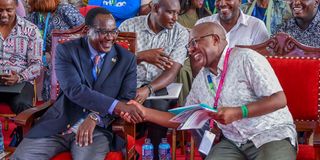
Education Cabinet Secretary Julius Ogamba (center) with his Principal Secretary Prof Julius Bitok (left) and the national chairman of Kenya Secondary Schools Heads Association Willie Kuria during the 48th Annual National Conference for Kenya Secondary Schools Heads Association in Mombasa on June 25, 2025.
Photo credit: Kevin Odit | Nation Media Group
Meanwhile, the Cabinet Secretary for Education, Julius Ogamba, denied that the government has scrapped free education but had only adjusted the capitation amount due to budgetary constraints.
“We are still at Sh22,244 but because of limitation, we divide that amount and it comes down and we were saying the last year at 16,000. This year, it will probably be slightly higher. So, what I am trying to tell you is the government has not changed the policy of financing free education. I saw someone saying we are killing the dream. We are not, because we actually we have many more students coming through our institutions than before,” said the CS.