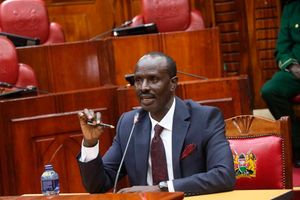
Former Knut Secretary-General Wilson Sossion.

A Sh72,000 payment has emerged at the heart of former Kenya National Union of Teachers (Knut) secretary-general Wilson Sossion’s failed bid to return to the union’s top office, with the court ruling that the money did not restore his membership.
Mr Sossion, now serving as a member of the Teachers Service Commission, sued on March 2026, challenging his exclusion and arguing that the payment of his union dues made him eligible to contest the Secretary-General position in the April 2026 elections.
But the Employment and Labour Relations Court has dismissed his petition after finding that paying the dues did not revive his membership or override Knut’s constitutional requirements for eligibility.
“The provisions of section 31(1) and (4) (a) of the Labour Relations Act did not grant the first petitioner the absolute right to contest for the position of the Secretary General," said Justice Jacob Gakeri.
He sued alongside Martha Omollo, a Knut member and teacher at Harambee School in Nairobi, who was also challenging her exclusion from the race for Deputy Secretary-General.

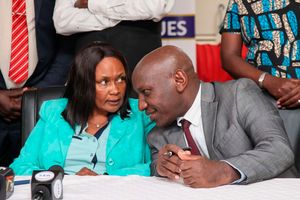
Kenya National Teachers Pressure Group spokesperson Martha Omollo addresses journalists in Nairobi on October 4, 2021.
The dispute began after Mr Sossion wrote to Knut Secretary-General Collins Oyuu on February 18, 2026, expressing interest in contesting the union’s top position.
He had paid Sh72,000 into Knut’s KCB account on November 7, 2025, covering dues he said ran from July 2022 to June 2026. The union later returned the money on December 31 without explanation, according to his petition.
Mr Sossion made another payment on February 27, 2026, and sent the deposit slip to the union. He argued that this made him compliant with Section 33 of the Labour Relations Act.
The union disputed that position. Mr Oyuu said the payment could not make Mr Sossion eligible because Knut’s constitution did not provide for such a payment to restore membership.
The union also said membership was tied to registered teachers, whose subscriptions were ordinarily deducted from salaries through the check-off system.
The union further argued that Mr Sossion had ceased to qualify for membership after the Teachers Service Commission removed his name from the register of teachers following his nomination to Parliament in 2017.
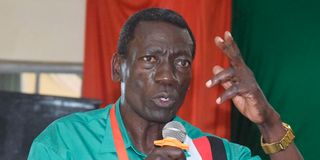
Kenya National Union of Teachers secretary general Collins Oyuu.
His employment as a teacher was later terminated, and his name was removed from the teachers’ register through a 2019 Gazette notice.
In February 2026, the Court of Appeal found that the procedure used to terminate his employment did not comply with teachers’ regulations. The appellate court, however, did not restore his name to the teachers’ register.
The Knut dispute turned on whether Mr Sossion could rely on Section 31(4)(a) of the Labour Relations Act after leaving teaching. The provision states that a general secretary of a trade union “may be a person not engaged or employed in the sector concerned.”
Mr Sossion argued that this allowed him to contest despite no longer being a registered teacher.
Knut maintained that Mr Sossion still had to meet the membership and eligibility requirements set out in the union's Constitution, revised in February 2022, which restricted membership to persons meeting its prescribed requirements, including registration as teachers.
The court agreed with Knut on the relationship between the law and the union constitution.
The judge quoted Section 34 of the Labour Relations Act, which provides that “the election of officials of a trade union, employers’ organisation or federation shall be conducted in accordance with their registered constitutions.”
The court said Section 31(4)(a) did not give Mr Sossion an automatic route into the contest.
"He still had to contend with the provisions of the Constitution of the union. This is because trade unions are associations of members who agree on how to govern themselves as mandated by the Constitution, provided they act in accordance with the law. Neither of the Petitioners ' evidence demonstrated how their rights were violated by the Respondents or any of them," said the court.
The court also considered the case of the second petitioner, Martha Omollo, a teacher at Harambee School in Makadara, Nairobi.
Ms Omollo had contested for Nairobi Branch Executive Secretary on March 17, 2026, but lost. She then sought to contest for Deputy Secretary-General.
Knut said she had not shown that she was an elected or designated branch delegate. The court agreed that she provided no evidence establishing that status.
“The second petitioner provided no evidence of being an elected official of the union or designated delegate,” the court said.
The union proceeded with the April 3 elections because there was no order stopping the exercise, where Mr Oyuu was re-elected as secretary-general unopposed at the polls held in Kisumu. The court noted the offices had been filled.
The court said “all other issues having been overtaken by events”, only the interpretation of Sections 31 and 34 remained for determination.
Follow our WhatsApp channel for breaking news updates and more stories like this.