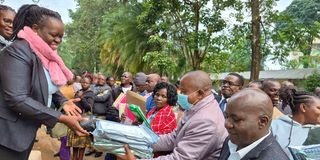
Teachers have been praised for their role in the administration of the Kenya Junior School Education Assessment.
In the new competency-based assessment (CBA) model, teachers play a significant role in the administration as well as marking and reporting the performance to the Kenya National Examinations Council (Knec).
A total of 176,628 teachers were actively engaged in the administration of the 2025 KJSEA. Of these, 24,277 served as centre managers, 26,632 as supervisors, and 125,719 as invigilators. Teachers also played a pivotal role in stage-based assessments for learners with profound disabilities who are unable to follow the regular curriculum.
Education Ministry releases KJSEA results
Dr David Njengere, the Chief Executive Officer of Knec, acknowledged the invaluable role teachers have played in implementing the CBE.
“Teachers were instrumental in preparing learners for the pioneering KJSEA. They guided students through a curriculum that emphasizes practical skills, critical thinking, and individual competencies. This is a clear indication of their commitment to nurturing holistic learners who can excel beyond traditional examinations.” Said Dr Njengere.
The acting CEO of the Teachers Service Commission (TSC), Eveleen Mitei, noted that the success of the assessment was anchored on teachers’ professionalism and dedication.
“During this exercise, a total of 176,620 teachers supported the administration of KJSEA. 24,277 were managers, 36,617 were supervisors, and 105,719 were invigilators. We equally recognise all teachers who participated in the school-based assessments nationwide. Their unwavering commitment made this milestone achievement possible,” she said.
Beyond examination administration, teachers were central to ensuring the credibility and integrity of the assessment. The KJSEA is the first of its kind to assess learners at the end of junior school under the CBE, tracking performance through formative and summative assessments, including projects, multiple-choice questions, essays, and short structured responses.
The approach requires teachers to not only administer assessments but also mentor learners to showcase their individual strengths and competencies at different stages of learning.
In preparation for the transition to senior school, teachers are also being retooled through joint initiatives by the Ministry of Education and TSC. This involves training teachers on new frameworks, guidelines, and assessment tools to ensure seamless delivery of education under the CBE system. Dr Njeng’ere emphasised that teachers’ continuous professional development is critical to sustaining the quality of education and preparing learners for the challenges of the 21st century.
“As the education system ushers in the pioneer Grade 10 cohort in 2026, the council has been instituting various initiatives to facilitate assessment in senior schools. These include retooling teachers in senior schools through joint initiatives with MoE and TSC,” said Dr Njengere.