The release of the 2025 Kenya Junior School Education Assessment (KJSEA) results today is a watershed moment in the Competency-Based Education (CBE) journey.
Being the first such examination, many candidates, teachers and parents are eager to see the grading and computation of the results.
The 1.1 million children who sat the assessment will have their results presented in a format different from what the country is used to. The results will be descriptive, followed by a quantitative score.
Every subject has a maximum of eight points, and, given the nine that were tested, the maximum points a candidate can score are 72.
It will, therefore, not be easy to rank candidates according to their cumulative percentage scores.
The exact percentage marks candidates score will not be revealed to them, but will be used to place them in different bands – Exceeding Expectation, Meeting Expectation, Approaching Expectation and Below Expectation.
The marks will be submitted by the Kenya National Examinations Council (Knec) to the Ministry of Education for placement of learners to senior school.
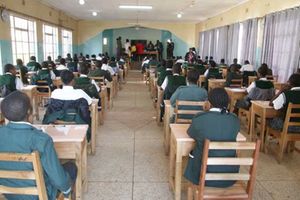
Grade Nine candidates start KJSEA English language at Moi Nyeri Complex Primary School in Nyeri county on October 27, 2025.
Photo credit: Joseph Kanyi | Nation Media Group
The children will get transcripts that show their performance across different learning areas without revealing exact percentages. There will be no certificate issued to mark the end of junior school education.
“The award of certificates at primary level in the 8-4-4 system resulted in undue competition and discouraged children who, at a young age, would be considered as having failed, yet they had not had an opportunity to explore education and find their niche to excel,” Education Cabinet Secretary Julius Ogamba told the Daily Nation.
“The absence of certificates at earlier levels is meant to increase learners’ motivation as the transcripts Knec will provide indicate how they are faring in every aspect as far as meeting expectations is concerned.”
The results will be a computation of the learners’ progress through continuous assessments and the tests they sat at the end of their primary-level education at Grade Nine.
The ministry and Knec say candidates and schools will not be ranked. This is meant to curb unhealthy rivalry in children and learning institutions.
The candidates’ performance at the end of Grade Six in the Kenya Primary School Education Assessment (KPSEA) will account for 20 per cent of the final score in every subject, while a similar percentage will be from school-based assessments at Grade Seven and Eight.
The remaining 60 per cent will come from the final test that the candidates sat in October and November.
The learners will be placed into four performance bands, which have been further split into two, resulting in an eight-level score matrix.
Scores of 90 to 100 per cent will earn eight points, while 75-89 per cent will be seven points.
Candidates in the Meeting Expectations band will be within a scoring range of 41 to 74 per cent. In this band, candidates with 58-74 per cent earn six points, while those with 41-57 per cent get five.
Candidates classified as Approaching Expectations will fall within a scoring of 21 to 40 per cent. In this band, 31 to 40 per cent earn four points, while 21-30 per cent will earn three points.
A score of 11 to 20 will earn two points, while 10 and below will get a candidate one point.
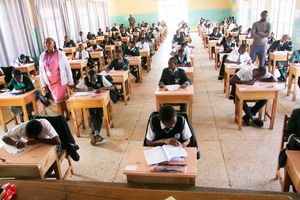
Grade Nine candidates take their KJSEA English language paper at Moi Nyeri Complex Primary School in Nyeri County on October 27, 2025.
Photo credit: Joseph Kanyi | Nation Media School
After the announcement of the results, the ministry will embark on placing learners in senior school through a computerised process.
Senior schools have been categorised based on classroom and laboratory capacity, staffing levels and boarding facilities.
Placement will consider a learner’s performance in KJSEA, their chosen career pathway and competition for limited spaces, particularly in Cluster One (national) and Cluster Two (extra-county) schools.
The curriculum introduces multiple pathways – Science, Technology, Engineering and Mathematics (STEM); Social Sciences; and Arts/Sports– at senior school, allowing learners to specialise based on interests, aptitude and career goals.
Education Cabinet Secretary Julius Ogamba.
Photo credit: Lucy Wanjiru | Nation Media Group
“This provides a more convergent entry into university and tertiary training than under the 8-4-4 system,” Mr Ogamba said.
At the end of Grade 12, learners will be awarded the Kenya Certificate of Basic Education (KCBE) – the only official certificate in this level of education.