Thousands of teachers seeking promotion will have to compete for the available slots under a new scoring system by the Teachers Service Commission (TSC) that rewards length of service, performance, academic qualifications and additional responsibilities.
The new guidelines for the 2026/2027 financial year show that candidates will be assessed on several factors, including length of service in their current grade, their performance under the Teacher Performance Appraisal and Development (TPAD) system, academic qualifications and additional responsibilities they have undertaken.
The TSC on July, 8, 2026 advertised 34,016 promotion vacancies for teachers across public primary schools, secondary schools and teachers’ training colleges, opening applications for career advancement in the 2026/2027 financial year.
The vacancies span 30 cadres, with 13,490 Senior Teacher II posts, 5,956 Senior Master IV positions, 4,210 Senior Teacher I posts, 3,075 Deputy Headteacher II positions (C3–C4), 1,865 Deputy Headteacher I positions (C4–C5), 1,665 Senior Master III positions (C4–C5), 1,068 Deputy Principal III positions (C5–D1), 891 Deputy Principal II positions (D1–D2) and 770 Deputy Principal I positions (D2–D3)which are expected to provide career progression opportunities for thousands of teachers who have remained in the same grades.
Unlike an automatic progression based on years of service, teachers will compete for advertised vacancies, with the commission using the scores to shortlist and rank candidates.
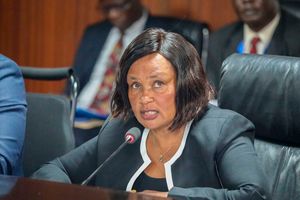
The acting Chief Executive Officer of the Teachers Service Commission (TSC) Evaleen Mitei before the National Assembly Departmental Committee on Education.
Photo credit: Dennis Onsongo| Nation Media Group
Under the guidelines, a teacher must have served for at least three years in the current grade to qualify for promotion. The commission will shortlist candidates at a ratio of three applicants for every advertised vacancy, based on eligibility and merit.
The final selection will then be based on interview scores, subject to considerations including gender representation, regional diversity and inclusion of persons with disabilities.
But the scoring system reveals how teachers can gain or lose crucial marks during the promotion exercise. For senior administrative and teaching positions, length of stay in the current grade carries substantial weight, meaning teachers who have remained in one grade for longer could have an advantage over colleagues with shorter periods of service.
For example, the scoring guide for the position of Chief Principal gives up to 45 marks for length of stay in the current grade. Teachers who have served for eight years or more receive the maximum marks, while those with three years in the grade receive 20 marks.
The system also rewards teachers who have taken on administrative responsibilities. A teacher who has performed administrative duties for eight years or more can earn the maximum 25 marks, while those with seven years get 22, six years 19, five years 16, four years 13, three years 10, two years seven and between six months and one year four marks.
Teachers who have remained in the grade for eight years or more receive 25 marks, seven years earns 21, six years 17, five years 13, four years nine and three years three marks.
The average TPAD rating for the previous three years will be used, with teachers scoring 81 per cent and above receiving 10 marks. Those with ratings of 61 to 80 per cent get eight marks, 41 to 60 per cent six marks, 21 to 40 per cent four marks and one to 20 per cent two marks.
Teachers aged 57 years and above receive the maximum 30 marks, those aged 52 to 56 receive 25, 47 to 51 receive 20, 42 to 46 receive 15, while those aged 41 and below receive 10.
Participation in co-curricular activities can earn up to five additional marks, with international participation earning five marks, national four, regional three, county two and sub-county one.
The same principle applies to other promotion cadres, although the distribution of marks changes.
For Deputy Headteacher I, for instance, academic and professional qualifications account for three marks, while specified TSC, KNEC and KICD professional assignments account for two.
Administrative responsibility and length of stay in the current grade carry the biggest combined allocation at 55 marks.
Teachers Service Commission (TSC) headquarters in Upper Hill, Nairobi.
Photo credit: File | Nation Media Group
Teachers performing headteacher duties for eight years or more can earn 25 marks under administrative responsibility, with the marks reducing according to the number of years served in the responsibility.
Length of stay in the current grade carries a further 30 marks, with teachers who have remained in the grade for eight years or more receiving the highest score.
TPAD performance accounts for another 10 marks, while age carries 25 marks and co-curricular activities five.
The scoring therefore means that two teachers with similar academic qualifications can end up with different final scores depending on their experience, TPAD performance, administrative responsibilities and other activities recognised by the Commission.
Importantly, the marks are not simply awarded by one interviewer but a panel. The guidelines state that each panel member will award marks for every section as the interview progresses.
The actual score for each section is then calculated as the average mark awarded by the panel members, with the scores from the different sections added together to determine the candidate's final score.
This means a teacher's final position in the promotion competition will depend on the combined score across all the categories rather than performance in a single part of the interview.
The TSC says the scoring framework is intended to promote merit, fairness, transparency and consistency in the promotion process.
Academic qualifications will also contribute to the final score. Teachers with higher qualifications will receive more marks, with PhD holders scoring more than those with master's degrees, who in turn score more than those with bachelor's degrees in the relevant scoring guides.
TSC says it will endeavour to ensure that at least five per cent of promoted candidates are teachers registered as persons with disabilities.
The promotion process itself will be conducted at different administrative levels depending on the position.
Sub-county panels will handle interviews for primary school teachers, including head teachers and deputy head teachers, while County Selection Panels will interview post-primary teachers, including deputy principals.
Regional panels will handle principals in secondary schools, teachers' training colleges and curriculum support officers (CSOs).
The Commission has further reserved the right to review, correct or revoke a promotion decision where material errors, fraudulent information, procedural violations, administrative anomalies or new information affecting the decision emerge.