Thousands of students preparing to join various universities in September this year risk missing out on the financial support from the Higher Education Loans Board (Helb) as the body is in dire financial need.
Documents tabled before the National Assembly Committee on Education by the board indicate that in this new financial year, a total of 1,199,423 students require support, but the board only has Sh56.71 billion against a requirement of Sh114.36 billion, leaving a financial gap of Sh57.65 billion
“The major constant factor affecting Helb’s mandate remains the widening mismatch between student financing requirements and available budget allocations,” the board told the committee.
For the last four financial years, Helb has continued to operate on a budget deficit despite the sharp increase in students who need financial assistance.
The board has now sounded an alarm to Parliament that it needs urgent financial assistance from the National Treasury in order to cater for the increased number of students in each financial year.
The document indicates that from the Financial Year 2023/24, the board has strained to offer the much-needed assistance to the needy students.
“The board continues to work closely with the Ministry of Education and the National Treasury to mobilise additional resources to sustain equitable access to higher education financing,” the board told the committee.
The document indicates that between 2023/2024 and 2025/26 financial years, the board had a cumulative financial gap of Sh19.27 billion due to the persistent budgetary shortfalls.
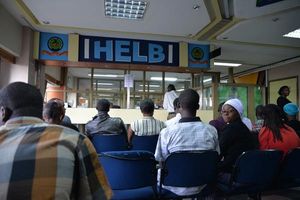
The Higher Education Loans Board offices in Nairobi.
Photo credit: File | Nation Media Group
In the 2024/25 financial year, for instance, the board had a financial hole of Sh10.694 billion, while in the 2025/26 financial year, the board had a funding gap of Sh18.58 billion.
In this new financial year, which is just 23 days old, the board told the committee it already has a funding gap of Sh57.654 billion.
“Helb continues to engage the Ministry of Education, National Treasury and stakeholders to address these challenges and enhance sustainability of higher financing,” the board said.
The board told the committee that it is grappling with three major risks, namely financial risk, liquidity risk and operational risk, which it termed as a major risk to its continued support of needy students.
“The board continues to monitor these risks through established governance structures, periodic risk assessments and implementation of targeted mitigation measures,” the board said.
The board told the committee that the introduction of the student-centred funding model in 2023/24 significantly expanded access to government student financing, leading to the increase in the number of students supported to jump from 576,338 to 823,691 in the 2025/26 financial year.
The board pointed out that due to the increase in the number of students being supported, tuition loans continued to be remitted directly to institutions and upkeep loans disbursed to eligible students within the available resources, part of the assessed financing requirement of Sh29.27 billion remained outstanding pending availability of additional budgetary resources.
Higher Education Principal Secretary Beatrice Inyangala and Higher Education Loans Board CEO Geoffrey Monari before the Senate Education Committee on March 20, 2025.
Photo credit: Dennis Onsongo | Nation Media Group
In the 2025/26 Financial Year, the board received Sh45.66 billion comprising Sh40.9 billion from the exchequer and Sh4.7 billion Appropriations-in-Aid (A-I-A)
However, in April, the Board of Directors revised its operation budget to Sh49.1 billion in response to the expected increased loan recoveries following enhanced recovery strategies.
During the year under review, the student financing scheme recorded an expenditure of Sh48.6 billion in 2025/26 against a budget provision of Sh47 billion.
The document indicates that a total of 823,691 qualifying students in various universities and Tvet institutions were awarded loans.
In addition, a total of 23,333 students were awarded bursaries during the year, while 364,279 students were awarded loans in promotion of Science, Technology, Engineering, Mathematics, Innovation, Fisheries and Agriculture (STEMIFA)
The move was in line with the government’s Bottom-UP Economic Transformation Agenda (BETA) and Vision 2030. University students apply for funding by the University Fund and the Higher Education Loans Board (Helb) through a joint portal that was introduced in 2023.
The data collected by the two agencies is used to categorise students according to their level of vulnerability.
Under the current higher education funding model, every student admitted to a public university qualifies for some level of government scholarship
In the arrangement, students from the most vulnerable households receive the highest scholarship allocation, with the government meeting up to 55 per cent of their tuition costs while the remaining amount is covered through loans and household contributions depending on financial needs.
On Tuesday, July 21, President William Ruto announced at State House, Nairobi, that all students who qualify for university education will receive full funding from the government, signaling that the government is mulling overhauling the funding model it introduced in 2023
Students have always complained about the funding model the government introduced in 2023, saying it limits them from pursuing their preferred courses.