The country is set to mark a historic milestone next week with the expected release of the first-ever Kenya Junior School Education Assessment (KJSEA) results for 1,130,680 learners, ushering in a new era in how students are assessed and transitioned under the Competency-Based Education (CBE) system.
Last month, Basic Education Principal Secretary Julius Bitok said the Junior School assessment outcomes would be ready by December 11, with placement completed within a week. Learners are expected to receive admission letters before Christmas, ahead of schools reopening in January.
The results will guide the placement of the pioneer junior school cohort into senior school, officially replacing the long-standing Kenya Certificate of Primary Education (KCPE) that defined the 8-4-4 system for nearly four decades.
Unlike KCPE, a single high-stakes examination taken after eight years of primary schooling, KJSEA combines continuous assessment and a final summative evaluation administered across Grades 7, 8 and 9.
The shift moves emphasis from memorisation and ranking to competencies, skills development and learner growth — a fundamental change in how educational achievement is measured.
One of the most significant differences is that junior school learners will not receive certificates or have top performers publicly celebrated, unlike under KCPE. Instead, they will be issued detailed performance transcripts indicating how they are progressing in each learning area.
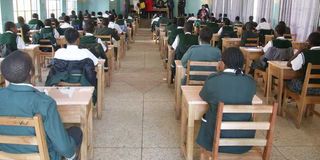
Grade Nine candidates take KJSEA English language paper at Moi Nyeri Complex Primary School in Nyeri County on October 27, 2025.
Photo credit: Joseph Kanyi | Nation Media Group
“The award of certificates at primary level in the 8-4-4 system introduced undue competition and discouraged children who, at a very young age, were considered to have failed before they had explored their potential. The absence of certificates at earlier levels aims to boost motivation because Knec transcripts show how learners are faring in each aspect as far as meeting expectations is concerned,” Education Cabinet Secretary Julius Ogamba told Nation .
Mr Ogamba added that the KJSEA outcomes, combined with learner interests, will guide placement into three senior school pathways: STEM (Science, Technology, Engineering and Mathematics), Social Sciences, and Arts/Sports. Unlike KCPE, which largely relied on marks for placement, the new approach allows specialisation based on aptitude and career aspirations.
“The new curriculum introduces multiple pathways at senior school level, allowing learners to specialise based on interests, aptitudes and career goals. Certificates after senior school will be issued according to the chosen pathway, providing a more convergent entry into university and tertiary training than under 8-4-4,” said the CS.
Upon completing Grade 12, learners will be awarded the Kenya Certificate of Basic Education (KCBE) — the only official certificate under basic education — reflecting their specialisation pathway for transition to university, college or technical training.
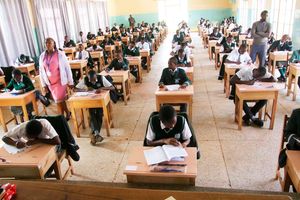
Grade 9 students at St Mary’s Girls Comprehensive and Junior School in Nakuru County sit for their Kenya Junior School Education Assessment (KJSEA) on October 27, 2025.
Photo credit: Bonface Mwangi | Nation
The assessment framework blends formative and summative evaluations to provide continuous feedback, support mastery of skills and reduce malpractice.
To enhance data accuracy, Knec assigns each learner a unique assessment number at Grade 3, which follows them throughout basic education, enabling the development of comprehensive academic records for reporting, planning and research.
Official statistics indicate that transition rates have improved under CBE. Between 2017 and 2020, the average KCPE–KCSE transition rate was about 82 per cent. Under CBE, it is higher; 1,283,323 learners sat KPSEA in 2022, while 1,130,680 have registered for KJSEA 2025 — a transition rate of 88.1 per cent.
On Wednesday, Knec warned the public against fraudsters claiming they can manipulate national examination results, noting reports of individuals posing as insiders and promising to change grades for money.
The council dismissed the claims as fraudulent and emphasised that scripts are anonymised to protect candidate identity and ensure integrity during marking.
“Beware of fraudsters purporting to alter candidates’ scores during marking of KCSE or KJSEA. All answer scripts are anonymised to safeguard integrity,” Knec said, urging candidates and parents not to fall prey to scams circulating on social media.