The financially troubled Moi University faces the daunting task of raising over Sh1 billion to clear the interest on a Sh185 million debt between the institution and a contractor in a botched construction deal.
The university management has admitted that the liability could severely strain its budget, potentially affecting salaries, infrastructure projects, research funding and student services.
“We are racing against time to come up with a payment plan, but it will definitely result in financial strain and disrupt smooth operations,” said Prof Kiplagat Kotut, the Acting Vice-Chancellor.
The university is pursuing several options, including a bailout by the government, with less than a week before the High Court issues a ruling on the matter.
The High Court delivered judgment on February 2, 2024, ordering Moi University to pay a total claim that stood at Sh1.2 billion when interest was applied at prevailing bank rates.
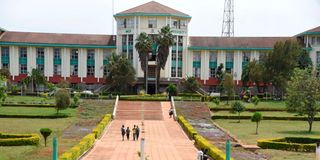
The main entrance to Moi University in Kesses, Uasin Gishu County.
Photo credit: Jared Nyataya | Nation Media Group
On February 2, 2025, M/s Nelson Havi, representing Vishva Builders Ltd, obtained a decree of Sh1.08 billion as computation of the interest amount.
Last month, the High Court gave the university 30 days to come up with a plan to pay the debt to Vishva Builders Ltd, failure to which its 69 bank accounts would be attached.
An attachment order had been issued against the institution's 69 bank accounts, and the university challenged the order, especially the interest on the debt. The construction firm is demanding Sh1.25 billion.
The dispute stems from a contract for the construction of the Faculty of Science Complex, a government-sponsored project initiated in the 1990s and which was to be financed by the National Treasury.
But the university, which once rivalled the University of Nairobi and Kenyatta University, failed to pay the Sh185 million penalty, resulting in accrued interest for almost 25 years.
“It is truly an example of a court case having the proverbial ‘nine lives’,” said Justice Wananda Anuro when he ruled in favour of the construction company, putting the matter to rest and directing the university to pay the company Sh185.3 million for the botched contract.
Moi University is faced with numerous financial challenges, ranging from a Sh25 million tender for a new gate project to the diversion of Sh7.7 million in student fees by dishonest employees into a private account.
Other debt burdens include a Sh3 billion loan to modernise the New Rivatex after spending Sh600 million to acquire it, and declining student enrolment from 50,000 in 2015 to 27,000 in 2021.
The closure of non-viable campuses, reduced exchequer funding due to the implementation of the Differentiated Unit Cost (DUC) model in computing recurrent capitation, and rising personnel costs due to National Collective Bargaining Agreements (CBAs) that have not been fully funded are other factors contributing to the institution’s woes.
The newly installed Moi University Council has, however, introduced a major restructuring process to resolve the financial crisis, debt burden and operational dysfunction by effecting cost-cutting measures to salvage the institution and reclaim its lost glory.
The council is working on a turnaround strategy focusing on infrastructural reorganisation, revenue diversification and staff redundancy as part of cost-cutting measures.
“The university has over time been constrained by a range of historical challenges that have undermined its ability to sustain its standing as a premier institution of higher learning in Kenya. These challenges, if left unaddressed, pose a serious risk to the institution’s long-term viability,” disclosed Prof Noah Midamba, Council chair.
He admitted that the university is still faced with financial constraints despite an increase in student enrolment from 4,500 to 6,750 last academic year, among other strategies meant to restore confidence through proper governance, transparency and accountability.
“The council is working on five key pillars in a comprehensive strategy to guide the recovery of the university, which has for long faced a financial crisis, debt burden and administrative mismanagement,” said Prof Midamba.
According to Prof Kotut, student numbers have dropped from 48,000 in 2015 to the current 21,000, making it a challenge for the university to meet its financial obligations, including payment of employees’ emoluments.
The institution has implemented staff redundancy to weed out ghost workers from the payroll and closed down some non-viable campuses as part of cost-cutting measures.
The university has been grappling with significant financial issues, including certified outstanding debts of Sh8 billion, with Auditor-General Nancy Gathungu ordering a forensic audit of the university’s books of accounts.
“We have put in place strategies that will ensure that the university does not collapse. Currently, refurbishment of student hostels is ongoing, staff are receiving salaries on time, and the university will soon reclaim its glory,” said Dr Edwin Sambili, a council member.
Several public institutions are grappling with salary arrears, pension obligations and stalled development projects.