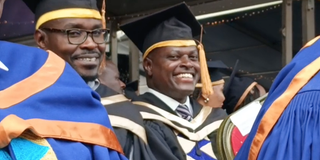
Kakamega Governor Fernandes Barasa and Kiharu MP Ndindi Nyoro are among thousands of students who graduated from Kenyatta University on Friday in a ceremony that underscored the growing presence of senior public officials in Kenya’s lecture halls.
Governor Barasa was awarded a Doctor of Philosophy in Public Policy and Management, while Mr Nyoro graduated with a Master of Economics degree in Public Policy.
For Mr Nyoro, the degree adds to his academic record, having graduated with a Master of Arts in Economics from the University of Nairobi in September this year. The MP has been pursuing the two master’s programmes concurrently. He is also a former chairman of the Budget and Appropriations Committee of the National Assembly.
Kenyatta University conferred 61 doctoral degrees, 571 master’s degrees and 5,888 undergraduate degrees, making it one of the largest graduation ceremonies in the country this year.
Education Cabinet Secretary Julius Ogamba, who was the chief guest at the ceremony, challenged public universities to fundamentally rethink how they finance their operations, urging them to move away from reliance on the Exchequer and instead leverage research, innovation and talent.
“The Exchequer cannot continue to bear the entire weight of the university sector. We must move away from a culture of dependence towards innovation and revenue generation,” he said. “Our universities must leverage their research expertise, talent pool and infrastructure to become self-sustaining economic hubs.”
Mr Ogamba also said the government has begun settling outstanding arrears from the 2017–2021 Collective Bargaining Agreement (CBA), assuring university staff of continued commitment to labour stability in the education sector.
He revealed that the first instalment of Sh3.8 billion out of the Sh7.7 billion owed had already been paid ahead of schedule.
“The outstanding arrears from the 2017–2021 CBA are now being settled as agreed. The first instalment of Sh3.8 billion, which was due to be paid by December 1, 2025, has already been released ahead of time. It hit your university account yesterday. The balance of Sh3.8 billion will be paid as scheduled in the 2026/2027 financial year,” he said.
“We are resolute in our commitment to fast-track the negotiations and conclusion of the 2025–2029 CBA. We must, and we will, break this cycle of industrial strife and build an environment of trust and harmony in our institutions, from basic education to higher education,” he said.
Speaking under the theme Inventing education and research for the digital world , Mr Ogamba said the theme was “beyond being a mere slogan,” describing it as “the strategic imperative of our time.”
He noted that the digital era, marked by speed, data abundance and the convergence of physical and virtual realities, demands a new role for universities.
“The government’s vision is to see our universities move beyond simply using digital tools and instead actively shape the digital future of Kenya and the region at large,” he said.
Kiharu MP Ndindi Nyoro among thousands of students who graduated from Kenyatta University on Friday.
Photo credit: Screengrab
Mr Nyoro, first elected to Parliament in 2017, has cultivated a reputation for combining political engagement with academic achievement, a strategy mirrored by several other lawmakers in recent years.
His pursuit of two master’s degrees simultaneously has drawn attention, highlighting the growing pressure on public figures to demonstrate expertise beyond politics.
Governor Barasa, a former Kenya Electricity Transmission Company (Ketraco) managing director, has also emphasised the role of education in governance. His pursuit of a PhD is part of a growing trend among county leaders to bolster their academic credentials while holding office.
The graduation ceremony comes at a time when the higher education sector is grappling with expansion challenges, including limited infrastructure and faculty shortages, even as demand for postgraduate and professional programmes continues to grow.
In an interview, Mr Nyoro explained his decision to return to the lecture hall while serving as an MP.
“Many of the economic parameters we discuss are not only technical, but also far-reaching in how they shape our daily lives and the future of our country,” he said.
He noted that his experience as chair of the Budget Committee revealed the centrality of economic challenges in Kenya, prompting him to deepen his expertise.
“I actually started pursuing two master’s degrees concurrently—one at Kenyatta University in Public Policy and the other at the University of Nairobi in Economics. I attended classes physically where required and online where possible, fully as a student and not as an MP,” he said.
Mr Nyoro described balancing parliamentary duties with coursework as stressful, but said he maintained attendance and actively participated in all academic requirements.
“I wanted to deepen my knowledge so the decisions I make are optimal, objective and geared towards advancing our country,” he said.
He also highlighted the practical relevance of his studies, citing public participation initiatives across counties and exposure in Mandera County as experiences that informed his understanding of policymaking.
By integrating his academic work with his legislative responsibilities, Mr Nyoro said his studies are part of a broader commitment to effective leadership.
“Even as we serve in specific capacities, we must continue to develop ourselves to make efficient decisions as leaders,” he said.