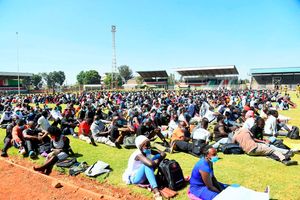
Kenya is quietly facing a crisis that few are willing to confront — the paradox of underemployed PhD holders. While advanced education is often hailed as the path to opportunity, for many of the country’s most educated citizens, it has instead become a journey into uncertainty.
“There is a silent crisis among PhD holders — a paradox that few are willing to confront,” says Dr Vince Arasa Nyabunga, a part-time lecturer who teaches Kiswahili, Communication, and Translation. “When scholars with Master’s and Doctoral degrees cannot find meaningful work, it reflects a deeper systemic issue in our society.”
Despite Kenya not having an overwhelmingly low number of PhD holders, their unemployment and underemployment rates continue to rise.
According to the Commission of University Education (CUE) website, Kenya produces approximately 300 to 400 PhD graduates per year, against a national target of at least 1000 annually.
Also, current data from the CUE website indicates that the total number of PhD holders in Kenya is less than 10,000.
“It is ironic that the highest level of education — a Doctorate of Philosophy — now opens fewer doors in Kenya than ever before,” Dr Nyabunga says.
Behind every PhD certificate lies years of sacrifice — long nights, financial strain, and immense dedication. Yet, instead of leading research and policy, many of Kenya’s scholars are trapped in cycles of part-time teaching, unpaid consultancies, or total joblessness.
Kenya’s higher education sector has expanded rapidly, with new universities and ballooning student populations. But the same growth has not translated into jobs. There is a growing class of overqualified but unemployed Kenyans.
“Some lecturers handle 700 to 800 students in a single class, earning about Sh7, 000 per course. That is underemployment,” Dr Nyabunga explains.
Public universities — once the main employers of PhD and Master’s graduates — are now in financial distress. Reduced government funding and the end of student placement in private universities have left institutions scrambling. Most now rely heavily on part-time lecturers, often paid late and with no benefits.
“It’s not uncommon to find one PhD holder teaching in three universities,” he adds. “No job security, no research support — this is intellectual casual labour. It erodes the dignity of academic work.”
While advanced education is often hailed as the path to opportunity, for many of the country’s most educated citizens, it has instead become a journey into uncertainty
Photo credit: Shutterstock
Dr Nahashon Nyangeri Akunga, another part-time lecturer, agrees. “Many universities are run by a handful of full-time staff — the dean, a director, and the vice-chancellor. The rest of us fill the gap as casuals,” he says. “This over-reliance on part-time teaching has commercialised academia. Teaching has become transactional rather than professional, whereby universities took pride in quality learning, research and innovation.”
Dr Nyangeri paints a grim picture of opaque recruitment processes in academia. “I once applied for a position where the shortlisted candidate later called me for my notes and course outlines. That same person had been declared ‘most qualified’,” he recalls. “Merit has been replaced by nepotism, tribalism, and politics.”
He believes that this broken system of bias and corruption over meritocracy is pushing qualified scholars out of universities and into other ventures. “When my colleagues ask what to do, I tell them — bana usomi haulipi — education alone doesn’t pay. You must find something practical to sustain yourself,” he says.
Some have turned to business, freelance research, and translation work. Others are moving abroad in search of better opportunities — in Tanzania, Rwanda, South Africa, and beyond. “It’s a brain drain born out of frustration,” Dr Nyangeri adds.
An anonymous Kiswahili and Translations scholar echoes the sentiment. “I graduated with a PhD nearly two years ago, but I’m still teaching part-time at two universities. I’ve applied for full-time jobs repeatedly — last year alone, over five applications — but I was only shortlisted once. There were 20 of us, all with PhDs, competing for one position,” he says.
Nation has established that some universities are paying part-time lecturers as little as Sh1, 000 per hour. After taxes, the pay per unit per semester ranges between Sh32, 000 and Sh50, 000. Meanwhile, a full-time PhD lecturer in a public university takes home around Sh120, 000, and about Sh100, 000 in private universities.
“When you see Master’s and PhD graduates struggling, what about Bachelor’s and Diploma holders?” he asks. “Our families invested in us. They expected that with a PhD, life would be easier — but it hasn’t been.”
The struggles of PhD scholars extend beyond universities. In Machakos County, an early childhood and development education (ECDE) scholar pursuing a PhD says the situation for teachers in early childhood education is even worse.
“I’ve worked in ECDE since 2009, and I’m still not formally employed,” she says. “In Machakos, ECDE teachers earn a flat rate of Sh18, 000 per month — whether you have a certificate, diploma, Masters or even a PhD. They have never implemented the Scheme of Service for ECDE teachers.”
Behind every PhD certificate lies years of sacrifice — long nights, financial strain, and immense dedication.
Photo credit: Shutterstock
The teacher-to-pupil ratio, added the scholar who sought anonymity for the fear of victimisation, can reach 1:80 — double the recommended 1:40 — making quality teaching nearly impossible. “It’s heartbreaking,” she says. “Many ECDE teachers have pursued degrees and even Master’s, but their qualifications mean nothing. The system doesn’t reward learning.”
She argues that the Salaries and Remuneration Commission (SRC) and county governments must standardise pay for ECDE teachers nationwide. “If a teacher has a degree or PhD, whether they teach in ECDE, secondary, or university, the pay should reflect that qualification,” she insists. “We all go through the same process and pay the same tuition fees.”
But despite her passion for education, she admits morale is low. “Many ECDE teachers are leaving the profession for boda boda business, masonry labour, or small vending businesses. Others retire with nothing because they were never on pensionable terms. I know one who retired even before his Master’s degree could add to him something.”
Scholars agree that Kenya’s treatment of its most educated citizens reflects a failure in planning and policy. “The government should know how many PhDs and Master’s graduates the country produces each year — and create mechanisms to absorb them into research, policy, and innovation roles,” says the anonymous Kiswahili scholar.
Dr Nyabunga believes Kenya must redefine the role of the PhD in national development. “In developed economies, PhD holders drive policy, innovation, and research. In Kenya, we treat them as glorified teachers and confine them to lecture halls,” he says. “We must create systems to harness their knowledge.”
As a nation, we have failed to integrate advanced scholarship into our wider systems of governance, innovation, and industry, Dr Nyabunga says thoughtfully. “In developed economies, PhD holders drive research in government — they are the think tanks of the state. They serve in innovation hubs, industrial development, and public policy institutes, helping shape a nation’s socio-economic and infrastructure agenda.”
But in Kenya, he laments, the PhD remains narrowly viewed as a teaching qualification. “We have not transitioned to a point where earning a PhD opens doors beyond academia — yet the knowledge, creativity, and analytical ability that come with such a qualification should empower scholars to excel in diverse fields,” he notes.
This narrow perception, Dr Nyabunga adds, has wasted valuable intellectual capital. “Our economists could inform fiscal policy; our scientists could lead research on food security, climate change, and innovation; our linguists could help shape national identity and communication policy. But instead, many of these minds are sidelined from decision-making spaces, creating the false impression that Kenya’s PhD holders are detached from the country’s development agenda.”