Private universities may have to wait longer for the release of the Sh58.8 billion they claim the government owes them after the Ministry of Education disclosed that the figure has been forwarded to the Pending Bills Committee for verification.
This comes in after Private university dons sounded the alarm over what they describe as a financial crisis, demanding immediate settlement of Sh58.8 billion owed by the Government for tuition of sponsored students.
According to the dons, the delayed payments, spanning the 2016/2017 to 2023/2024 academic years, have left several institutions struggling to meet operational costs and maintain educational quality.
However, the Ministry noted that the accumulated bill has already been forwarded to the Pending Bills Committee for verification, meaning the exact amount cannot be confirmed until the process is complete.
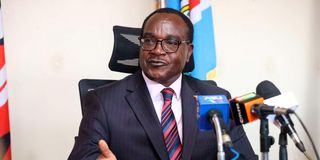
“We are continuously engaging stakeholders including the National Treasury and National Assembly as part of ongoing sector consultations aimed at exploring appropriate alternatives and sustainable financing options for both public and private Universities,” Education Cabinet Secretary Julius Ogamba told the Nation .
Mr Ogamba noted that as part of the wider reforms currently underway in the higher education sector, the Ministry is reviewing all pending obligations with the aim of establishing a structured and sustainable way forward.
“Discussions are ongoing to explore viable options within the available budgetary framework. Specific timelines will be considered once the requisite consultations with relevant government agencies and stakeholders are concluded including the report from the pending bills committee,” he said.
The Ministry said it is strengthening the Student-Centred Funding Model to improve predictability and equity in university financing. It noted that closer coordination with funding agencies would help streamline student support and reduce the likelihood of similar arrears piling up again.
Delayed disbursement of funds
“To enhance predictability, inclusiveness, and equity in university financing, the Ministry is strengthening the funding frameworks under the Student Centred Funding Model. This includes closer collaboration with the relevant government institutions to streamline student funding and minimize the likelihood of similar challenges arising in the future,” he said.
“Ongoing engagements will inform any future interventions aimed at supporting institutions to deliver quality education and ensure continuity of student services. We remain committed to constructive dialogue with sector stakeholders as part of strengthening the overall higher education landscape,” he added.
Private universities have repeatedly warned that without immediate intervention, the prolonged delay in releasing the funds could disrupt learning for thousands of government-sponsored students placed in their institutions.
KAPU emphasized that investments in higher education are not profit-driven but serve the public good, with revenues reinvested into improving quality, research, and student support.
“The delayed disbursement of funds has forced most private universities to eat into their reserves to finance the education of government-placed students. This has financially crippled our institutions. We are collectively owed KSh48.8 billion. This is not just a financial issue—it threatens the sustainability of private higher education in Kenya,” said Prof. Stephen Mbugua Ngari, KAPU Chairperson.
According to their presentations, The Kenya Association of Private Universities (KAPU) said universities such as Mount Kenya University, facing Sh12.9 billion in arrears, Catholic University of East Africa Sh4.3 billion, KCA University Sh6.67 billion and Kabarak University Sh6.8 billion. Overall, 33 member universities are collectively owed Sh58.8 billion.
“Investments in higher education are not for profit but for the public good. The revenue we generate is reinvested into improving quality, research, and student services. Private universities have complemented government efforts since before independence, producing skilled graduates who serve the country in both public and private sectors,” said Prof Ngari.