Day school learners are bearing the brunt of illegal levies, with nearly two-thirds being sent home or locked out of class when their families fail to pay, a new survey shows.
The survey by the Elimu Bora Working Group (EBWG) found that 64.9 per cent of day-school learners are sent home or denied access to class because of levies, compared with 40.5 per cent of learners in boarding schools.
The findings expose a glaring contradiction in Kenya’s free day secondary education policy, with the children the programme was designed to support facing exclusion over school levies.
“The government policy on free day secondary education has fallen flat. It’s not working because the children in day schools are suffering the most,” EBWG’s official, Chris Owalla, said on Tuesday during the release of the report titled “Free Education Betrayed”.
The survey found that illegal levies are widespread in public secondary schools, ranging from Sh15,000 to Sh20,000 in day schools and rising to as much as Sh60,000 in boarding schools.
The survey, which covered 388 parents, guardians and grandparents in 11 counties, found that illegal levies are often demanded verbally and include charges for remedial tuition, motivation, development, ICT and computers, PTA activities and holiday tuition.
The counties covered were Baringo, Kakamega, Kiambu, Kisumu, Makueni, Mandera, Meru, Mombasa, Nairobi, Nakuru and Uasin Gishu.
“In day schools, the illegal levies, which go up to Sh20,000, are in the name of lunch programmes and remedial classes, which go against the tenets of compulsory free basic education,” Mr Owalla said.
The survey, which examined payments made in 2025 and those expected in 2026 across day, boarding and mixed public secondary schools, found that the financial burden falls disproportionately on poorer households.
The financial pressure is forcing families to take desperate measures, with some resorting to borrowing money or selling assets to meet the charges.
“Six in 10 households, or 61.6 per cent of respondents, said extra levies were difficult or impossible to afford, and nearly 37 per cent reported borrowing money or selling assets very often to meet these illegal costs,” said Cornelius Oduor, an EBWG member and deputy executive director at the Kenya Human Rights Commission.
The Basic Education Act, 2013 prohibits tuition fees in public schools and requires any other charges to comply with guidelines issued by the Education Cabinet secretary.
Since 2008, the government has financed public secondary schools through Free Day Secondary Education capitation grants and has set maximum annual fees for boarding schools.
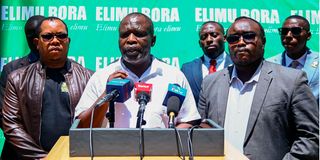
Elimu Bora Working Group members Cornelius Oduor(left), Maxwel Magawi and David Karani addressing journalists in Nairobi on December 15,2024.
Photo credit: Evans Habil | Nation Media Group
For the 2026 academic year, the gazetted fee for public boarding secondary schools stands at Sh53,554, while day schools are not expected to charge tuition fees.
The EBWG survey also revealed weak accountability systems that leave parents reluctant to challenge schools for fear that their children could be victimised. An overwhelming 87.4 per cent had never complained.
Only 19.1 per cent of respondents said they had been properly consulted before levies were introduced, while 58.2 per cent said they received no meaningful explanation of how the money collected was used.
As part of its recommendations, the EBWG wants a national audit of fee structures in all public secondary schools to establish the scale of illegal levies and identify non-compliant institutions.
“The Ministry of Education must urgently audit school fee structures, enforce the law against institutions imposing illegal levies, ensure full and timely capitation and establish confidential complaints mechanisms that protect parents and learners from retaliation,” Mr Oduor said.
The lobby group also wants sanctions against schools imposing unauthorised charges and reimbursement for parents who have paid illegal levies.
“Illegal levies are a barrier to the right to education, and the government must not allow schools to impose them and then punish children for their parents’ inability to pay,” he said.
The group further wants the government to ensure timely release of capitation and improve transparency in school finances. It also calls for schools to be prohibited from sending children home, denying them meals or excluding them from examinations because their families cannot pay.