Bills dating back 10 years, a ballooning wage bill now at Sh450 million, an ageing workforce earning the highest bands, and a reduced student enrolment are some of the issues bedevilling Moi University.
This, as the university management and lecturers’ body—the University Academic Staff Union—are in a standoff over implementation of a Collective Bargaining Agreement (CBA).
Added to this is the non-payment of statutory deductions will take longer than expected to be addressed due to financial challenges.
The university management on Thursday disclosed that it is experiencing financial difficulties in effecting the monetary clauses in the November 2024 return to work agreement and accused the union of using the strike to sabotage operations at the institution, as it admits the 2025/2026 academic year learners.
Moi University is set to auction some of its animals, a vehicle and an assortment of used tyres.
Photo credit: File | Nation
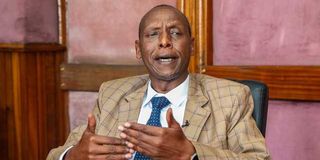
“We are operating in the red and it is almost impossible to implement the monetary clauses in the deal.
"There are historical bills dating back more than 10 years, a ballooning wage bill of Sh450 million monthly, and an ageing workforce drawing huge salaries at their apex scale, coupled with reduced student enrolment.
"All these consume much of our finances, making it difficult to implement the monetary elements in the deal,” explained acting vice chancellor, Prof Kiplagat Kotut.
“The non-monetary elements in the CBA have been implemented, and it amounts to sabotage for the union to declare the strike when we are admitting first-year students, which is likely to scare away some of them and impact negatively on capitation to the university,” added Prof Kotut, noting that they have convened a crisis meeting with the union leadership to iron out the differences.
He admitted they used the Sh1.5 billion released by the government to pay workers’ salaries, noting that the university was currently not generating any internal revenue to support its operations.
"We have a monthly wage bill of about Sh450 million and the entire amount was used to pay workers’ salaries. Some of the debts are before the pending bills committee of the National Assembly and the union needs to be patient as we await the outcome," explained Prof Kotut.
Lecturers have downed tools, accusing the university management of failure to honour the return to work formula over the Sh8.6 billion salary and statutory deduction arrears agreed to in November last year, which ended a three-month strike by workers.
“It is unfortunate that the university management has not implemented any of the 25 clauses of the CBA despite the government releasing Sh500 million as part of the deal,” said Dr Busolo Wegesa, the UASU Moi University chapter secretary.
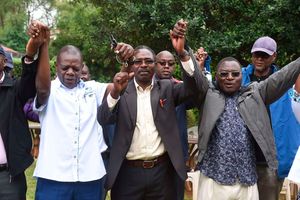
University Academic Staff Union's Secretary for Moi University Chapter, Dr Busolo Wegesa (left), the chapter's Organising Secretary Ojuki Nyabuta (centre) and other officials during the start of their strike in Eldoret City, Uasin Gishu County, on August 20, 2025.
Photo credit: Jared Nyataya | Nation Media Group
He said the university has not remitted deductions for the pension scheme amounting to Sh4.6 billion, while the lecturers cannot access health services due to non-remittance of contributions to the Social Health Authority (SHA) for the last three months.
“We are not demanding any salary increment but what belongs to us under the return to work formula entered with the university management,” added Dr Busolo.
Under the deal between the union and university management last November and witnessed by Julius Ogamba, Principal Secretary for Higher Education, and Dr Beatrice Inyangala, the workers secured Sh2.6 billion in terms of cash and assets, with the immediate release of Sh500 million.
The university management was to surrender assets—land in Kitale, Nairobi, and Mombasa—worth Sh2.1 billion, which will be transferred to the union’s pension scheme.
The union was to receive Sh1.25 billion in the 2025/2026 financial year to be used to offset the 2016/2017 CBA salary arrears.
Under the agreement, an additional Sh3.3 billion will be released in the 2026/2027 financial year to settle bank loans and any arrears in the pension scheme.
The final payment of Sh1.75 billion will be factored in the 2027/2028 financial year and will be used to settle any pending payments.
The back-to-work formula included Sh100 million factored to offset bank loans, Sh30 million for the benevolent fund, Sh40 million for welfare, and Sh30 million for the group life insurance scheme. Another Sh50 million was allocated for union dues and Sh100 million as a refund for bank loans paid individually by the workers.
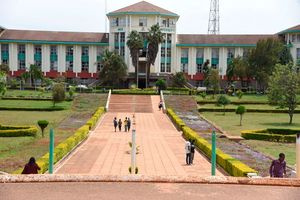
The entrance to Moi University's main campus in Kesses, Uasin Gishu County on February 8, 2024.
Photo credit: Jared Nyataya | Nation Media Group
But the university has admitted that it faces challenges paying salaries to its staff even after it received additional funding from the National Treasury, and has disclosed plans to lay off hundreds of employees to cut down on the ballooning wage bill.
Moi University, once a giant institution of higher learning in the country, sent some 324 workers on contract basis early this year, even as it recovers from a three-month closure following protests by teaching and non-teaching staff.
Prof Kotut said student numbers have dropped from 48,000 in 2015 to the current 21,000, making it a challenge for the university to meet its financial obligations, including payment of employees’ emoluments.
CS Ogamba confirmed that the university was grappling with significant financial issues, including debts of Sh8 billion.
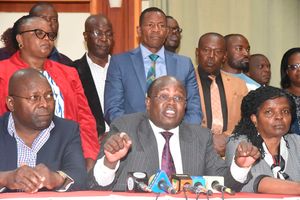
Education Cabinet Secretary Julius Ogamba before the National Assembly Committee on Implementation at Bunge Tower, Nairobi, on August 19, 2025.
Photo credit: Dennis Onsongo | Nation Media Group
Among factors contributing to the financial woes facing the institution are declining student enrolment from 50,000 in 2015 to 27,000 in 2021, closure of non-viable campuses, reduced exchequer funding and rising personnel costs due to National Collective Bargaining Agreements (CBAs) that have not been fully funded.