Ruto awards ILU charter, challenges universities to produce job creators
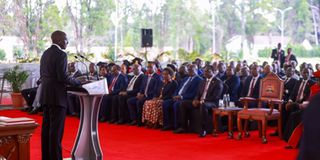
President William Ruto has challenged institutions to prioritise critical thinking, enterprise education, and mandatory digital and AI literacy.

President William Ruto has challenged universities to rethink their training models and produce graduates equipped to create jobs, rather than compete for the few available opportunities, as Kenya seeks to build a knowledge-driven economy.
Dr Ruto said universities must move beyond awarding academic qualifications and focus on developing graduates capable of solving real-world problems, establishing businesses and responding to changing demands in the labour market.
Speaking at State House, Nairobi, on Thursday during the award of a charter to International Leadership University (ILU), the President said Kenya could not build a competitive economy using an education system that prepares learners to reproduce outdated knowledge.


“We must move from memorisation to critical thinking, from certificates to competence, and from preparing graduates merely to seek employment to equipping them to create enterprises, create jobs and generate wealth,” he said.
President Ruto outlined four areas he wants universities to prioritise, including teaching through real-life challenges, involving employers in curriculum development, strengthening digital skills and making enterprise education part of university training.
He challenged universities to work with counties, hospitals and cooperatives to identify practical problems that students can tackle as part of their training.
He said employers should also be brought into classrooms to help design academic programmes and expand industrial attachments, allowing students to acquire workplace experience before graduation.
On digital skills, Dr Ruto said every graduate should be capable of using technology, working with data and applying artificial intelligence responsibly.
“Graduates should know how to identify a need, develop a solution, find customers, and build sustainable businesses. Kenya needs young people capable of taking up jobs and creating them,” he said.
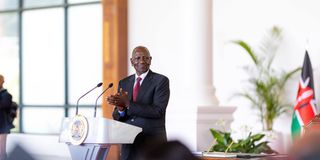
President William Ruto urged universities to transition from rote learning to practical competence.
He warned that universities must adapt to changes in the world of work, citing the World Economic Forum's Future of Jobs Report 2025, which estimates that 39 per cent of workers' skills will change or become outdated by 2030.
Artificial intelligence, automation and digital technologies are already transforming how economies produce, trade and compete, he said.
Dr Ruto said Kenya's ambition was to build a knowledge-driven economy that exports not only agricultural produce and manufactured goods but also technology, financial services, professional expertise and innovation.
He cited the possibility of software engineers in Nairobi serving companies in London and financial analysts in counties such as Kisumu, Migori and Lodwar supporting enterprises in New York.
The President defended the Government's investment in education, saying the sector had received Sh784.5 billion in the 2026/27 financial year, compared with Sh527 billion in 2022/23, representing a 49 per cent increase.
He said the Government had recruited 100,000 teachers since 2023, with another 20,000 expected to join by the end of this year.
More than 23,000 classrooms have also been constructed, while the Government is progressing with the establishment of 1,600 laboratories to strengthen science, technology, engineering and mathematics.
On university education, Dr Ruto said 202,133 students had been placed in degree programmes this year under the student-centred higher education funding model, which provides scholarships and loans according to financial need.
He also announced plans to expand the National Internship Programme from January 1, 2027, to accommodate 50,000 young Kenyans, who will receive monthly stipends.
The Government will introduce incentives for private employers offering internship opportunities, with the President urging businesses to provide graduates with practical experience and mentorship.
The award of the charter to ILU marks a new chapter for the institution, which began in 1980 as the Nairobi International School of Theology.
The university has since trained men and women for service in the Church, business, Government and communities.
Dr Ruto said the charter came with greater responsibility to prepare leaders capable of addressing the country's challenges.
“These investments and reforms serve a purpose greater than expanding our education system or preparing young people for employment. They are part of a much larger national undertaking: Fulfilling the promise Kenyans made to themselves when they adopted our Constitution in 2010,” said Dr Ruto.
He further linked education and economic opportunity to the Constitution, saying the rights to education, healthcare, housing and social security required investment, competent institutions and accountable leadership.
“There is no dignity in the conditions of poverty. A hungry child has the right to education, but hunger makes it harder to learn. A graduate has the freedom to pursue their ambitions, but unemployment makes those ambitions harder to realise,” he said.
He challenged ILU to measure its success not simply by the number of graduates it produces but by the problems they solve, businesses they establish, institutions they strengthen and lives they improve.
Follow our WhatsApp channel for breaking news updates and more stories like this.