Schools across the country reopened on Monday amid mixed levels of preparedness, low student turnout and mounting concerns over rising education costs.
Parents reported difficulties in preparing their children for school, with a tough economy and high cost of living stretching household budgets. Challenges of inadequate infrastructure were also reported nationwide.
The 2026 academic year is particularly high-stakes, marking the transition of 1.13 million pioneer Grade 10 learners into senior school under the Competency-Based Education (CBE) system.
According to the Ministry of Education’s 2026 academic calendar, Term I runs from January 5 to April 2, with a half-term break from February 25 to March 1 and an April 7 to 24 holiday.
Term II runs from April 27 to July 31, with a half-term break from June 24 to 28. Schools will break for holiday from August 3 to 21. Term III begins on August 24 and ends on October 23, followed by national examinations and the December holiday from October 26, 2026, to January 1, 2027.
This year also marks a major financial milestone for schools. The government disbursed Sh44 billion to stabilise the CBE rollout ahead of opening day. Funds for the free primary and day secondary education have also been released.
The Kenya Primary Schools Heads Association (Kepsha) said that capitation funds were credited to school accounts last Friday, three days before schools reopened. The association’s chairperson, Mr Fuad Ali Johnson Nzioka, described the move as a game-changer. He said that early disbursement of cash would enable schools to plan effectively and avoid disruptions.
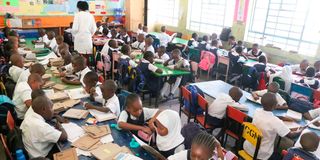
Grade Two pupils in class at St Xaviers Primary School in Nakuru City on January 5, 2026 on day one of Term One.
Photo credit: Boniface Mwangi | Nation Media Group
“For the first time in history, we received capitation before schools reopened. We can now plan the term’s activities without hiccups. Parents are advised to take school opening dates seriously, particularly in January,” Mr Ali said.
“Full attendance has not been achieved due to transport challenges, especially for learners returning from rural areas.”
However, a recent report by the National Gender and Equality Commission indicates that the rollout of the new curriculum continues to face significant hurdles. Inadequate infrastructure and learning materials, teacher shortages and challenges accessing the national assessment portal, are listed as some of the shortcomings.
The report notes that the situation is most severe in arid and semi-arid lands (Asal) counties, where technology gaps have worsened digital inequality.
A spot-check by the Daily Nation in Lamu County revealed that out of five schools within the dense Boni Forest, four failed to reopen. Only Kiangwe Comprehensive School resumed learning, though partially, as most teachers had not reported to work.
The schools that remained closed—Mangai, Mararani, Basuba and Milimani—serve at least 300 pupils from pre-primary to Grade 6.
Stranded due to lack of transport
At Kiangwe Comprehensive School, at least 150 pupils had reported on Monday. The school has six teachers, but not all of them were present.
Transport problems were cited. Kiangwe village borders Boni Forest to the west and the Indian Ocean to the east. Boats are the main means of transport.
Teachers in the other four schools — located deep inside Boni Forest — depend on prearranged security to get to their workstations. The area has experienced persistent threats from terrorist group Al-Shabaab for over a decade.
The teachers who were interviewed said that they stranded due to lack of transport. Most of them are non-locals.
Leah Wanjiku (right) attends to a customer at Topgate Bookshop which is situated along Lagos Road in Nairobi, on January 5, 2026.
Photo credit: Bonface Bogita | Nation Media Group
Mangai Comprehensive School headteacher Khamis Athman Mwaleso, who is from Matuga in Kwale County, said there has been no communication on transport arrangements.
“We cannot go to Boni Forest on our own. Security clearance and transport must be coordinated by the Interior Ministry. That is why we could not open schools today (yesterday),” he said.
Lamu East Deputy County Commissioner Philip Muoki said that plans were underway to transport teachers to schools.
“We are coordinating with the Ministry of Education to ferry teachers safely, preferably by air. If that is not possible, road transport under armed escort will be arranged,” he said.
In Kisumu County, school readiness and attendance varied. At Kibwai Primary School, the headteacher, Ms Benter Japar, said preparations were complete.
In Kisii, traders reported sluggish sales of school items. Ms Alice Mokeira, who sells school bags in Kisii town, said many parents walked away after being told the prices.
“I was given a long list of requirements, but I can only afford the essential items,” said Mr Kefa Michieka, a parent in Gesusu.
In Homa Bay, activist Mr Julius Omuga asked the government to discipline principals who imposed illegal levies.
In Murang’a County, Ms Esther Wangechi said that she could not afford to take her son to Grade 10. Other parents said the same.
Grade Two pupils in class at St Xaviers Primary School in Nakuru City on January 5, 2026 on day one of Term One.
Photo credit: Boniface Mwangi | Nation Media Group
In Baringo, parents said that the prolonged holidays, cultural obligations and drought drained their finances. A parent, Mr Richard Chepchomei from Baringo North, said that he was struggling to cater for his children.
In Tiaty East, Ms Martha Pkemoi said drought had weakened livestock and she was unable to sell her goats to pay fees for her daughter.
In Turkana County, back-to-school activity in Lodwar was subdued. Residents complained about the effects of drought and poor livestock prices.
In Trans Nzoia County, parents were busy shopping for school items in Kitale town, although many said that they had tight budgets. And parents in some schools in Ndaragua Constituency protested over the lack of classes. At Umoja Mbuyu Primary School in Nyandrua County, parents complained about inadequate classrooms.
At Tenwek Boys High school in Bomet County, the school uses makeshift dining halls and dormitories due to high enrolment with over 3,000 learners. On the other hand, Litein Boys High School in Kericho County faces an uphill task after buildings were damaged during a students’ strike last year
Reporting by Mercy Simiyu, Lynet Igadwah, Mary Wangari, Kalume Kazungu, Winnie Atieno, Domnic Ombok, Wycliffe Nyaberi, Martin Mwaura, George Odiwuor, Florah Koech, Evans Jaola, Waikwa Maina, Vitalis Kimutai and Sammy Lutta