As school gates swing open this week for the 2026 academic calendar, the education sector is bracing for a turbulent start to its most historic transition, amid disputes over fees, teachers and facility shortages.
For the first time, 1.13 million pioneer learners under the Competency-Based Education (CBE) system are crossing into senior school (Grade 10), marking the final and most consequential stretch of a decade-long reform.
However, what should be a proud milestone is already dogged by a merit blackout in student placement, a desperate race for infrastructure, and a biting teacher shortage that has left parents, principals and learners on edge.
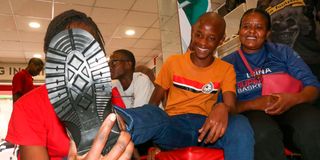
Mercyline Anyango (right) attends to customers at Kibrose Uniforms in Nairobi on January 4, 2026.
Photo credit: Lucy Wanjiru | Nation Media Group
In an effort to stabilise the transition, the State released Sh44 billion in capitation funds for Term One. Free Day Secondary (Senior School) will receive Sh26 billion, Free Day Junior School Sh14 billion, while Free Primary Education has been allocated Sh3.7 billion.
Education Cabinet Secretary Julius Ogamba warned principals against imposing extra levies, noting that some school heads have been charging hidden costs for lunch and infrastructure.
“School heads and principals are directed to ensure prudent use of these public resources entrusted to their care for the benefit of learners, and to desist from imposing any extra levies or fees. As a Ministry, we will deal firmly with any verified cases of misappropriation of resources and the imposition of extra levies or fees,” said Mr Ogamba in a statement.
Principals, however, say funding remains the biggest challenge, both in terms of capitation and fees paid by parents, which were last fixed in 2014 and no longer reflect current realities.
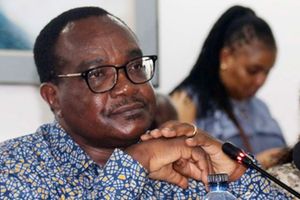
The Kenya Secondary Schools Heads Association (Kessha) chairperson, Willie Kuria, urged the State to urgently address the funding challenge.
Education Cabinet Secretary Julius Ogamba (left) and National Chairman, Kenya Secondary Schools Heads Association Willy Kuria during the 48thKESSHA Annual National Conference for in Mombasa on June 25, 2025.
Photo credit: Kevin Odit | Nation Media Group
“The challenge has been compounded by a declining student population after one class was moved to primary schools, yet the cost of running schools, including salaries and utility bills, remains the same,” said Mr Kuria.
He warned that some secondary schools may be forced to close due to low enrolment and lack of funds.
Meanwhile, parents are walking a financial tightrope. While boarding fees remain capped at Sh53,554, school heads argue the figure—set in 2014—is outdated.
Unlike the former 8-4-4 system, which allowed differentiated boarding fees across national, extra-county and county schools, the new flat-rate structure has raised concerns among stakeholders.
National Parents Association chairperson Silas Obuhatsa urged the State to ensure no Grade 10 learner is sent home over fees.
“These are very young children. We do not want to risk their lives by sending them away. Under CBE, we want proper implementation and no learner being chased from school,” he said.
Massive infrastructure shortfall
The digital leap into Grade 10 has been anything but seamless. More than 350,000 learners have applied for placement reviews after expressing dissatisfaction with their initial senior school placement.
To address the grievances, the Ministry has opened a final revision window from January 6 to January 9, 2026.
“The revision will provide parents, guardians and learners with the opportunity to present legitimate and verifiable grounds to justify a reconsideration of the initial or revised placement,” said CS Ogamba.
Education Cabinet Secretary Julius Ogamba.
Photo credit: Lucy Wanjiru | Nation Media Group
The new classification of schools into C1, C2, C3 and C4 has raised fears of deepening inequality.
C1 schools—formerly national schools—offer all three pathways: STEM, Social Sciences, and Arts and Sports, while C2 to C4 schools offer limited options depending on available facilities.
At the centre of the rollout headache is a massive infrastructure shortfall. Thousands of senior schools lack specialised facilities required for the pathways, particularly in STEM and Arts. Laboratories, workshops, ICT rooms and sports facilities are either non-existent or in poor condition.
Rural schools and institutions in marginalised areas are the worst affected. Recently, President William Ruto directed the Ministry of Education to prioritise the construction of facilities in rural areas to bridge the gap and ensure equity.
Mr Kuria also raised concerns about staff shortages, especially with the expanded curriculum under CBE.
“We need infrastructure to handle technical subjects that have been introduced, such as electricity, woodwork and others,” he said.
Stakeholders, led by the Kenya Human Rights Commission (KHRC), warn that rural and marginalised schools risk being left behind.
KHRC Deputy Executive Director Cornelius Oduor said it makes little sense for top-performing students to cluster in C1 schools with superior facilities while others languish in ill-equipped C3 and C4 institutions.
He urged the State to equip all public schools to ensure learners from disadvantaged backgrounds can still access quality education within their localities.
“The few who get into top-notch schools will continue to outperform the rest, and they are also the ones likely to secure the best university courses,” he said, urging the government to prioritise teacher recruitment in 2026 to bridge glaring disparities.
“We thought CBE would remove inequalities in education, but why are so many learners now scrambling for admission into a few selected blue-chip schools?” Mr Oduor posed.
The Teachers Service Commission (TSC) faces a daunting task in staffing the new Grade 10 pathways, with a requirement for 58,590 senior school teachers.
TSC Director of Quality Assurance Dr Reuben Nthamburi highlighted acute shortages in technical subjects such as Marine and Fisheries, Mandarin (Chinese), Agriculture and Creative Arts.
Parent purchase school uniforms for their children at Mombasa Uniform Stores January 2, 2026.
Photo credit: Kevin Odit | Nation Media Group
TSC estimates it needs 35,000 teachers for STEM, 14,600 for Social Sciences and 8,778 for Arts and Sports.
Ministry of Education statistics show that more than half of the 1.13 million learners who recently sat the Kenya Junior Secondary Education Assessment (KJSEA) opted for the STEM pathway. About 437,000 chose Social Sciences, while 124,000 selected Arts and Sports.
This month, TSC will recruit 9,000 teachers to replace those who exited the service, including 2,000 for senior schools and 7,000 for primary schools.
Parents are also making frantic preparations for Grade 10, with many expressing anxiety and financial strain.
“I am preparing early because I don’t want a last-minute rush,” said Ms Mwanakombo Lambat, a parent from Kwale County shopping for her daughter placed at Bahari Girls High School.
“For a long time, the government has run the sector independently, leaving parents out. We want collaboration between government and all stakeholders for smooth implementation,” said Mr Obuhatsa.
Wide-ranging education reforms
The shifting CBE syllabus has also affected traders. Mombasa-based wholesalers Mohammed Abbass and Mohammed Ali reported combined losses of Sh5 million due to unsold textbooks.
“I wish the State would stop introducing new textbooks every year. It is costly for parents and suppliers,” said Mr Ali of Eden Books.
Mr Abbass said he donated unsold stock to orphanages and had considered quitting the business altogether.
However, pressure from loyal customers seeking one-stop shops has forced him to continue, albeit cautiously.
Meanwhile, uniform sellers are reporting better business. Mr Alfred Mutua, proprietor of Mombasa Uniform Centre, said demand had picked up due to Grade 10 admissions.
“Compared to the last two years, business is fairly good. We are seeing parents shopping early for Grade 10,” he said.
As the pioneer Grade 10 learners prepare to report on January 12, the success of the CBE overhaul hinges on whether the government can bridge the gap between ambitious policy and classroom reality.
For the 1.13 million learners, 2026 is not just another school year—it is the ultimate litmus test for the future of Kenyan education. Recently, President Ruto guaranteed a 100 per cent transition for the inaugural cohort.
“All the 1.13 million children will get placement in senior schools in January. We have made adequate arrangements; no child will be left behind,” he said.
The President noted that his administration has undertaken wide-ranging education reforms since 2022.
“This first cohort going to senior school is the most consequential transition in Kenya’s education history. It will define how our students progress under the reformed system,” he said.
President Ruto also highlighted infrastructure and staffing milestones, including the employment of 100,000 teachers by January 2026, construction of 23,000 classrooms, and the ongoing establishment of 1,600 laboratories.
“We have employed the largest number of teachers, built the most classrooms, corrected the confusion in CBE and are now undertaking this most consequential transition,” he said.