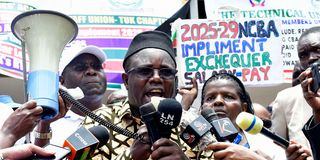
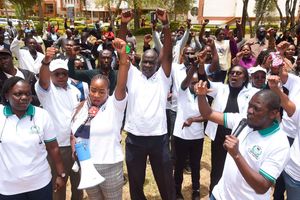
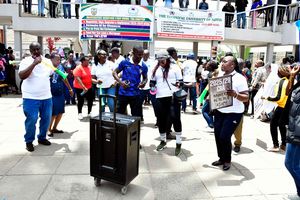
Talks to end the one-week strike that has ground learning and other operations in public universities on Thursday, October 8, failed to unlock the stalemate as contentious issues remain unresolved.
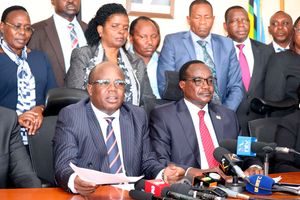
The meeting was attended by technical teams from the three unions whose members have downed tools since Friday last week, the Inter-Public Universities Councils Consultative Forum (IPUCCF) and the Ministry of Labour.
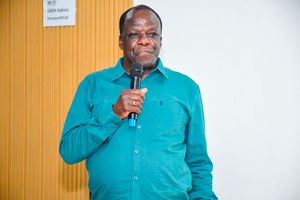
“We met and did simulations on the process. The chairman will present to the government and let them consult, decide and give a counter-offer. We hope after consultations they’re going to invite us,” Constantine Wasonga, the secretary-general of the Universities Academic Staff Union (UASU) told Nation .
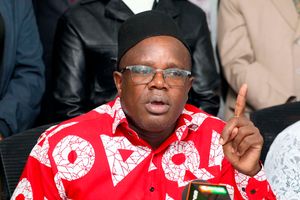
The secretary-general of the Kenya Universities Staff Union (KUSU) Charles Mukhwaya described the process as “Miniature progress; nothing to write home about” and later revealed that no deal had been struck.
However, the Principal Secretary for Higher Education Beatrice Inyangala told Nation that the government is hopeful the dispute will be resolved and students resuming learning.
Why lecturers and university staff are on strike again
“We have made substantial progress, and I want to put this in the right context. The CBA issue we are dealing with today did not start yesterday. Some of these matters have been carried over from previous agreements and previous administrations. This government inherited those challenges, but we have not used that as an excuse. We have gone back, looked at the outstanding commitments and started resolving them. We have made progress on the 2017–2021 and 2021–2025 CBAs, and a number of issues that had remained unresolved for years have now been addressed,” Dr Inyangala said.
She added that there is still work to do on the current dispute, “but the discussions are at a point where we believe the remaining issues can be resolved through engagement”.
Alongside UASU and KUSU, members of the Kenya Union of Domestic, Hotels, Educational Institutions, Hospitals and Allied Workers (Kudheiha) are also on strike.
State Department for Higher Education and Research Principal Secretary Dr Beatrice Inyangala.
Photo credit: Francis Nderitu | Nation Media Group
“Our approach has been very straightforward: listen to the unions, look at the commitments, look at the resources available and find an agreement that government can actually implement,” Dr Inyangala said. “We have no interest in signing an agreement simply to end a strike and then come back with another dispute because the commitments cannot be honoured. We want a CBA that is fair to our university staff, but equally sustainable for our universities and the government. That is the conversation taking place now.”
She however, could not give an exact date when students in public universities will resume learning. Over the past one week, the students have not been learning although they continue to incur living expenses.
“We want our students back in class as soon as possible. But I would rather give students an honest answer than announce a date for the sake of making headlines. Once the parties conclude the outstanding issues, we will move quickly to facilitate the resumption of learning.
The disruption has consequences for students, parents and the universities themselves. Nobody benefits from a prolonged dispute,” said Dr Inyangala.
“I therefore call on the unions and all stakeholders to stay at the negotiating table, maintain good faith and focus on finding a workable settlement.”