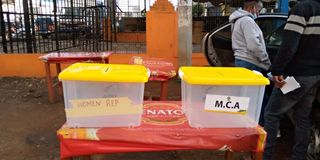
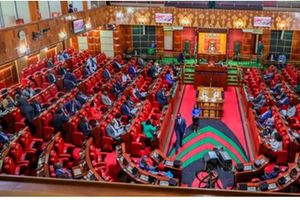
Members of Parliament now want the Independent Electoral and Boundaries Commission (IEBC) locked out of conducting or hearing disputes arising from party nominations, citing interference with the independence of political parties.
During the consideration of the Elections (Amendment) Bill, 2024, the lawmakers argued that political parties are like clubs and the commission has no business in how they conduct their nominations.
The MPs are pushing for an amendment to the Elections Act so as to lock out the commission from handling any disputes arising from party primaries and instead transfer the power to the Elections Disputes Tribunal.
According to Article 88 of the Constitution, IEBC is responsible for conducting or supervising referenda and elections to any elective body or office established by this Constitution, and any other elections as prescribed by an Act of Parliament.
Specifically, Article 88 (4) (e) states that “the commission is responsible for the settlement of electoral disputes, including disputes relating to or arising from nominations but excluding election petitions and disputes subsequent to the declaration of election results.”
According to the lawmakers, involvement of the commission in either conducting party primaries or sitting to hear and determine disputes arising from the nomination exercise erodes political parties’ independence.
The MPs argued that a decision to either hand an aspirant direct ticket or subject others to primaries is purely a prerogative of the political parties and therefore IEBC should not be granted any powers to hear disputes arising from such decisions.
The lawmakers also pointed out that involvement of IEBC in party primaries amounts to ‘meddling’ into the internal affairs of political parties by the commission.
Further, the lawmakers also raised the conflict of interest factor by IEBC in instances where a political party chooses the commission to conduct for them their primaries due to capacity and technology superiority, then they will also be the same party that will handle disputes arising from the same exercise.
Currently, IEBC has been setting up tribunals where an aggrieved aspirant who feels shortchanged in nominations can lodge a dispute with his party at the tribunal for review.
The tribunal has powers to quash the nomination and order a fresh exercise if evidence provided indicates that it was not free and fair.
“We have to delete the role of the IEBC in the settlement of electoral disputes, including disputes relating to or arising from nominations,” said chairman of the Justice and Legal Affairs Committee, George Murugara.
“What we are seeking to do is to remove the role of the IEBC in this, so that the IEBC would deal with the disputes regarding registration. Now, disputes regarding your nomination will have to be dealt with by the Elections Disputes Tribunal,” Mr Murugara added
According to Ugenya MP David Ochieng’, the Office of the Registrar of Political Parties should endeavour to strengthen political parties by ensuring that they have systems that can assist them in managing their affairs independently
“I believe the IEBC has no business in party nominations. Parties are clubs. If they decide they want to give me a direct ticket, so be it. Why should the IEBC get involved?” he asked.
“Parties should be allowed to run independently. They should not be inviting the IEBC into their local and internal affairs,” he added.
Baringo Woman Representative Florence Jematiah, however, pointed out that while there might be no problem in IEBC helping parties with no capacity to conduct their primaries, concerns may arise when the same people from the commission who conducted the primaries sit to determine disputes arising from the same.
“I would not have a problem with the IEBC conducting party elections. The only problem I might have is that, if there is a dispute within my party, the same IEBC would be involved in arbitrating it and that is where confusion could arise,” Ms Jematiah said.
According to an elaborate Election Operation Plan (EOP) 2025-2027 launched in May, all political parties who intend to present a candidate in the August 10, 2027 General Elections have until May 9, 2027 to conduct all their primaries and resolve any disputes arising thereof from the exercise.
According to the timelines, individuals not happy with how their parties have handled the primaries dispute have until June 12, 2027 to lodge their complaints with the Commission, which shall determine them within 10 days.
According to the IEBC operations plan, which forms the blueprint that will guide the Commission’s preparations for the General Election, Political parties must have their Nomination Rules certified by the Registrar of Political Parties by October 30, 2026 and submitted to the Commission by November, 6 2026.
In addition, political parties shall submit their membership lists to the Commission by Tuesday, 16th March 2027. On the same day, they are also required to submit the names of candidates contesting in their party primaries, along with the dates and venues for those primaries.
Bungled nominations have in the past haunted parties with disgruntled aspirants bolting out to join rivals, a move that has also caused voter apathy.
In areas dominated by a single political party, primaries are more competitive since securing a party ticket gives an individual an upper hand in winning the general elections.