Half of Grade Six learners cannot read and comprehend a Grade Three-level English story or solve numeracy problems at the same level, a new report has found, raising fresh concerns about the quality of basic education.
The findings suggest that many learners are ill-prepared for junior school and subsequent learning stages. Grade Six marks the final year of primary education before transition to junior school under the competency-based education (CBE) system.
The report, released yesterday by Usawa Agenda, paints a particularly worrying picture in public primary schools, where 51.3 per cent of Grade Six learners are unable to read and comprehend a Grade Three-appropriate English passage. In private schools, 42.3 per cent of learners also lack basic literacy and numeracy skills.
The results are especially concerning given that Grade Six learners are at a critical point in the CBE pathway and are preparing to sit the Kenya Primary School Education Assessment (KPSEA) ahead of transition to senior school.
“Literacy is the mother of all learning. If you cannot read, it becomes very difficult to learn, because even some numeracy questions are presented in paragraph form,” said Usawa Agenda Executive Director Dr Emmanuel Manyasa during the release of the Foundational Literacy and Numeracy Assessment Report (FLANA 2025).
Usawa Agenda Executive Director Dr Emmanuel Manyasa.
Photo credit: Francis Nderitu | Nation Media Group
The survey, conducted between June and July 2025 across all 47 counties, assessed 49,835 children aged between 10 and 15 years, both in and out of school, covering learners in Grades Three to Nine. Overall, 43 out of every 100 Grade Six learners were unable to solve a Grade Three-level numeracy problem, with the challenge more pronounced in rural areas, where 45 out of 100 learners struggled, compared with 38 out of 100 in urban areas.
For the first time, the assessment included learners in refugee camps, even as the findings showed that urban schools generally provide a more conducive learning environment than their rural counterparts.
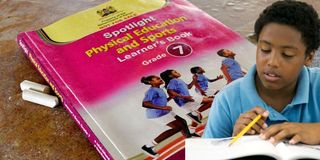
A pupil at Kandaria Comprehensive School reads at the institution on August 15, 2024.
Photo credit: Alex Odhiambo | Nation Media Group
“Among the refugee community, 56 per cent of Grade Six learners cannot solve a Grade Three mathematics problem, yet these are pupils exiting primary school,” Dr Manyasa said.
The survey also examined staffing levels and found that public primary schools have a higher learner-teacher ratio of 42:1, compared with 34:1 in private schools.
In public schools, eight out of every 100 teachers are employed by the Teachers Service Commission (TSC) on permanent and pensionable terms, five out of 100 are on internship contracts, while one in every 10 is hired by boards of management (BoMs) on temporary terms. Parents shoulder the cost of teachers hired by BoMs, contributing 63 out of every 100 shillings nationally, rising to 66 out of every 100 shillings in rural schools.
“We found that Board of Management (BoM) teachers are poorly paid, with about 50 per cent earning less than Sh10,000 a month. In some cases, school heads are forced to divert capitation funds to pay them,” said Dr Manyasa. The findings further show that sanitation standards in many schools remain inadequate, with one water point serving an average of 173 learners, while 47 girls share a single toilet and 64 boys use one latrine.
The Ministry of Education has initiated the development of comprehensive guidelines aimed at strengthening foundational learning in pre-primary and lower primary grades across the country. The move follows persistent gaps in implementation, coordination and funding of early-grade education, despite the ongoing rollout of the Competency-Based Education (CBE) curriculum.
“We already have interventions outlined in the guidelines that will help us support learners who are lagging behind,” said Ms Martha Oduor, the Ministry’s head of Early Childhood Development (ECD).
Kenya is also drawing lessons from global best practices, particularly from Rwanda and Brazil, which have recorded notable gains in early-grade literacy and numeracy.
According to the Foundational Literacy and Numeracy Assessment (FLANA) report, an average of 94.2 per cent of children aged between four and 17 years are enrolled in school.
The 10 counties with enrolment rates below the national average are all located in arid and semi-arid lands (ASALs).
Garissa, Mandera and Turkana top the list of counties with the highest number of out-of-school children, with those aged four and five years most affected.
The study also shows that 97 per cent of primary schools are connected to either electricity or solar power as their main energy source, while 46.3 per cent have access to the internet.
However, only 23.7 per cent of primary schools have functional computer laboratories, more than half of which (53.2 per cent) are in private institutions.