The government is seeking a new law to overhaul the financing of universities and Technical and Vocational Education and Training (TVET) institutions in a bid to end chronic funding shortages that have left the sector facing a combined deficit of nearly Sh44 billion.
Education Cabinet Secretary Julius Ogamba told MPs that the Ministry of Education is finalising the Tertiary Education and Funding Bill, 2025, which seeks to establish a long-term financing framework for higher education after years of budget shortfalls, delayed capitation and scholarship disbursements.
Official figures show public universities face a funding gap of Sh28.97 billion, while TVET institutions are short by Sh14.9 billion, leaving the sector with a combined deficit of about Sh43.9 billion.
"We have now done a Tertiary Education and Funding Bill 2025 which is on its way to Parliament,” he said.
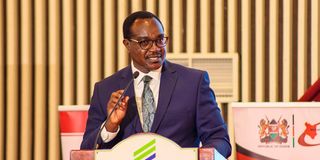
Education Cabinet Secretary Julius Ogamba (center) addresses the media during the Kenya Universities and Colleges Central Placement Service (KUCCPS) stakeholders' forum for the release of the 2026 university and college placement results in Nairobi on July 8, 2026.
Photo credit: Wilfred Nyangaresi | Nation Media Group
Mr Ogamba said the proposed law is based on recommendations of the Presidential Working Party on Education Reforms, which called for a sustainable financing model for tertiary education instead of relying on annual budget allocations that have consistently fallen short.
“One of the recommendations is that we will need to relook at all the funds that are available that we are utilising in the sector of education and have them in one pot that we can then use to distribute and support our students,” he told the Committee chaired by Luanda MP Dick Maungu.
The Cabinet Secretary said universities required Sh70.39 billion for scholarships and grants in the financial year ending June 2026 but received Sh41.42 billion, leaving a Sh28.97 billion deficit.
Under the student-centred funding model alone, universities required Sh29.5 billion but received Sh18 billion, while continuing students under the previous DUC model faced another Sh17.4 billion funding gap.
The Cabinet Secretary disclosed that annual capitation for TVET institutions has remained at Sh5.2 billion for several years despite a sharp increase in student enrolment.
He said the funding caters for trainees under the previous capitation system as well as scholarships under the student-centred funding model introduced in the 2023/24 financial year but the budget has not kept pace with demand.
According to the Ministry, while the approved annual allocation has remained at Sh5.2 billion, actual disbursements have in several years fallen below that amount, creating funding deficits for institutions.
The CS painted an even bleaker picture for public universities, saying the institutions are grappling with structural underfunding that has accumulated over several years.
He revealed that under the student-centred funding model, universities required Sh29.9 billion during the 2025/26 financial year but received only Sh18 billion, leaving a funding gap of nearly Sh11.5 billion.
Continuing students under the previous Differentiated Unit Cost (DUC) model required Sh40.4 billion, yet only Sh23 billion was allocated, resulting in another Sh17.4 billion shortfall.
"The figures represent budgetary gaps arising from inadequate allocations, not undistributed Exchequer funds. Every shilling released to the Universities Fund was disbursed to eligible public universities," he said.
Mr Ogamba added that the persistent mismatch between institutional obligations and available resources has fuelled the accumulation of pending bills and weakened universities' ability to meet payroll, pay suppliers and maintain teaching, research and student services.
Data tabled in Parliament by the State Department of Higher Education in March shows total pending bills across public university institutions surged 17.6 percent to Sh100.3 billion in just eight months.
In July 2025, total pending bills across the institutions, which include unremitted SACCO and statutory deductions, unpaid suppliers, capital projects, and part-time lecturers, stood at Sh85 billion.