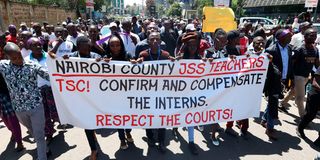
The Teachers Service Commission (TSC) has proposed a new administrative structure which, if adopted, aims to resolve the long-standing leadership conflict between primary school head teachers and tutors deployed to the junior school section.
Since the junior school section was incorporated into primary schools in 2023, the combined institutions have been referred to as comprehensive schools, with the head teacher acting as the principal.
The commission now proposes a structure in which the institution will be headed by a principal, assisted by two deputies: one for the primary section and one for the junior school.
Ms Antonina Lentoijoni, the Director of Staffing, revealed this information when answering questions from senators during a meeting in Mombasa. However, the new structure will require legal amendments to take effect.
“We actually have a challenge there. Even our junior school teachers do not respect the heads, especially when they know that they are P1-trained teachers. But this is a transitional period. Before the laws are enacted to recognise comprehensive schools, the primary school head teachers are still in charge of the junior school,” she added.
She was responding to the vice chairperson of the Senate Education Committee, Prof Margaret Kamar, who had asked how the TSC handles issues that arise between primary school heads and junior school teachers.
“Until that happens, our head teachers are helping us, and they have guidelines on how to handle the situation. But at the moment, they are assisting us with junior school matters,” she said.
Teachers, through the Kenya Union of Post-Primary Education Teachers (Kuppet) and the Kenya Association of Junior School Teachers (KAJST), have been demanding administrative autonomy from primary school head teachers. They argue that the current system hinders their professional and career development.
On Saturday, Kuppet Secretary-General Akello Misori, was jeered during a meeting at State House in Nairobi during a meeting between teachers and President William Ruto. Mr Misori had suggested that junior schools be domiciled in secondary schools.
Teachers deployed to junior schools
Ms Lentoijoni explained that the commission is reviewing staffing norms to align with the recommendations of the Presidential Working Party on Education Reforms.
“Two to three weeks ago, we received the guidelines on the rationalisation of senior schools, and last year we received the same for junior schools, due to reforms implemented by the Education Taskforce. The review is necessary because of these reforms,” she said.
After the review, the TSC will know exactly how many teachers are required in junior schools. Currently, the commission is using the existing staffing norms for secondary schools.
“That is what has resulted in a shortage of 72,442 teachers in junior schools. We have now received all the guidelines from the Ministry of Education, which will enable us to determine the exact numbers,” said Ms Lentoijoni.
Although “comprehensive schools” are not yet legally recognised, the Ministry of Education has drafted Bills that are pending in the National Assembly.
However, the staffing officer insisted that junior school teachers must be qualified to teach in secondary schools. This includes achieving a minimum mean grade of C+ in the Kenya Certificate of Secondary Education (KCSE) and a grade of C+ or higher in two teaching subjects.
The director revealed that the 14,000 primary school teachers recently deployed to junior schools to address an acute shortage met these requirements.
TSC acting Chief Executive Officer Eveleen Mitei said the teachers were deployed to junior schools because there was a surplus of tutors in primary schools.
“That is why we allowed qualified primary school teachers to move to junior schools. There is no shortage of teachers in primary schools other than those who leave and are replaced. There is a bit of stability at primary level,” said Ms Mitei.
During the State House meeting thatwas held on Saturday, President Ruto directed Education Cabinet Secretary Julius Ogamba to fast-track crucial Bills to resolve issues in competency-based education.