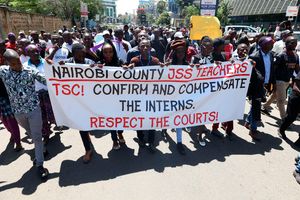
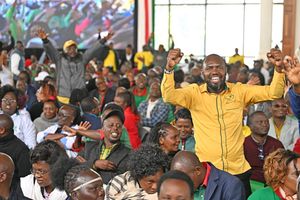
Three years after the roll-out of the junior school segment, teachers deployed to the schools remain unsettled, under-resourced, overworked and agitating for autonomy from the administrations of primary schools where they are domiciled.
There are also tensions between the teachers and head teachers who manage both the primary and junior school sections. The teachers, who are courted to join rival trade unions for representation, complain that they lack clear career progression pathways and now calling for de-linkage from primary schools. Deployment to junior schools has been chaotic from with most of them initially hired as interns before being confirmed.
On Sunday, scores of junior school teachers took to the streets in Nyeri town to air their grievances. The demonstrations were organised by the Nyeri branch of the Kenya Union of Post Primary Education Teachers (KUPPET) and the Nyeri Junior School Teachers Association. They called for junior schools to be recognised as standalone institutions separate from primary schools.
Peter Kimathi, the interim chair of the teachers’ association said many junior schools are understaffed, with single-stream schools having only one or two teachers. Due to this, the teachers are forced to teach subjects outside their areas of expertise.
“We call upon the Teachers Service Commission (TSC) to confirm the current interns [to permanent and pensionable terms] and deploy more teachers to address this shortage. This unfair distribution of workload severely undermines curriculum delivery,” he said.
Although there is no common association representing junior school teachers, there are a number of groupings they have formed to lobby on their behalf. The placing of junior school in primary schools was arrived at following recommendations of the Presidential Working Party on Education Reforms.
In counties such as Kwale, Embu and Bungoma, junior school teachers complained of alleged disrespect, harassment, and being forced to do non-teaching duties at school.
“I have to prepare myself every weekend because I know every Monday is kitchen duty for me, in addition to classes. I have been doing this since the beginning of the year,” said Kevin*, a teacher in Msambweni, Kwale County.
He added that efforts to complain about the newly assigned duties led to the teachers being threatened. KEJUSTA national chairperson James Odhiambo said such incidences have made the teachers to push for autonomy, with the schools having their own administration.
“It is a national crisis and we need dignity and respect at the workplace. We are rejecting the idea of comprehensive schools because this will create even more confusion and conflict between the head of institution and the teachers,” said Mr Odhiambo.
He added that the independence would also lead to better budgeting of the funds provided by the government in the school to cater for stationery and critical teaching and learning materials in laboratories and libraries.
“Nothing is ongoing in most of these schools because the labs are not equipped. The administration is not supportive and most teachers are either given a few chalks or asked to buy their own,” added Mr Odhiambo.
On career progression, he said there was no clear pathway to guarantee professional growth or motivations to the teachers based on their skills and experience.
In Bungoma County, KEJUSTA organising secretary Ladyisar Simiyu said most of the funds sent to schools were not used to support activities in junior schools.
“Some learners do not have desks. Co-curricular activities such as sports, music, science, engineering and drama are not fully supported in the junior section and this is alarming,” said Ms Simiyu.
Mr Kimathi faulted head teachers for over-reliance on commercial examinations, saying they burden both students and teachers. He claimed the examinations are often administered during teaching periods and results rushed for sub-county rankings.
“These tests are costly for parents and focus on competition at the expense of competency-based education,” he said, adding that only end-term exams should be mandatory, with opener and mid-term assessments set by classroom teachers or developed by the junior school staff.
He further demanded that junior schools be allowed to manage their own co-curricular activities. Mr Kimathi said that when primary and junior schools are lumped together, junior school learners lose opportunities.
“In a recent case, a junior school teacher and a primary school teacher both prepared for a sports competition, but the administration treated the school as one unit and reduced the team size, denying junior school learners a fair chance to participate,” he said.
According to KUPPET executive secretary of Kwale County Leonard Oronje recognising junior schools as a distinct and separate level of education would fully adhere to the competency-based education structure of 2-6-3-3. He said if the Ministry of Education does not respond to the demands for separation, the union would move to the High Court.
“How do you expect a teacher to handle 40 lessons a week? That means they have no time to rest and must attend classes one after another,” said Mr Oronje.
Last week, the TSC director of staffing Antonina Lentoijoni revealed that the commission had proposed a new structure that will allow comprehensive schools to be headed by a principal, assisted by two deputies one for primary school and one for junior school.