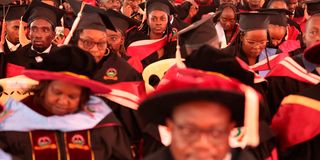
The Auditor-General, Nancy Gathungu, has poked holes into the higher education funding model after an audit showed that some deserving students were denied funding while some who had even deferred studies were allocated funds.
The audit report linked the lack of integration between the funding model and the Kenya Universities and Colleges Central Placement Services (KUCCPS) system to the problems the model has faced. It was introduced in 2023.
"The model is not integrated with the Kenya Universities Central Placement Service system to ensure seamless tracking of students from placements in the universities, to funding," further says the report.
Auditor-General Nancy Gathungu.
Photo credit: File | Nation Media Group
It is this disconnect the auditor says has made it difficult to track students throughout their academic journey. Without a proper link, some students have received funds despite not being officially placed in universities, while others have been omitted due to missing or duplicated registration numbers.
"A review of documents and interviews with the Fund management revealed critical challenges the model is facing. For instance; there is no coordination between the other government agencies dealing with the higher education students support," reads part of the report.
Ms Gathungu further revealed that scholarships were paid to students, who had deferred their studies, failed to report to university or had been expelled. The report is for the year ending June 2024, and has exposed gaps that have left many students struggling to access funds, raising serious questions about the system’s viability.
"This raises concerns about the system’s ability to fairly allocate funds. As such, the effectiveness of control over scholarship management processes could not be confirmed,” the report reads.
When President William Ruto's administration established a new model for funding higher education in 2023, it was touted as the best funding approach, student-centered and the panacea to more equitable education. The model uses a means testing instrument (MTI), to assess the financial needs of the students, who are then categorised in five bands. The instrument is meant to ensure targeted support through scholarships, loans and household contributions.
However, the audit found that the MTI used to assess students was flawed due to inaccurate data submitted by applicants, leading to miscalculations in aid distribution.
"Review of the means testing instruments (MTIs) used for placing students in bands against approved MTIs revealed variances between the approved MTIs and the system-configured MTIs. In the circumstances, students' placements resulting from use of the unapproved MTIs were inaccurate," reads the report.
It also emerged that a lack of awareness about the funding model was a major challenge. The audit revealed that many students, especially those in marginalised regions, were unaware of how to apply for financial aid, limiting their chances of benefiting from the scheme. Inclusivity has also emerged as a concern.
"Vulnerable groups such as students living with disabilities and those from remote areas have faced difficulties accessing funds," notes the report.
“There were also emerging concerns on unique challenges, such as those faced by Muslim students who require Sharia-compliant financial products, further hindering inclusivity,” Ms Gathungu observed.
Beyond the challenges, the audit warns that the sustainability of the fund is at risk due to low loan repayment rates.
"Loan repayment burden due to high unemployment and underemployment rates are making it difficult for graduates to repay their loans, increasing default rates and threatening sustainability big the revolving fund," further reads the report.
The report further indicates the funding programme has also faced legal challenges. In December 2024, the High Court declared it unconstitutional, ruling that it was discriminatory and lacked public participation.
Justice Chacha Mwita found that shifting the responsibility of university financing from the government to parents was a violation of the constitution. However, on March 26 2025,the Court of Appeal overturned the High Court ruling that declared the Higher Education Funding Model unconstitutional. The appellate court ordered the reinstatement of the model, pending a final decision on the matter.
The court instructed the Universities Fund to notify all public universities and students about the reinstated funding framework within 14 days. The case was filed by the Kenya Human Rights Commission Elimu Bora Working Group and the Students Caucus.
The model combines scholarships, student loans, and household contributions, allocated on a graduated scale using the MTI. The UF caters for the scholarship component while student loans are awarded by the Higher Education Loans Board.
Since its rollout in 2023, the funding model has drawn criticism for what critics argue is its failure to guarantee fairness and efficiency. Pressure has been mounting on the government to either overhaul the system or find alternative solutions to secure the future of higher education funding.