The planned visit by over 3,000 teachers’ representatives to State House, Nairobi on Friday, September 12, is the latest such delegation to be hosted by President William Ruto at the address.
The President has hosted delegations from various parts of the country to address issues affecting them and recently hosted a ‘youth empowerment’ event at the venue. Whereas previous delegations to State House have carried political messaging, senior officials of the unions and associations invited denied the meeting has anything to do with politics.
The attendees are drawn from teachers’ unions and associations and will be drawn from the grassroots to the national leadership. Those invited are from the Kenya National Union of Teachers (Knut), Kenya Primary Schools Heads Association (Kepsha), Kenya Union of Post-Primary Education Teachers (Kuppet) and the Kenya Secondary Schools Heads Association (Kessha).
“To enable proper logistical preparations, all county chairpersons are requested to submit the details of their delegates per sub-county in the following format: name, position, school, sub-county, county, telephone number,” Fuad Ali, the Kepsha chairperson wrote in a memo communicating the invitation to State House.
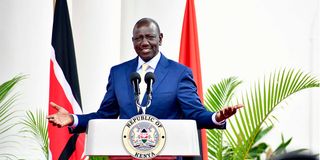
State House Spokesperson Hussein Mohamed gestures during a press briefing at State House on May 24, 2023 on the Housing Pillar of the Bottom Up Economic Agenda.
Photo credit: Francis Nderitu | NMG
Sources at State House also told Daily Nation that the meeting will not involve politics and that it would address pressing challenges within the sector. According to officials involved in the planning, the meeting is meant to provide a platform to deliberate on solutions. However, it is not yet clear if the media will be invited.
“The meeting is purely on education matters, taking into consideration what the government has done in regard to the competency-based education and training; the expansion of infrastructure, including classrooms for junior school and laboratories for senior and high schools; the higher education funding model; and the increased recruitment of teachers, among many other contemporary issues,” Hussein Mohammed, the State House spokesperson told Daily Nation .
“State House is a public place, not exclusive to some and closed off to others. What’s the problem with interest groups holding meetings with the President at State House? Isn’t that what leadership should be about: Engaging on issues that improve our country?”
He said that those who will attend the meeting will decide on the way forward they will craft and that the deliberations of the meeting between the President and the teachers will be communicated by the State House media team.
“This is not about politics; it is a genuine effort to listen to stakeholders and find practical solutions for the education sector. You know there is a lot of noise, but this is to understand what is going on in the sector and to talk about the way forward,” another source said.
Mr Ali told Daily Nation that one of the main concerns they will raise with President Ruto is the perennial delayed release of school funds. Late disbursement of the funds has often disrupted learning, left institutions struggling to cover operational costs, and in some cases parents are made to pay extra levies to cover the deficit.
It is also expected that the teachers will bring up the issue of reduced funding to schools under the Free Primary Education, junior school and Free Day Secondary Education programmes. Schools are owed in excess of Sh70 billion in undisbursed funds.
Kuppet Secretary General Akello Misori (second right) gestures during a joint press briefing with officials from Knut at Eka Hotel in Nairobi yesterday.
Photo credit: Francis Nderitu| Nation Media Group
Knut and Kuppet have also squabbled over the domiciling of junior school in primary school and union membership for teachers of junior schools. Further, Kuppet wants secondary school teachers to administratively head junior schools instead of the current where primary school head teachers double as heads of junior schools. It is expected the President will addres the sibling rivalry.
The attendees also want the government to provide clarity on readiness for transition to Grade 10 (senior school) in January 2026 and career guidance for learners.
According to the County-Based Dialogue on Education Quality and Learning Outcomes in Competency-Based Education (CBE) report that was released in April this year, stakeholders raised fresh concerns over the implementation of the CBE, citing challenges in assessment, teacher management, and welfare.
The report reveals that the competency-based assessment (CBA) process has been faulted for being costly, unfair, and lacking inclusivity. Parents complained about inflated fees while schools reported inflated scores in school-based assessments. Stakeholders further warned that examination malpractice, previously common under the 8-4-4 system, risks creeping back under CBE.
“Many stakeholders were unaware of the range of assessments administered by the Kenya National Examinations Council across different education levels. Stakeholders pointed out that subjects like creative arts were not comprehensively assessed due to insufficient teacher capacity. Concerns were raised regarding certification at Grade 12, particularly on how literacy levels would be measured in light of dropout rates. Similarly, there were uncertainties about assessing learners who may have dropped out at Grade 6. The restriction on repetition under the CBA system led to questions about the fate of learners who failed to meet Kenya Junior School Education Assessment requirements,” reads the report.
Staffing concerns were most acute in junior schools, where teachers were often forced to teach outside their areas of expertise. High turnover, particularly in underserved regions, was linked to poor living conditions, isolation, and lack of transport.
The shortage of Special Needs Education teachers was flagged as a critical barrier to implementing inclusive education.
On professional development, stakeholders faulted short-term retooling sessions as inadequate and called for structured, long-term in-service training tailored to specialised subjects. Teachers in refugee schools were also said to be excluded from national retooling programmes.
Welfare issues further weighed down the teaching force. Teachers complained of heavy workloads, weak health insurance cover, lack of mental health support, and even unauthorised deductions from their salaries.
“Teachers in remote regions are overburdened, demotivated, and burnt out. Without addressing their welfare, quality learning outcomes cannot be achieved,” the report noted.
To resolve these gaps, stakeholders recommended that teachers in junior schools be reassigned to their subject specialisations, retooling programmes be restructured to address real capacity needs, and teacher welfare improved through better health insurance, counseling, and stress management workshops.