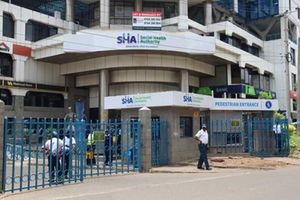
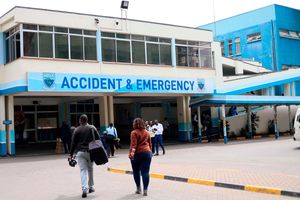
Teachers across the country are facing growing healthcare access challenges under the Social Health Authority (SHA), with unions warning of a possible boycott if the system is not urgently fixed.
The unions say they have handled numerous cases from different regions where educators have been denied treatment at major hospitals due to SHA-related delays and unclear procedures.
Kenya Union of Post-Primary Education Teachers (Kuppet) national chairman Omboko Milemba told the Sunday Nation that the SHA medical deal for teachers was up for review — and all the complaints from teachers and their experiences will be taken into account.
Mr Milemba said Kuppet had agreed with relevant agencies that the rollout would be treated as a test drive, followed by a review after three months — a period he said has now lapsed.
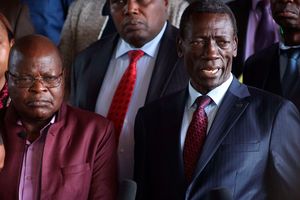
Kenya Union of Post-Primary Education Teachers Chairman Omboko Milemba (left), Secretary-General Akelo Misori and National Vice Chairman Julius Korir (right) and other officials during the National Governing Council meeting in Nairobi on July 11, 2025.
Photo credit: Wilfred Nyangaresi | Nation Media Group
“After the test drive of two months, we agreed that we would do a review in three months. According to us, the three months have ended, and we are demanding that review so that the emerging issues can be addressed,” Mr Milemba said.
“The challenges are many. Teachers are being turned away from hospitals, last expense and group life benefits are delayed, and there is no clear structure on where complaints should be reported,” he added.
Union officials cited recent incidents where teachers involved in accidents were turned away from Nairobi Hospital, Avenue Hospital, Guru Nanak Hospital and Aga Khan University Hospital, as the facilities waited for confirmation or approval under the SHA framework.
Kuppet deputy secretary general Moses Nthurima, on his part, issued a warning, saying it will convene a meeting next week to assess the situation and decide on the next steps.
“We are meeting next week to discuss where we are with SHA, and if they can’t fix these issues, we will tell our teachers to boycott the scheme and walk away. This is a government scheme, yet it’s unclear where teachers are supposed to go. Facilities keep refusing them, and some are even dying,” he said.
SHA Chief Executive Officer Dr Mercy Mwangangi.
Photo credit: File | Nation Media Group
But in a detailed response to the issues raised by teachers, SHA chief executive Dr Mercy Mwangangi dismissed claims that teachers are facing widespread challenges in accessing healthcare under the Mwalimu Comprehensive Medical Cover, saying reported cases are isolated and not systemic.
Data provided by SHA shows that more than 225,000 teachers and their dependants have accessed services under the scheme so far. The Authority said it continuously analyses utilisation and claims data to identify access gaps, monitor provider performance and improve service delivery.
“SHA has received a small number of isolated reports of teachers experiencing challenges when accessing care. These cases are not widespread or systemic and do not reflect the intended operation of the scheme,” said Dr Mwangangi.
Kenya Union of Post Primary Education Teachers Deputy Secretary-General Moses Nthurima.
Photo credit: File | Nation Media Group
But Mr Nthurima said the new arrangement has complicated access to care, unlike the previous Minet insurance scheme, which had clear reporting channels and a dedicated system for handling emergencies.
“Under Minet, we knew exactly where to report and who to speak to when there was a problem. Now we have to go through TSC to reach SHA, and that delay is costing lives. This is a government scheme, and that is part of the problem. There is confusion over responsibility, and teachers are being sent away from facilities. Some have died in the process,” he said.
The unionist further blamed the crisis on what it termed poor coordination within the government-run scheme, saying teachers are unsure where to seek help when hospitals decline to treat them.
Hospitals not accepting SHA
Concerns have also been raised over the management of teachers’ medical contributions, with the union questioning claims that funds have been exhausted.
“Teachers’ money is supposed to be pooled so that those who need care can be supported. But we are being told the funds are exhausted, and yet teachers continue to make contributions,” the union said.
Kenya National Union of Teachers (Knut) deputy secretary general Hesbon Otieno noted that over the past week, the union had received dozens of complaints from teachers that some hospitals were not accepting SHA.
Kenya National Union of Teachers officials, led by deputy secretary general Hesbon Otieno (centre), address the media in Litein, Kericho County on June 7, 2025.
Photo credit: Vitalis Kimutai | Nation Media Group
“We have a case from Homa Bay where a teacher was asked to pay Sh19, 000 after their child was treated, and an additional Sh5, 000 for X-ray services,” he said.
While unions have raised concerns over access to treatment, SHA said most complaints received so far have come from individual teachers rather than formal submissions from unions.
“All reported cases are handled through a structured process that includes immediate intervention to support the affected teacher, engagement with the healthcare provider and follow-up to prevent repeat incidents,” said Dr Mwangangi.
Mr Milemba, the Kuppet chairman, said the union has raised several concerns over SHA, noting that while teachers initially accessed a wide range of hospitals that access has since reduced.
“There is also confusion over hospital accreditation. When a teacher’s name comes up, some hospitals say they are not accredited, yet teachers were previously accessing services there,” he said, describing this as a major challenge.
But Dr Mwangangi clarified that SHA does not accredit health facilities, noting that accreditation and licensing fall under statutory regulatory bodies. Its role, SHA said, is to contract licensed facilities to offer services under the scheme.
According to SHA, teachers currently access care from more than 8,000 contracted public, private and faith-based facilities across the country, providing wide geographic coverage.
Mr Milemba further raised concerns over delays in settling last expense claims following the death of teachers, noting that under the previous medical scheme, payments were processed within 24 to 48 hours.
But SHA, in its defence, said it has rolled out county-based clinics to sensitise healthcare providers and identify operational challenges that could affect service delivery, including claims processing and preauthorisation.
“Claims management and preauthorisation are standard cost and quality control mechanisms used globally to ensure appropriate care and long-term scheme sustainability,” said Dr Mwangangi.
“SHA monitors and enforces compliance through contractual requirements governing cashless service delivery, claims audits and utilisation reviews, analysis of facility-level trends and incident patterns, and corrective or enforcement action where breaches occur,” she added.
Facilities that repeatedly violate scheme rules, such as demanding cash for covered services, are subject to remedial action under their contracts, the SHA boss said.
On the push for a structured complaints and conflict-resolution mechanism at national, regional and county levels, SHA said it has strengthened communication channels to ensure all members understand their entitlements, including a 24-hour toll-free line (0800 720 601) and a dedicated email ([email protected] ).
Dr Mwangangi said the agency has also deployed SHA champions in every county office to handle teachers’ cover and continues to engage teachers through social media, community and vernacular radio, and national media outlets.
The challenges with SHA became painfully clear when KUPPET members faced difficulties admitting their colleagues to various hospitals in Nairobi following an accident that has since claimed three lives.
“There were delays in undertaking treatment of a teacher who was taken to KNH. It was only after parents raised Sh80, 000 that surgery was performed 48 hours later,” KUPPET secretary general Akelo Misori said this week.
For the teachers, the cases are disturbing. For James Kuria* , a teacher whose Afya Yangu app indicates a coverage limit of Sh1 million,
his spouse, whose legs were injured in an accident in December, was briefly detained at the AIC Kijabe Hospital as the bill grew at an average of Sh11, 000 a day to around Sh450,000 for non-payment of bills.
“It took my going to the SHA offices physically for the matter to be addressed. Officers there merely said it was a technical hitch in the system,” said Kuria, who missed classes to be at the hospital.
He noted that although the matter was eventually resolved, the ordeal caused significant distress, work absences and high daily commuting costs.
A similar distress has engulfed another teacher at Ruai Family Hospital in Nairobi for failing to raise Sh62, 800 after SHA only catered for part of the Sh130, 000 total bill.
Her 10-year-old child underwent emergency surgery to remove the appendix, and efforts to raise the money from relatives and friends have proved futile as many are struggling with hard economic times.
“As we are detained here due to the bill, I am absent from work. I wonder why I am being demanded to foot part of the bill, yet under Minet I had a card and the medical cover was catered for in full,” lamented the C3 teacher, a single mother.
In Chwele, Bungoma, another teacher narrated her ordeal, saying she was asked to produce her national ID before her child, who had suffered a minor stroke, could be attended to under SHA.
The teacher, who had misplaced her ID, said this was a departure from Minet, where the only requirement was submitting TSC numbers.
Dr Mwangangi said that even with reported challenges, the agency believes the current scheme is sustainable for all beneficiaries, including teachers.
“SHA believes the scheme is sustainable and aligned with international best practice in public health insurance management. The teachers’ scheme meets these criteria and is supported by employer remittances and a stable membership base,” she said.